Indiana's Flood Was a 1-in-1,000-Year Storm the Drains Couldn't Handle
Record rain overwhelmed small-town Indiana this month. The bigger story is a stormwater system that earned a D on its last national report card, and a $115 billion repair bill nobody's paying.
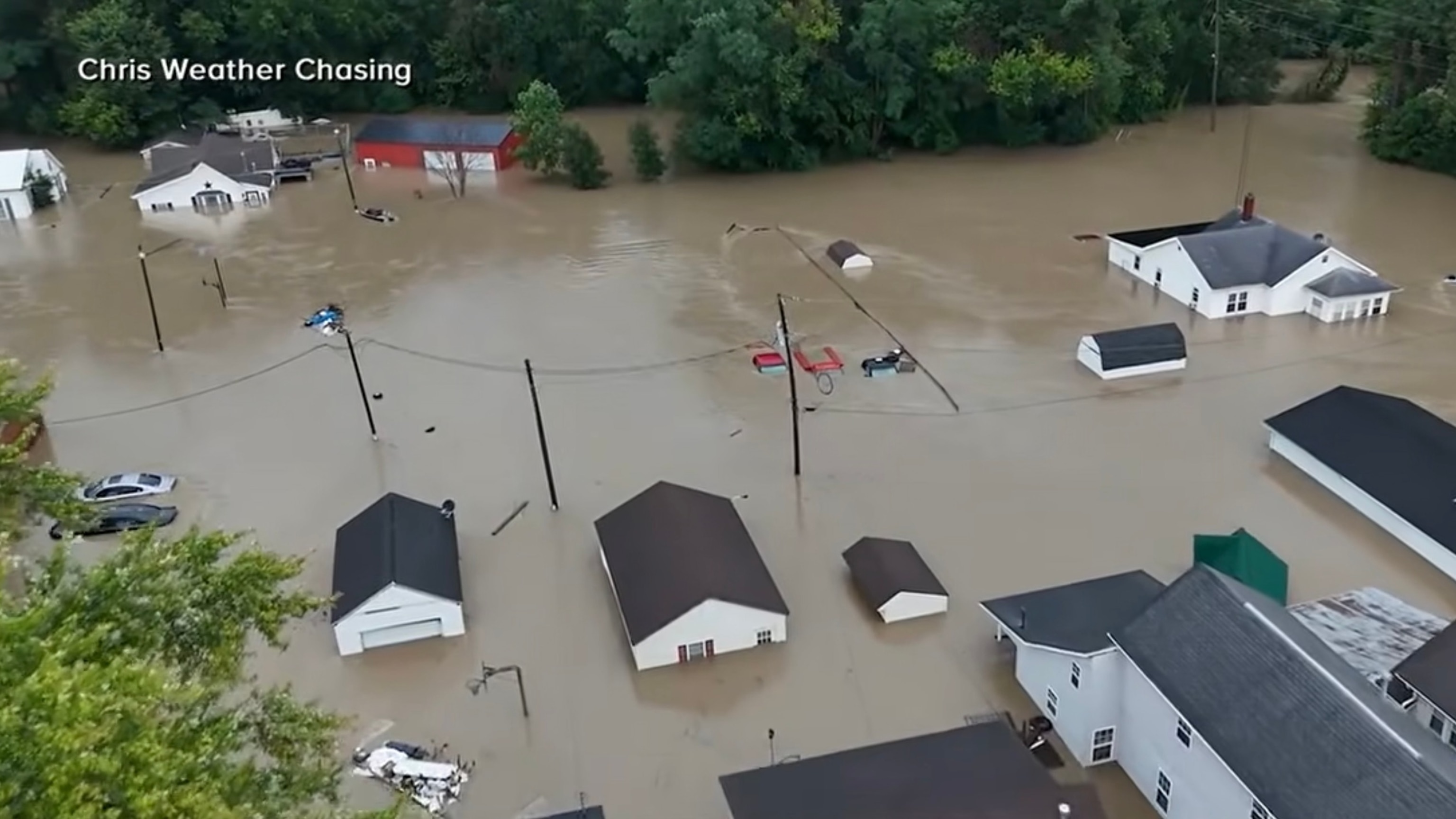
Christian Corder watched the water outside his New Castle, Indiana, home rise for more than a day before it finally stopped climbing. The rain never stopped — it just kept coming and coming,
he told CBS Mornings after wading out of what the storm left of his house.
New Castle's rain gauge explains why. The town recorded more than 11 inches of rain in just over a day — a rainfall total so extreme that CBS News calculated it has roughly a 1-in-1,000, or 0.1%, chance of happening in any given year. A few miles away in Cambridge City, streets became rivers, dozens of people were rescued by boat, and a stretch of Interstate 70 buckled under the weight of the rain. Indiana Gov. Mike Braun declared a statewide disaster emergency on Aug. 13; at least three people died in the storms that hit the region that week, two in Ohio and one in Indiana.
None of that is really a story about one unlucky town. It's a story about what happens when infrastructure engineered for one climate meets the rainfall patterns of another.
A grade that predicted this
Every four years, the American Society of Civil Engineers grades the nation's infrastructure, category by category. In its 2025 report card, stormwater tied transit for the lowest score of any category: a D. It's the same grade the sector got in 2021, the first year it was assessed on its own. More than 60% of the stormwater utilities ASCE surveyed named aging infrastructure as a top concern, and the report estimates a $115.3 billion gap between what the country's storm sewer systems need over the next 20 years and what's actually funded — nearly five times the $23.8 billion estimate from a decade earlier.
The engineers who wrote that report card weren't guessing about the rain, either. They cited the U.S. Global Change Research Program's 2023 Fifth National Climate Assessment, which found that intense, single-day precipitation events have been increasing for decades — not necessarily more total rain everywhere, but more of it arriving in short, severe bursts. That's roughly the shape of what hit Indiana: CBS meteorologist Nikki Nolan tracked 277 separate flash-flooding incidents across the Ohio Valley in less than a week.
Pipes built for a different storm
Stormwater systems move rain off streets and rooftops using a mix of pipes, ditches, retention basins and, increasingly, "green" infrastructure like rain gardens and permeable pavement. NOAA's Office for Coastal Management notes that even well-designed systems depend on gravity to move water through pipes, a method that stops working efficiently once outfalls are submerged or overwhelmed — and the more intense and prolonged the rain event, the longer the flooding lasts.
Impervious surfaces make the problem worse before a single drop reaches a pipe. Roads, roofs and parking lots don't absorb water the way soil and vegetation do, so rain that would once have soaked into the ground now runs straight into the storm system, all at once. ASCE estimates the area of impervious surface in the U.S. is expanding by about 1% every five years — a slow creep that adds up over a watershed's lifetime, pushing more volume toward pipes that, in many older towns, were never sized for it.
Green infrastructure helps at the margins, but the report card is blunt about its limits: it "cannot provide sufficient capacity to manage large-scale stormwater events" on its own. A rain garden slows a drizzle. It does nothing for 11 inches in a day.
The part no report card measures
What ASCE's grade doesn't capture is what it looks like on the ground when the math finally breaks. In Anderson, Indiana, 70-year-old Charlie Simmons finished renovating his home two months before it flooded completely. Financial-wise, I'm cooked,
he told CBS News. Start again, 70 years old, start over, what are you going to do.
Tony Smith, also of Anderson, lost his house and his business in the same storm. We are totally devastated,
he said. We've had five feet plus of water in all of our homes here.
Stories like theirs are part of why a storm's official category or a rainfall record rarely captures the real danger — the damage tracks the water, not the label attached to whatever weather event produced it.
Federal money is moving, if slowly. The 2021 infrastructure law and 2022 climate law added $46 billion for stormwater, wastewater and drinking water projects combined through 2026 — useful, ASCE says, but nowhere close to closing the $115.3 billion stormwater gap on its own. NOAA is meanwhile building a new tool, Atlas 15, meant to give engineers updated rainfall-frequency data that accounts for a shifting climate instead of decades-old averages; early pieces of it are already public, though the full version isn't due until 2027. Until design standards catch up with the storms actually arriving, the gap between what the pipes were built for and what the sky delivers is the story that keeps repeating, one town at a time.


