How Congo's Ebola Trial Uses a Typhoid Shot to Test Ervebo
The first Ebola vaccine trial in Congo's Bundibugyo outbreak offers every volunteer the candidate within about a month, which keeps the blinded comparison short. Here is what that design can and cannot show.
The control shot in this Ebola vaccine trial is a typhoid vaccine.
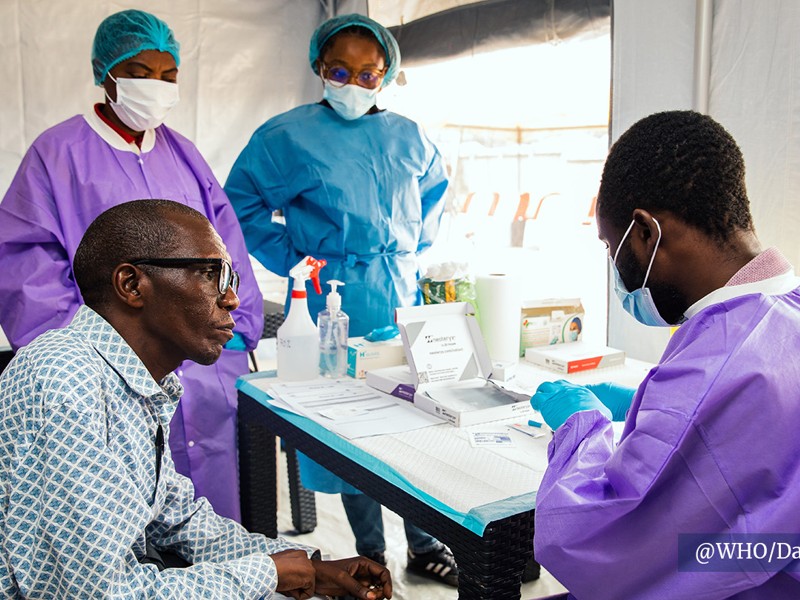
That detail sits in the trial's registry entry, not in most of the headlines. On Friday, Oct. 23, the first participant was vaccinated in Bunia, the capital of Ituri province in northeastern Congo, in a Phase 2/3 study named Tumaini, Swahili for "hope." (Phase 2/3 means one study asks both whether a vaccine is safe and whether it prevents disease.) No vaccine is licensed against Bundibugyo virus, the Ebola species behind the current outbreak. The first candidate being tested is Ervebo, Merck's vaccine, which is licensed only against the Zaire species. Two Bundibugyo-specific vaccines, from Moderna and from Oxford with the Serum Institute of India, are expected to join "shortly," says CEPI's announcement. Both are so far only in Phase 1 trials elsewhere.
Post by @DrTedros
AFP reports Tedros added that the trial "will help us understand whether any of the vaccine candidates designed for Bundibugyo virus work."
Ervebo is already in use outside it, though only for a narrow group. Under a compassionate-use programme, frontline and health workers began receiving it in Kisangani, in Tshopo province, in late August. Bunia followed on Saturday, Sept. 19. WHO told Healio in September that about 2,000 frontline workers had been vaccinated and that Congo holds about 70,000 doses, 50,000 for frontline workers and 20,000 for the trial. Health workers are among the people most exposed, as our earlier report on medics killed by Ebola showed. The registry still read "Not yet recruiting" on Saturday, Oct. 24.
The outbreak, now the largest of its kind, was declared on May 15, 23 weeks before the first trial shot. Congo's health authorities reported 9,704 confirmed cases, including 4,687 deaths, as of Oct. 20. CEPI's release gives 9,552 cases and 4,602 deaths as of Oct. 21, citing an epidemic dashboard. The later date carries the lower figure: the sources do not explain the gap, so neither is "the" toll. Both count confirmed cases only, not probable or suspected ones.
Everyone is offered the real vaccine by Day 29
The trial works on "rings." A ring is the set of people who had close contact with one confirmed patient. Within each ring, according to the registry, eligible contacts are randomised one by one on Day 1 to a candidate vaccine or to an "active comparator," meaning a real vaccine for another disease, here typhoid. On Day 29, everyone is due to receive the other product.
| Group | Day 1 | Day 29 |
|---|---|---|
| Candidate first | One dose of the candidate vaccine | The comparator, a typhoid vaccine |
| Comparator first | The comparator, a typhoid vaccine | One dose of the candidate vaccine |
Everyone is offered the candidate by about Day 29; the blinded comparison covers symptom onset on days 10 to 29 after the first shot. Source: ClinicalTrials.gov NCT07842107.
The registry says the swap exists "so that every participant is offered a candidate vaccine while the comparison between groups remains blinded." Blinded here is thorough: participants, care providers, investigators and outcome assessors are all unaware who got what, and a third party such as a trial pharmacist prepares the doses. The registry does not say who, if anyone, is unmasked, so "the first Ervebo shot" in wire reports may describe the candidate under test rather than every injection given on day one. The registry lists an estimated 3,620 volunteers in total, without a per-candidate count.
The design differs from the one that worked against Zaire Ebola. In Guinea in 2015, whole rings were randomised to immediate vaccination or a three-week delay. Of 11,841 participants, 5,837 received the vaccine, then called rVSV-ZEBOV and now sold as Ervebo; WHO's 2016 release said "no Ebola cases were recorded 10 days or more after vaccination" among them, against 23 among those not vaccinated. Tumaini compares contacts of the same case with each other and masks everyone. The price is a short controlled period, because on Day 29 the comparison group gets the candidate.
A contact of a case confirmed within the previous 21 days qualifies if they shared a household, visited the patient after symptoms began, cared for them without adequate protection, or helped with funeral handling. Ages start at one year, within each candidate's own age indication. Pregnant women and children 12 and older are included, and Valérie Briand of Epicentre said children from one year can receive Ervebo.
Exclusions include confirmed past Bundibugyo disease, a history of anaphylaxis to a vaccine, and symptoms at screening. So are places the investigator deems inaccessible: no usable road or river access, "an active security incident or armed clash affecting the locality within the preceding 7 days," or a local order not to deploy. The trial cannot reach every person at risk. Jennifer Nuzzo of Brown University's Pandemic Center told Healio on Aug. 11 that "the biggest challenges are likely to be operational," including reaching at-risk people "in an insecure setting."
On safety, WHO's advisory group "unanimously agreed that there were no safety concerns about the use of Ervebo in a clinical research study." Volunteers are watched for 30 minutes after a shot, and Phase 2 safety follow-up runs to Day 181.
The main yardstick counts illness, and the animal data point to survival
The Phase 3 primary outcome is "Vaccine efficacy against polymerase chain reaction (PCR)-confirmed symptomatic Bundibugyo virus disease with symptom onset 10 to 29 days after vaccination." PCR is a lab test that detects the virus's genetic material. The analysis is "per-protocol," meaning it counts people who followed the study plan.
Why start at day 10? WHO's Q&A on Ebola vaccines says Ervebo takes 10 to 14 days to build a sufficient immune response against Zaire Ebola, so a person "can still get infected and develop EVD before the vaccine provides protection." The registry tracks days 0 to 9 separately as the period before protection is expected to be established. The window is 20 days long, because a volunteer vaccinated on Oct. 23 stays in the controlled comparison only about four weeks.
Deaths are a secondary outcome: "Number of confirmed Bundibugyo virus disease deaths in each arm," Day 1 to Day 29. That matters because of why Ervebo was chosen. WHO's vaccine advisers met on July 31 and, with one exception among members, recommended it for Phase 3 without a preceding Phase 2, while leaving room for a Bundibugyo-specific vaccine later. Their evidence was thin, and they said so: "Key supporting evidence includes unpublished and non-peer-reviewed studies, and findings are preliminary." The Zaire and Bundibugyo surface proteins, which vaccines teach the body to recognise, share only "approximately 60-65% amino acid homology," WHO's May 28 guidance says.
| Study | Animals | Vaccine | Survived: vaccinated | Survived: unvaccinated |
|---|---|---|---|---|
| Falzarano et al., 2011 (published) | Monkeys (non-human primates) | Research-grade rVSV-Zaire vaccine | 3 of 4 | 1 of 4 |
| Lehrer (unpublished) | Monkeys (non-human primates) | Licensed Ervebo | 3 of 4 | "around 25%" |
| Banadyga (unpublished) | Ferrets | Research-grade vaccine (single dose or prime-boost) | "100% protection" (group size not reported) | All died within 10 days |
Small groups, some unpublished. WHO's advisers pooled the two primate studies as 6 of 8 survivors (75%) and said the findings are preliminary. Source: WHO TAG-CVP report, July 31, 2026.
Eight primates and an unreported number of ferrets are not much to carry a human trial. The advisers drew a careful conclusion:
"Expectations need to be managed about its likely protective effect if used in a Phase 3 ring vaccination trial as efficacy against symptomatic disease and transmission may not be high whereas protection against a fatal outcome may be achieved."
WHO Technical Advisory Group on Candidate Vaccine Prioritisation
The main yardstick counts symptomatic, PCR-confirmed illness. The advisers wrote that Ervebo "could protect against death." The record gives no expected numbers for either and no success threshold, so none can be guessed here. So a mixed result on illness would not by itself settle the question of death. Which yardstick the first readout leans on is the open question, and the advisers added that "a BDBV-specific vaccine remains the preferred option."
The answer depends on how many contacts fall ill
The registry estimates primary completion in April 2027 and full completion in June 2027, with results due within six months of the last primary-outcome visit "and earlier where appropriate during a public health emergency." These are the sponsors' estimates. The number of cases needed inside the rings is not published, so speed depends on how many contacts fall ill, which no source can predict.
The schedule has already slipped. On Aug. 11, WHO told Healio the trial could start by mid-September, about six weeks after the July 31 recommendation. On Sept. 10 it indicated October or November, and that it "may take months" to learn whether the vaccine protects. July 31 to Oct. 23 is 84 days, twice the six weeks first indicated. The registry's estimated start was Oct. 20; the first shot came three days later.
Dr. Chikwe Ihekweazu, executive director of WHO's Health Emergencies Programme, said: "If successful, this would be the first time we have clear evidence of vaccine efficacy against Bundibugyo virus, a major advance that could transform how we respond to this outbreak and prepare for future outbreaks and help save lives." The "if" matters: a clean result would be the first real human evidence for any Bundibugyo vaccine.
Moderna's mRNA-1469 announced a Phase 1 on Aug. 4 in about 80 healthy adults in Canada, and Oxford's version in July. No source gives human results or a date for either to enter Tumaini beyond "shortly." Wim Adriaensen of the Institute of Tropical Medicine Antwerp says labs will identify "the immune responses associated with vaccine protection," so that "vaccines that arrive late in, or even after, the outbreak" can be judged against them. Gavi has committed up to US$40 million to manufacturing readiness, so doses can be made at scale once a vaccine is approved.
Nothing in the trial changes what protects a person this month
A contact in an accessible part of Ituri may be offered a place, which is no substitute for care or for watching for symptoms. For health workers, WHO's Q&A says compassionate-use recipients should be told Ervebo "has only been proven to protect against EVD," and "should also be advised to continue all recommended measures to protect themselves from BVD."
Those measures are what WHO's Oct. 8 outbreak report (data as of Oct. 6) names, "as no approved vaccines or specific treatments currently exist": rapid case identification, isolation and care, contact tracing, safe burials and community engagement. As of Oct. 4, 80.4% of contacts (23,741 of 29,535) were being followed against a target of 85%. Of 372 deaths reported since Sept. 25, 264 occurred in communities and 108 in treatment centres, which points to delays in reaching care.
For travelers, the European Centre for Disease Prevention and Control said on Oct. 23 that infection risk for Europeans living in or visiting affected areas of Kenya and Nigeria is low "provided they follow recommended precautions," and overall EU/EEA risk "very low." It recommends no travel restrictions. Kenya, site of the earlier cluster, had nine confirmed cases and one death as of Oct. 22, ECDC said; Nigeria had one case. The U.S. CDC's Kenya notice is Level 1, "Practice Usual Precautions." There is no vaccine to seek out, and no one outside the research programmes can get one.
The trial's logic fits in 20 days: symptom onset from day 10 to day 29, after which the comparison group gets its shot. Whether those days will be read for illness or for survival is the question the first readout has yet to answer.