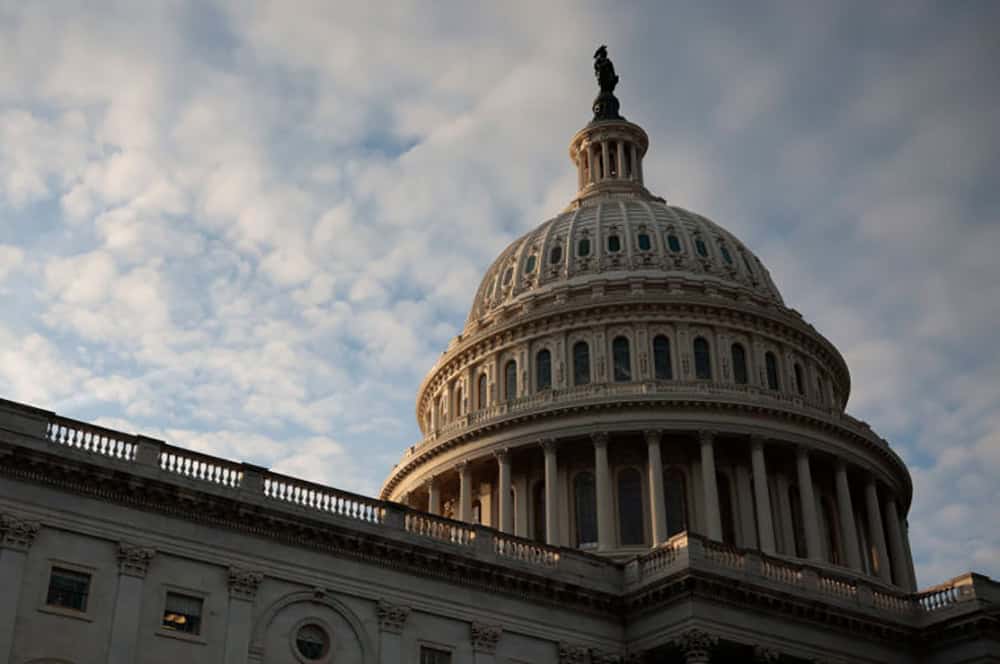
Congress's Insider Trading Fine Is Still Just $200
No member of Congress has ever been prosecuted for insider trading under the STOCK Act. A bill to close the gap has 93 co-sponsors and no floor vote.

The fine for a member of Congress who fails to disclose a stock trade on time is $200. It has been $200 since 2012. No member of Congress has ever been criminally prosecuted for insider trading under the law that set that number.
What exactly does the STOCK Act require members of Congress to do?
The Stop Trading on Congressional Knowledge Act, the STOCK Act, was signed into law on April 4, 2012, after then-President Barack Obama told Congress in his State of the Union address that January, "Send me a bill that bans insider trading by members of Congress; I will sign it tomorrow," according to Roll Call's reporting on the bill's history. The law doesn't actually ban members, their spouses or their dependent children from trading individual stocks. It requires them to disclose trades over $1,000 within 30 days, according to an explainer from the Brennan Center for Justice, and it applies standard insider-trading prohibitions to lawmakers who were, until then, in a legal gray area.
Fourteen years later, lawmakers still sit on committees with direct oversight of industries they hold stock in, still receive nonpublic briefings that can move markets, and still trade. A New York Times investigation cited by the Brennan Center found that from 2019 to 2021, 18 percent of members traded stock in sectors tied to the congressional committees they sat on.
Has anyone in Congress ever been prosecuted under the STOCK Act?
No. The penalty structure is part of the reason why. Campaign Legal Center, which has filed 15 complaints over the years representing between $14.3 million and $52.1 million in undisclosed or late-disclosed trades, calls the STOCK Act's enforcement a decade-long failure to live up to its own promise. The House's Office of Congressional Conduct investigates violations but has no subpoena power and can be abolished by a simple change to House rules; the Senate has no equivalent independent investigatory body at all.
What would the Stop Insider Trading Act change?
House Administration Committee Chairman Bryan Steil, R-Wis., introduced the Stop Insider Trading Act on January 12, 2026. It would bar members, spouses and dependent children from purchasing new publicly traded stock, require seven to 14 days of public notice before selling stock they already own, and raise the penalty for violations to $2,000 or 10 percent of the transaction's value, whichever is greater, plus forfeiture of any gain. "If you want to trade stocks, go to Wall Street, not Capitol Hill," Steil said when he introduced the bill, according to a press release from the House Administration Committee. Existing holdings would be grandfathered in; only new purchases would be banned.
The committee advanced the bill on January 14 by a party-line vote of 7 to 4. President Donald Trump endorsed it the following month in his State of the Union address, telling lawmakers to "pass the Stop Insider Trading Act without delay," a line that drew a rare bipartisan standing ovation, Roll Call reported. By late March, the bill had picked up 93 co-sponsors, including two Democrats, Reps. Josh Riley of New York and Ed Case of Hawaii. It still hadn't reached the House floor.
Why a bipartisan idea is still stuck
Part of the holdup is that Steil's bill isn't the only proposal on the table, and not everyone considers it sufficient. A separate, more sweeping bipartisan group, including Republican Reps. Chip Roy and Tim Burchett alongside Democratic Reps. Seth Magaziner, Pramila Jayapal and Alexandria Ocasio-Cortez, had already proposed the Restore Trust in Congress Act, which would ban members from owning or trading individual stocks at all and require current holdings to be sold off within 180 days of enactment. Dylan Hedtler-Gaudette of the watchdog group Project On Government Oversight told Roll Call the narrower Steil bill "is basically a paper tiger. It's not an actual congressional stock trading ban. It's riddled with loopholes."
Rep. Anna Paulina Luna, R-Fla., filed a discharge petition, the same procedural tool that can force a bill to the floor over leadership's objections, to try to bring the stricter bill to a vote. As of late March, it had 82 of the 218 signatures needed. House Administration ranking member Joseph Morelle, D-N.Y., who backs a Democratic alternative that would extend the trading ban to the president and vice president, told Roll Call: "Respectfully, Speaker Johnson hasn't seen a deadline he's not willing to burst through." Speaker Mike Johnson has not scheduled a floor vote on either bill.
Support for some version of a ban is broad and consistent across party lines: 86 percent of Americans back prohibiting members of Congress from trading individual stocks, according to polling cited by Campaign Legal Center. Whether that translates into an actual vote is, for now, still an open question, one that has already outlasted a presidential endorsement, a standing ovation, and a full quarter of the legislative calendar.