China's JUNO Detector Publishes First Neutrino Result in Nature
Using 59 days of data, the underground JUNO observatory sharpened two neutrino oscillation parameters by a factor of 1.6, a debut result its builders say proves the detector is ready for its main goal.
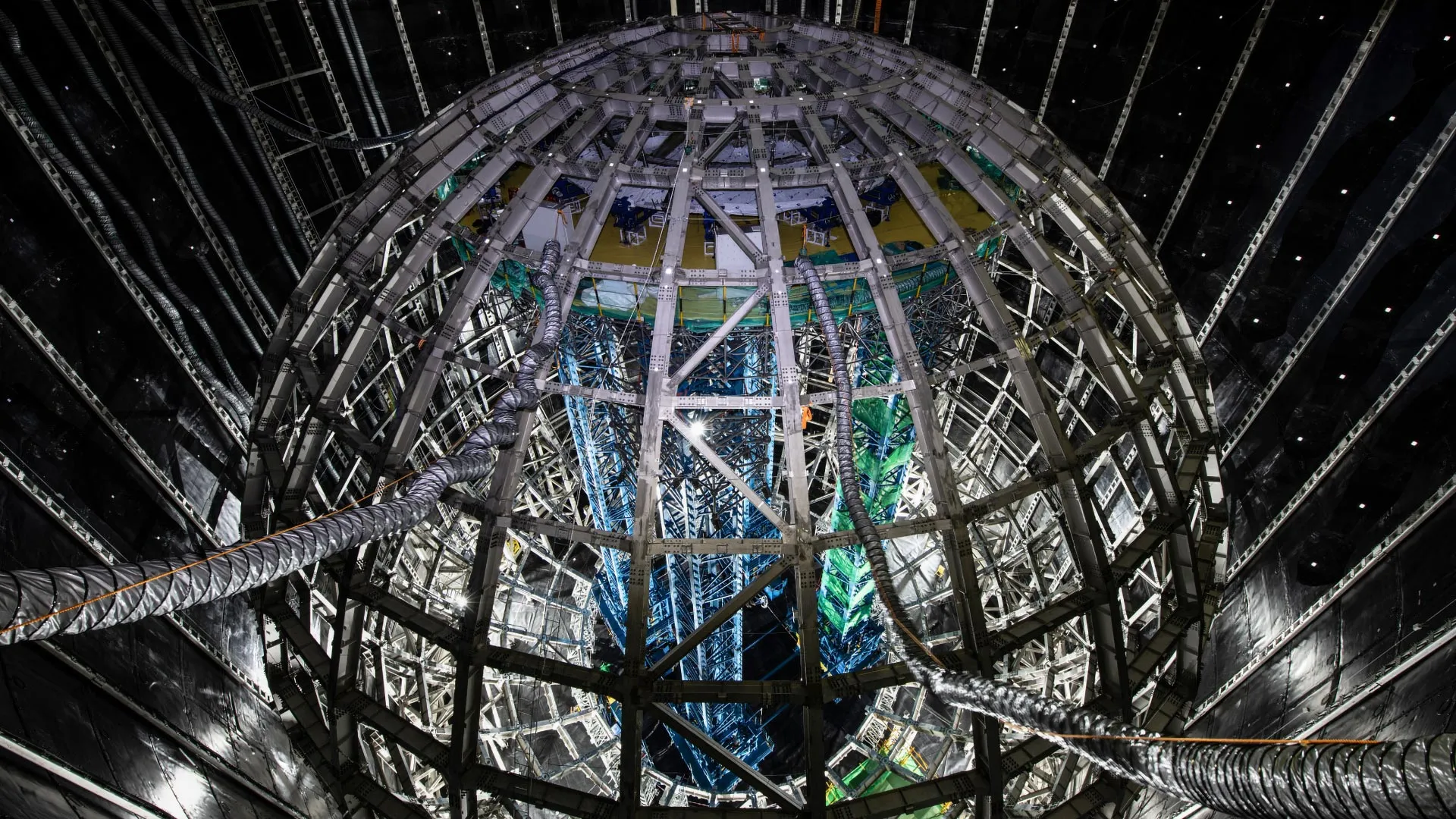
Seven hundred meters below ground in Guangdong province sits a sphere of clear acrylic 35.4 meters across, filled with 20,000 tons of liquid that flashes when a neutrino passes through. After nine months of operation, that detector has produced its first piece of physics — and the people who built it say it works exactly as designed.
The Jiangmen Underground Neutrino Observatory, or JUNO, published its debut result as a cover article in Nature on 10 June 2026. Using 59 days of validated data collected between 26 August and 2 November 2025, the collaboration, led by the Institute of High Energy Physics of the Chinese Academy of Sciences, measured two of the parameters that govern how neutrinos shift between types as they travel. The analysis cut the uncertainty on those numbers by a factor of 1.6 compared with the combined results of earlier experiments built up over decades.
What the detector actually measures
Neutrinos are the awkward case of particle physics: electrically neutral, almost massless, and so weakly interacting that they stream through the Earth — and through people — without leaving a trace. That is precisely why they are the least understood of the known elementary particles, and why catching even a faint signal requires this much hardware.
Inside JUNO, 20,000 large 20-inch photomultiplier tubes and more than 25,000 smaller three-inch tubes watch the liquid scintillator for the tiny flashes of light a neutrino interaction produces. The acrylic sphere hangs inside a stainless-steel structure 41.1 meters in diameter, all of it submerged in a water pool 44 meters deep to shield against stray radiation. By timing and measuring those flashes, the detector reconstructs each neutrino's energy.
The first paper points the instrument at a known puzzle. The two oscillation parameters can be pinned down using either neutrinos from the Sun or those from nuclear reactors, and past measurements from the two routes disagreed by about 1.5 standard deviations — a mismatch physicists call the "solar neutrino tension." Using reactor neutrinos, JUNO confirmed the discrepancy is still there rather than erasing it. That sounds modest, but for a brand-new detector the point is the precision itself: it shows the machine has hit its design performance.
Why the verdict was so strong
Reviewers were blunt about what the result means for the field. One wrote that the data establish JUNO as a key player in the emerging precision era of neutrino oscillation physics.
A Nature News & Views article framed it as a starting gun:
"This first analysis builds confidence that the detector will be able to determine the mass ordering. This first result from JUNO marks the dawn of the next era of precise neutrino oscillation measurements, and will provide insights into the properties of these mysterious fundamental particles."
Nature, News & Views
Arthur McDonald, who shared the 2015 Nobel Prize in Physics for showing that neutrinos oscillate, said the detector had cleared its bar:
"JUNO has met its design objectives, achieving exceptional radiopurity, energy resolution, and detector stability. The experiment is fully operational and ready to pursue its ambitious physics goals."
Arthur McDonald, 2015 Nobel laureate in Physics
The harder question is still open. JUNO's headline goal is to determine the neutrino mass ordering — which of the three neutrino types is heaviest — one of particle physics' standing unknowns. It also aims to measure three of the six mixing parameters to better than 1 percent precision. None of that is settled by 59 days of data. The collaboration says more results should follow through the summer as the dataset grows, and the mass-ordering answer will take years of accumulated runs. For now, the claim is narrower and, because it has cleared peer review rather than sitting as a preprint, firmer: the detector is real, it is stable, and it is reading neutrinos as intended.