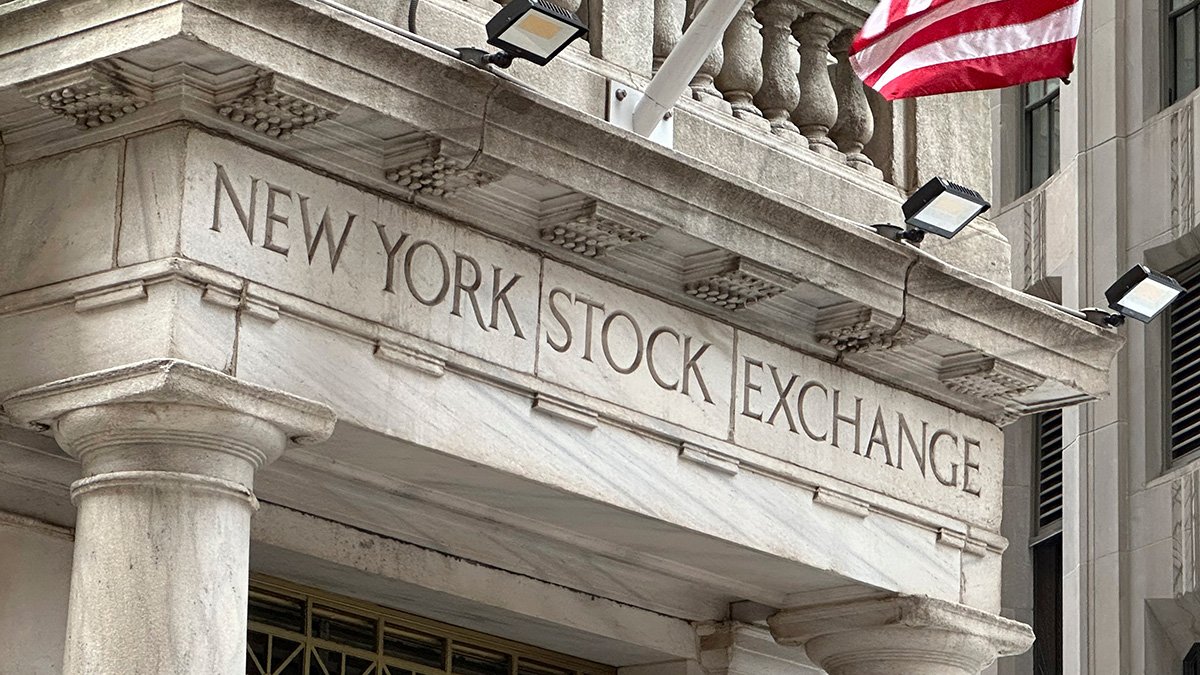
Hall and Woodford's Nobel Rewards the Fed Talk That Moves Mortgages
The 2026 economics prize honors the idea that a central bank's promises move today's loan rates. Since the Fed's June meeting, the 30-year mortgage average has climbed 0.93 point while the Fed's own rate rose 0.25.

For 46 years, Robert E. Hall sat on the small committee whose dates serve as the accepted record of when an American recession begins and ends. He was listed as its chair when it dated the 2008 downturn and again when it dated the pandemic collapse of 2020, according to the National Bureau of Economic Research.
On Monday, the Stanford economist was honored for the forward-looking half of his career. The work the prize rewards, his and that of Columbia University economist Michael Woodford, is the theory behind how the Federal Reserve can now move your borrowing costs with words, often before it moves its own rate.
Robert E. Hall of Stanford University and Michael Woodford of Columbia University were awarded the 2026 Sveriges Riksbank Prize in Economic Sciences in Memory of Alfred Nobel by the Royal Swedish Academy of Sciences on Monday, Oct. 12, 2026, "for microeconomic foundations of macroeconomic stabilisation." The prize of 12 million Swedish kronor (about $1.2 million) is split equally between them.
In plain terms, Hall showed that households spend according to what they expect about the future, and Woodford built the model central banks use to set rates, including the idea that a promised path for future rates changes behavior today. The Academy's announcement was made in Stockholm by Ellen Moons, Secretary General of the Royal Swedish Academy of Sciences, and the Academy's press release put it simply: "The laureates have helped us smooth out the economy's peaks and troughs."
A model built from kitchen-table decisions
"Microfoundations" sounds forbidding, but the idea is homely. You build the economy up from the choices of households and firms, each weighing the future before it spends or sets a price.
The approach was born of failure. During the 1970s oil crises, the Academy writes, Keynesian models "did not reduce unemployment, but led to uncontrolled inflation instead." Many concluded that stabilization policy "had done more harm than good."
Hall supplied an early cornerstone in 1978. If spending depends on expectations, he reasoned, households change their consumption only when news arrives, and since news is unpredictable, so are changes in consumption. The Academy calls that article "something of a eureka moment for research."
Hall and Fredric Mishkin found in 1982 that "around 80 per cent of them made their consumption decisions in line with the theory, while the rest lived hand-to-mouth." Roughly one family in five was spending income as it arrived.
That split explains what happens to a stimulus check. Studies cited by the Academy estimate that households spent 12–30% of the 2008 U.S. stimulus payments. Across the wider literature, a meta-analysis finds an average of 21%, or 11% after correcting for publication bias. Money aimed at cash-strapped families is another matter, which is why the Academy says fiscal policy "may be very effective, and more so than monetary policy, if aimed at the right groups of consumers".
Woodford carried the logic to the central bank. His 2003 book, Interest and Prices, presents what the Academy calls "a complete New Keynesian macro model," whose three equations are "the prototype for all the New Keynesian models that have followed" in its footsteps. He showed that central banks steer the economy "by adjusting interest rates, rather than by the amount of money in circulation," building on the Swedish economist Knut Wicksell's idea of a natural rate of interest.
The consequence is spelled out in the Academy's popular explainer: "Because businesses look to the future, expectations about future interest rates are important for inflation. Consequently, credibility and transparency are important attributes for a central bank." Such models now run in central banks worldwide, and the Academy says flatly that "there are no other viable alternatives."
From there it is a short step to forward guidance, the practice of telling markets where rates are headed. "If, in particular, a central bank announces a path for future nominal interest rates, it would affect the economy today," the Academy's scientific background says, crediting "Woodford and others." The Fed leaned on it when rates sat at zero, a period usually dated 2008–2015, in the hope that "such communication could lower loan rates on longer horizons today."
Woodford argued the case in person. At the Fed's Jackson Hole symposium in August 2012 he recommended "advance commitment to definite criteria for future policy decisions," and that December the Federal Open Market Committee adopted thresholds for unemployment and inflation. The Minneapolis Fed, introducing its 2014 interview with him, added a fair caveat: "there was no straight-line causality" between the two.
Both men trained at MIT. Hall, born in 1943 in Palo Alto, California, earned his PhD in 1967 and is an emeritus Hoover senior fellow and Stanford professor who, his Hoover profile says, has advised the Federal Reserve Board. Woodford, born in 1955 in Chicopee, Massachusetts, took his PhD in 1983 and teaches at Columbia in New York.
Promises that move the 30-year rate
For anyone shopping for a mortgage, this is where the prize stops being academic. The Fed under Chair Kevin Warsh is tightening, and its words are doing as much work as its votes.
On Wednesday, Sept. 16, the FOMC voted 12–0 to raise its target range a quarter point, to 3.75%–4%. "Inflation remains elevated," the Fed's Sept. 16 statement said. The bigger signal sat in the projections. In June, when the dot plot turned toward a hike, the median official expected the rate to end 2027 at 3.6%. By September that median was 4.1%, a projection of higher rates for longer, written in dots.
Markets moved further than the Fed. Since the June meeting, the midpoint of its target range is up 0.25 point. The 2-year Treasury yield rose from 4.20% on June 17 to 4.80% on Friday, Oct. 9. Freddie Mac's 30-year fixed average went from 6.47% on June 18 to 7.40% on Thursday, Oct. 8, a rise of 0.93 point.
Market borrowing costs rose roughly 2.4 to 3.7 times as much as the Fed's actual rate. That is consistent with the mechanism the Academy describes, in which expected future rates feed into longer-term loan rates. It is not proof of cause: other forces move long yields, and Daybreak Wire reported on Oct. 7 that the 10-year's climb traces to real rates.
Put that in a monthly bill. On a $400,000 30-year fixed loan, principal and interest come to $2,520.39 a month at June's 6.47% and $2,769.52 at 7.40%, an extra $249.13 every month, before taxes and insurance. A buyer who locked at 6.76% just before the September hike pays $172.47 a month less than one locking now, about $2,070 a year.
For savers the arithmetic runs the other way: a 2-year Treasury that paid 4.20% in June now pays 4.80%, a jump far larger than the Fed's single quarter-point move.
There is a policy parallel, too. In June the Fed blamed elevated inflation partly on "supply shocks that have driven price increases in certain sectors, including energy." The Academy notes that after an energy shock, "Unlike the traditional Keynesian models, Woodford's model recommends a cooling measure, such as increased interest rates" to avoid uncontrolled inflation. In September the Fed raised rates. A parallel, not a citation, but the playbook matches.
A tool that works only if believed
Since June, the Fed's statements have carried a flat promise: "The Committee will deliver price stability." In Woodford's world that sentence is a policy instrument, and its power depends on whether people believe it.
Looking back on the Fed's 2011–12 date-based guidance, he told the Minneapolis Fed's The Region in 2014:
"And, of course, the FOMC wasn't really making such a promise. If you looked at the fine print of what they said, they hadn't said we intend to do this. They hadn't said we will do this. They had said we currently anticipate that future conditions will warrant our doing it."
Michael Woodford, Columbia University economist
The 2026 Fed has written "will." That raises the stakes, because, as the Academy's scientific background puts it, "forward guidance requires credibility of the central bank's announced path, which is not to be taken for granted."
The Academy is candid about the limits. A 2023 study by Del Negro and co-authors found that in the simple model, announcements far into the future had "unreasonably strong effects on demand and prices today," a "forward guidance puzzle" for which "no single explanation has emerged as a consensus." The model also "presumes that inflation expectations are 'anchored' around the target, but anchoring cannot be taken for granted."
The bond market hints at that gap now. At 4.80%, the 2-year yield sits 0.7 point above the Fed's own median projection of 4.1% for the end of 2027. It is a sign that bond investors may expect rates to stay higher than the median official does.
Hall's other job is a useful counterweight to all this forward-looking confidence. After a conference call on Friday, Nov. 28, 2008, his committee announced on Dec. 1 that the recession had begun in December 2007, about 11 months earlier. In 2020 it dated the peak to February on June 8, but did not declare the two-month recession over until July 19, 2021. Hall left the panel in 2024, according to the committee's roster.
Expectations, by contrast, move markets the day they shift. That is why borrowers should read the Fed's words as closely as its decisions: the meeting that ends Oct. 28 brings no new projections, while the Dec. 8–9 meeting brings a fresh dot plot, and a hold paired with higher dots could still push mortgage quotes up. The laureates collect their 6 million kronor each on Dec. 10, at a prize Sweden's central bank created in 1968.
The Fed has now put "will deliver price stability" in writing, and the theory that just won a Nobel says that sentence is worth exactly as much as borrowers believe it.