$776,389 Now, $17.2 Million Later: Houston's Bet on Marvin Harrison Jr.
The Texans' real price for Marvin Harrison Jr. is not the 2027 second-round pick but a fifth-year option Over the Cap projects at $17,198,000 or $18,950,000, and his 2026 snaps decide which tier applies.
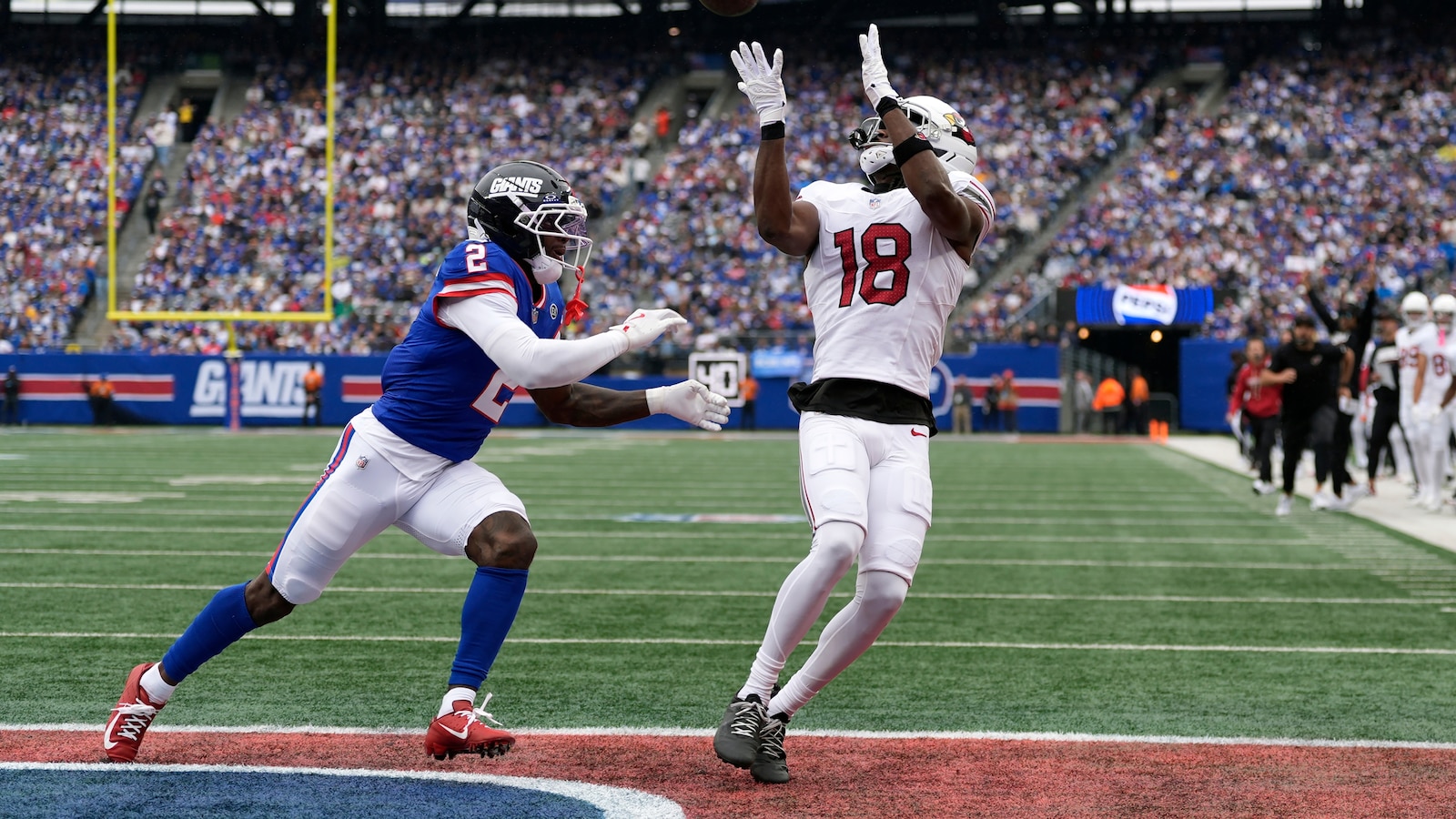
The Arizona Cardinals have paid Marvin Harrison Jr. $28,979,524 since he signed his rookie contract, and the Houston Texans will pay him $776,389 for the rest of this season. Arizona covered 81.92% of that four-year deal and will not get another snap for it, and that gap explains the trade that sent the No. 4 pick of the 2024 draft to Houston on Sunday, Oct. 11.
Under the terms reported by ESPN's Adam Schefter and NFL Network's Ian Rapoport, Arizona sends Harrison and a 2027 seventh-round pick to Houston for a 2027 second-round pick and a 2027 sixth-round pick, reuniting him with C.J. Stroud, his Ohio State quarterback. Houston then must decide before May 3, 2027, on a 2028 fifth-year option that Over the Cap projects at $17,198,000 or $18,950,000, and that decision, not the picks, will set the deal's real price.
Texans coach DeMeco Ryans saved the news for the end of his news conference in Nashville after a 26-3 win at Tennessee, Houston's first of the season. "You guys want to know, huh? Yes, we traded for Marvin Harrison," he told reporters. In the Associated Press account, he closed the news conference with "See ya!"
Harrison, meanwhile, was inactive as Arizona lost 45-21 to Detroit at home. As of Sunday night neither team had formally announced the deal; The Associated Press reported that its source spoke anonymously "because the full terms had not been announced."
The sticking point was a calendar, not a round. On Saturday, Oct. 10, ProFootballRumors reported Houston was willing to give a second-rounder only in the 2028 draft, while Arizona wanted it in 2027. Then Houston moved.
Post by @RapSheet
Rapoport's post on Sunday: Arizona general manager Monti Ossenfort held out for a 2027 second, and Houston's switch from 2028 is what closed the deal.
That one-year shift matters. A 2027 pick puts a player on a cheap rookie contract in Arizona's building a full season before a 2028 pick would, and a year of cheap control is real money.
Who paid for the rookie deal
Harrison signed on May 23, 2024, for four years and $35,374,742, every dollar fully guaranteed. It was a slotted deal, meaning its size was fixed by his draft position before Arizona ever turned in the card, as azcardinals.com put it at the time.
Arizona already paid the biggest pieces: a $22,547,084 signing bonus and this year's $2,935,886 roster bonus. What follows Harrison to Houston is the unpaid part of his $1,075,000 base salary for 2026, which Over the Cap puts at $776,389.
Next year Houston carries a $1,190,000 base salary and a $4,428,829 roster bonus, $5,618,829 combined. Its entire bill for the rookie deal is $6,395,218, or 18.08% of the contract. Houston will pay him less for the rest of 2026 than Arizona paid him in one roster bonus this year.
That split explains why reports disagreed. ESPN said Harrison is "due $4 million this year," his full-season pay with the roster bonus. Over the Cap's breakdown of his contract shows Houston's share as $776,389. Both are right; only one is Houston's problem.
And it is barely a problem. Over the Cap lists Houston with $6,810,289 in 2026 cap space even with Harrison on the books, though its 2027 projection, which will move as contracts change, shows the Texans at minus $43,555,505.
Arizona keeps the bill for money it already spent. The signing bonus counts against the cap at $5,636,771 a year. Add the $3,234,497 Arizona already paid him this season, and the Cardinals carry $8,871,268 in dead money this season and $5,636,771 next season, $14,508,039 in all. That is the way signing bonuses are spread across a contract: the cash leaves on signing day, the charge lingers. Harrison's original 2027 cap number was $11,255,600, so Arizona saves $5,618,829, to the dollar what Houston picks up.
What Arizona bought is a 2027 second, sooner than Houston first offered but less than it wanted. The Cardinals told teams they wanted first-round value, while other clubs saw "some form of second-day pick compensation," ESPN reported. The Colts found Arizona's asking price of a second-round pick and more too steep, ProFootballRumors reported, citing ESPN's Stephen Holder.
Coach Mike LaFleur said it "was in the best interest of this club," then took a share of the blame.
"Any guy that does not play to the level that I feel like they're capable of, I'm always going to put that on me and coaching in general."
Mike LaFleur, Cardinals head coach
On Sunday, Jalen Brooks took Harrison's X receiver spot and caught two passes for 16 yards, SI reported. Quarterback Jacoby Brissett, who said Harrison and LaFleur told the team on Saturday, added: "I'm sure a lot of us are rooting for Marv."
The option that sets the real price
Harrison's deal carries a team option for a fifth season, 2028, and that is where Houston's money actually sits. Over the Cap projects $17,198,000 at the Basic level and $18,950,000 at the Playtime level. The Pro Bowl tiers run higher: $26,544,000 with one selection and $30,914,000 with two or more.
Set against the trade, the scale flips. The Basic option is 2.69 times everything Houston owes on the rookie deal; Playtime is 2.96 times. Basic alone equals 48.6% of the whole four-year contract. Exercise it, and Houston's three-year cost becomes $23,593,218 at Basic or $25,345,218 at Playtime.
Which tier applies is decided by snaps. Under the collective bargaining agreement's option rules, a player reaches Playtime by taking at least 75% of his club's offensive plays in any two of his first three seasons, by averaging 75% across all three, or by playing at least 50% in each. Playtime costs more because it averages the 3rd- to 20th-highest salaries at the position, not the 3rd to 25th.
Harrison sits right on the line. Over the Cap has him at 78.9% of snaps in 2024 and 49.9% in 2025, missing the 50%-in-each-season route by 0.1 point. His path to Playtime runs through a second season at 75% or better, and he was at 73.8% through four games this year. The CBA text does not spell out how a mid-season trade is counted, but ProFootballRumors expects an upgrade "if he starts for his new team for the rest of the season." The $1,752,000 gap between tiers will be set by Houston's own depth chart.
The clock is fixed. Under the CBA, Houston's written notice must come after its last 2026 regular-season game and before May 3, 2027. That is 203 days from Monday, Oct. 12. Once exercised, the salary "shall become guaranteed for skill, injury, and Salary Cap-related termination."
Houston made this call on Stroud, whose option was exercised; ESPN reports he "will earn $25.9 million in 2027." Harrison's Basic number would ask for a smaller version of that promise to a receiver who has never had a 1,000-yard season.
Decline, and Harrison becomes an unrestricted free agent in 2028. That gives weight to a quiet September detail: on Sept. 23, 18 days before the trade, he hired agents Todd France and Tory Dandy, ESPN reported. His father, Hall of Famer Marvin Harrison, had handled his business until then. Whatever Houston decides, it will negotiate with professionals across the table.
What a second-round pick has bought before
CBS Sports Research found Harrison is the first top-five receiver traded within his first three seasons since Ahmad Rashad in 1974, whom the Cardinals also traded. CBS Sports' review of first-round receivers traded early supplies the closest comparisons: first-round receivers traded in their third or fourth season, per CBS Sports.
| Player (year traded) | Teams | Return |
|---|---|---|
| Marvin Harrison Jr. (2026) | Cardinals to Texans | 2027 2nd + 2027 6th; 2027 7th sent with Harrison |
| Amari Cooper (2018) | Raiders to Cowboys | 1st |
| Brandin Cooks (2017) | Saints to Patriots | 1st + 3rd; 4th sent with Cooks |
| Hollywood Brown (2022) | Ravens to Cardinals | 1st; 3rd sent with Brown |
| Sammy Watkins (2017) | Bills to Rams | E.J. Gaines + 2nd; 6th sent with Watkins |
| Jahan Dotson (2024) | Commanders to Eagles | 3rd + two 7ths; 5th sent with Dotson |
| Kelvin Benjamin (2017) | Panthers to Bills | 3rd + 7th |
| Jalen Reagor (2022) | Eagles to Vikings | 7th + conditional 4th/5th |
| N'Keal Harry (2022) | Patriots to Bears | 7th |
| Corey Coleman (2018) | Browns to Bills | 7th |
| Phillip Dorsett (2017) | Colts to Patriots | Jacoby Brissett |
The pattern is production. Of the three who fetched a first, CBS notes Cooper and Cooks "had already posted two 1,000-yard seasons before being traded," and CBS's table shows Brown with 1,008 yards the season before his deal. Harrison's best is 885, followed by 608 in 2025. A 2027 second sits between the groups: well below his draft slot, well above what output like his has fetched for others.
This month's market makes Arizona's insistence look shrewd. When the Eagles sent center Cam Jurgens to Baltimore and the Steelers sent cornerback Joey Porter Jr. to Dallas, both returns centered on 2028 second-round picks. Arizona demanded 2027 and got it.
One irony sits in the table. The player Indianapolis received for Dorsett in 2017 was Jacoby Brissett, now the Arizona quarterback who will be throwing to whoever replaces Harrison.
Houston's bet rests on 2022, when Harrison caught 77 passes for 1,263 yards and 14 touchdowns at Ohio State with Stroud throwing to him. Stroud said the front office asked his opinion first, and he told the AP Harrison is "probably the hardest worker I've ever been around in my life."
The need is real. Houston is 1-4, three games behind Jacksonville in the AFC South. Jayden Higgins, a 2025 second-rounder, tore an ACL in August, and Tank Dell is still working back from a 2024 knee injury. "That's official? Is that official? That's what's up," receiver Nico Collins said.
The skeptics have the numbers. ESPN's Seth Walder graded the deal C+ for Houston and A- for Arizona, citing Harrison's 1.5 yards per route run over his career (46th percentile among qualifying receivers) and 0.6 this season.
"But this move is not worth it if Harrison remains the same player he has been with the Cardinals because second-round picks have real value."
Seth Walder, ESPN analyst
His colleague Ben Solak warned that if Harrison becomes a deep decoy, "for the price of a future second-rounder, that would be a disastrous outcome."
They are right about the pick and early about the risk. The second-rounder is gone either way, but $6,395,218 buys a short audition Houston can end by declining the option. Arizona's return is already settled and cannot slump. Houston's real exposure starts the day it signs that option notice, because paying $17,198,000 to learn it was wrong would cost far more than a second-round pick ever did.