$47.3 Million for Jodi Was a $40.5 Million Bid Plus $6.755 Million in Fees
Fees account for $6.755 million of Jodi's $47.3 million price. The rest is a bid for scarcity: one of three Nanotyrannus skeletons, and the only one not in a museum.
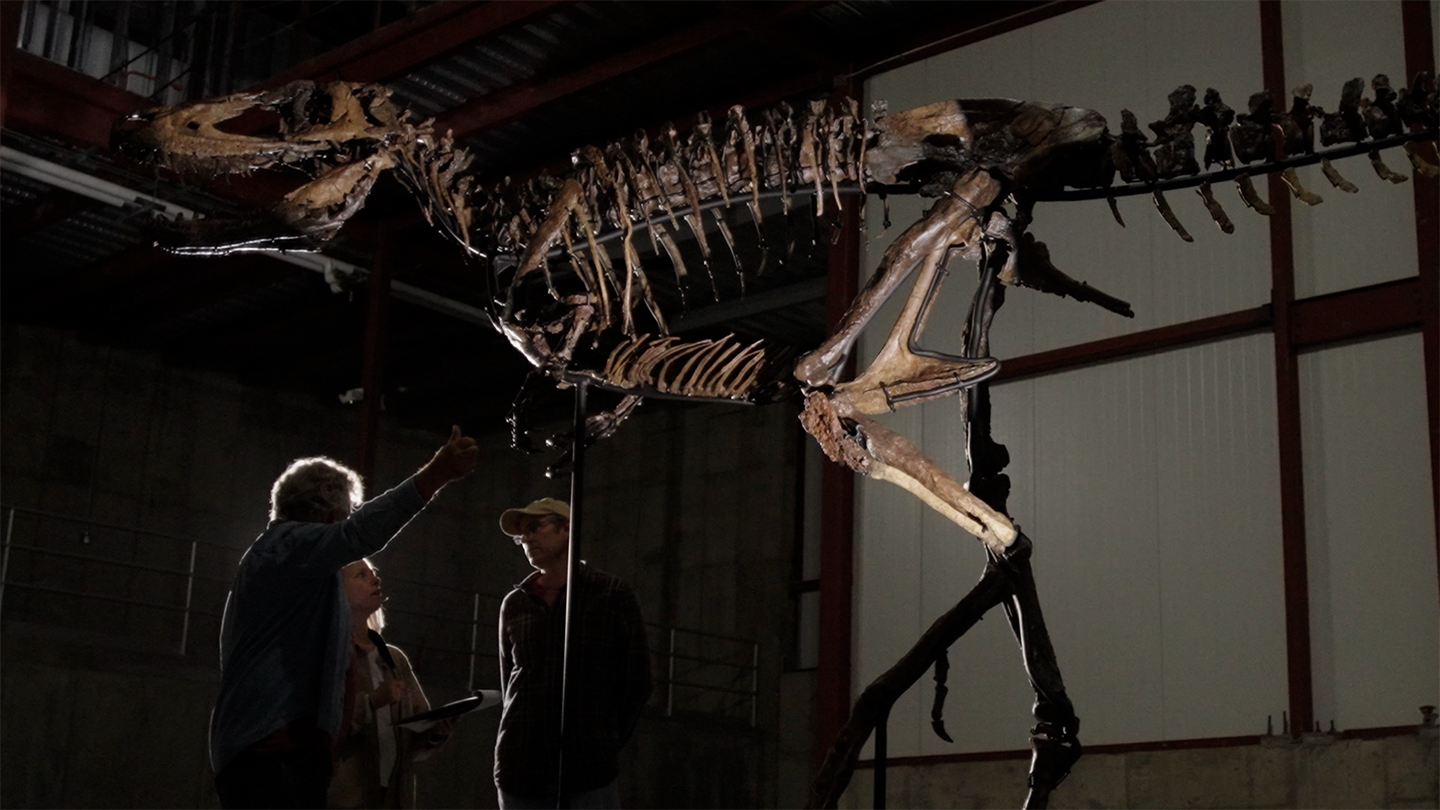
In October 2023, on a stand at Frieze Masters in London, a dealer named David Aaron showed a dinosaur skeleton called "Chomper." It was labelled a juvenile T. rex and carried a $20 million asking price. It did not sell.
On Tuesday, Oct. 27, 2026, the same bones sold at Sotheby's New York under a new name, Jodi, and a new identity, Nanotyrannus. The price was $47.3 million, and that figure hides a split.
Sotheby's own result page lists the sale at exactly $47,255,000. The lot sold by phone after twelve minutes, to a buyer who, AP reported, "has, for now, chosen to remain anonymous." As of publication, no name and no plans had been disclosed. Sotheby's calls Jodi the "second most valuable dinosaur ever sold at auction." Only Gus, a T. rex sold at the same house on Tuesday, July 14, ranks higher, at $50,130,000. The gap between them is $2,875,000.
The skeleton takes its name from Jodi Pierson, the Montana rancher who found it in 2019 on her own land in the Hell Creek Formation, Garfield County, near the town of Jordan. Her cousin, the commercial paleontologist Clayton Phipps, dug it up. The present consignor bought it in 2021, and from Oct. 13 it stood, 19.6 feet from nose to tail, in the lobby of Sotheby's headquarters.
The $6.755 million that headlines leave out
ARTnews reported that the skeleton "hammered at $40.5 million," and that $47.3 million was the price including fees. The hammer is the winning bid, the number called when the gavel falls. On top of it the buyer pays a premium, which Sotheby's describes as "a fee added to the hammer price" and included on the invoice.
Apply Sotheby's published schedule for New York to that hammer and the arithmetic closes to the dollar. The tiers are Sotheby's; the slices and fees are my calculation, and the total matches the price Sotheby's lists for the lot.
| Slice of the winning bid | Sotheby's rate | Amount in the slice | Fee |
|---|---|---|---|
| First $2 million | 28% | $2,000,000 | $560,000 |
| $2 million to $8 million | 22% | $6,000,000 | $1,320,000 |
| Everything above $8 million | 15% | $32,500,000 | $4,875,000 |
| Total | $40,500,000 | $6,755,000 |
The fee is $6,755,000, which is 16.7% of the hammer and 14.3% of the total. Add it to $40,500,000 and you get $47,255,000. Run the same schedule on Gus's reported hammer of $43 million (ARTnews's figure) and it returns $50,130,000, Gus's published price to the dollar.
The split matters for a second reason, which is the line printed in most of the coverage. ARTnews wrote that Jodi fetched "more than five times its $9 million high estimate." That is true only by mixing two kinds of number. Sotheby's says its pre-sale estimates "do not include the buyer's premium," so the fee-inclusive $47.3 million divided by $9 million gives 5.25, while the like-for-like comparison, the bid against the estimate, is 4.5. Sotheby's own post on X went with "nearly octupling its pre-sale estimate," which is the fee-inclusive price over the low end, 7.88. Jodi was an outlier of estimating as well as of price.
Now put the fee in human terms. Thomas R. Holtz Jr., a vertebrate paleontologist at the University of Maryland, said in remarks the Guardian published that excavating, preparing and mounting a skeleton like this costs "probably on the order of $1m at most, possibly much less." The buyer's premium alone is 6.8 times that ceiling. It is a charge for the room, not for the work that put bones on a stand.
The chart is also a map of where the bones went. Sue, the first dinosaur ever sold at auction, went to Chicago's Field Museum and is a centerpiece. Stan is on display at the Natural History Museum Abu Dhabi.
Apex, the Stegosaurus that brought $44.6 million in July 2024, went to Ken Griffin of Citadel, who loaned it for four years to the American Museum of Natural History, where it has been on view since December 2024. Observer reports the loan lets researchers study and sample the fossil. Griffin said he was "grateful that millions of visitors and researchers will now be able to see and learn from this magnificent specimen of the Late Jurassic Period."
Gus and Jodi were both sold by phone, to buyers nobody has named. After Gus, the Society of Vertebrate Paleontology's president-elect, Kristi Curry Rogers, said the society hoped its owner would donate it to an accredited museum. As of publication, no buyer had been named. Three of the five records can be seen by the public. The two most recent buyers have said nothing.
One of three skeletons, and the only one not in a museum
Why would a smaller, lesser-known animal come within $2,875,000 of Gus's price? Start with a paper in Nature, published online on Oct. 30, 2025, 362 days before the sale. Lindsay Zanno and James Napoli argued that Nanotyrannus is its own genus, and not a teenage T. rex, as many researchers had long suspected. Their specimen shares "autapomorphies," distinctive traits found in one group and no other, with the reference skeleton for Nanotyrannus lancensis. Growth rings and spinal fusion showed the animal was about 20 years old, with longer arms, more teeth and fewer tail vertebrae than a T. rex. Napoli, an anatomist at Stony Brook University, put the old theory bluntly: "For Nanotyrannus to be a juvenile T. rex, it would need to defy everything we know about vertebrate growth."
The paper did not set the price. In 2023 these bones asked $20 million as a juvenile T. rex. In 2026, as Nanotyrannus, they were estimated at $6 million to $9 million. What the paper did was change the count. There are three substantial Nanotyrannus skeletons known: Jodi, the Dueling Dinosaurs skeleton nicknamed "Bloody Mary" at the North Carolina Museum of Natural Sciences, which AP says is not for sale, and "Jane" at the Burpee Museum in Rockford, Illinois. Jodi is the only one a collector can own, and Sotheby's says it was the first to reach the market since the genus was confirmed.
That is what $47.3 million bought: an adult, by Sotheby's judgment, with about 191 bone elements, a "virtually complete" skull of 53 bones and about 50 teeth, and missing pieces replaced by 3D-printed elements. It comes with "full rights," CNN reported, so the owner may sell replicas. No published study of this skeleton has been reported. David Hone of Queen Mary University of London told CNN the "potential scientific value" is hard to put a number on "without proper and verified study by experts." He also said, "It does feel like this is a bubble of prices on dinosaurs which must burst at some point." The scarcity is real; the price may not be.
The skeleton that proved it failed at auction first
Here is the part the coverage skipped. The skeleton behind the Nature paper, the Dueling Dinosaurs Nanotyrannus, failed to sell at auction first. Phipps found it in 2006 on a neighbor's land, about eight miles from where Jodi lay.
On Nov. 19, 2013, Bonhams offered the Dueling Dinosaurs in New York, a Nanotyrannus and a horned relative of Triceratops sold together, at an estimate of $7 million to $9 million. The highest offer was $5.5 million. The lot did not make its reserve, which AP put at $6 million. Phipps said then, "I am hoping that it will be professionally and academically studied."
It was, in the end, after it did not sell. A campaign by the Friends of the North Carolina Museum of Natural Sciences and the funders of the Dueling Dinosaur Capital Campaign acquired it and gave it to the museum. The paper thanks them for "ensuring that it entered the public trust to be studied in perpetuity."
That loop settles the argument both sides keep having. Cassandra Hatton, Sotheby's head of science and natural history, defends commercial diggers: "We absolutely need private diggers who invest their own money to go do this." She is right that a commercial digger's find made the science possible. Phipps found one and dug up the other. But Stuart Sumida, the Society's president, is right too:
"No peer-reviewed scientific study can be published on specimens that are not held in the public trust."
Stuart Sumida, president, Society of Vertebrate Paleontology
The proof counted because its skeleton was in a museum. CNN gives the practical reason: if a fossil is privately held, studies cannot be reliably reproduced.
A Montana ranch's fossil belongs to the rancher
None of this makes the sale improper. In Montana, a fossil belongs to whoever owns the surface of the land. The 2019 Legislature unanimously passed a bill saying dinosaur fossils are not minerals unless a deed reserves them. On Wednesday, May 20, 2020, the state Supreme Court agreed, 4-3, in the Murray fossil dispute, and on June 17, 2020, the 9th U.S. Circuit upheld a ruling that the surface owners own the fossils.
Federal land follows a different law, the Paleontological Resources Preservation Act of 2009. On private land, Observer notes, fossils can generally be sold, unlike in many nations where significant specimens belong to the state. Under that rule, the owner of the land can sell what is dug from it. No one has a legal duty to let a researcher in.
That is the gap, and it is where Holtz lands his hardest point. He says some museums are closing or threatened by cost overruns "literally only 1/10th that of the final cost of Jodi." If the skeleton ends up in a billionaire's mansion,
"it is effectively lost to both the public and the scientific community. In fact, at that point, it is no different than if it had just been left in the ground."
Thomas R. Holtz Jr., principal lecturer on vertebrate paleontology, University of Maryland
The counterweight is fair. Megan Jacobs, a palaeontologist at the University of Portsmouth, told the BBC, "I don't begrudge the people involved for wanting to sell it for such a large amount of money." Defenders note, as Observer reports, that private ownership "does not necessarily preclude public access or scientific research." Compare fossil science done in the open, like the Nature survey of 476 deep-sea whale fossil sites.
Science cannot outbid this market, and no one should pretend it can. What remains is a question of behaviour: whether the buyer acts like Griffin, who put Apex on a museum floor with researchers invited, or like a collector who has not said a word. Gus and Jodi have so far chosen silence, and the market gives them no reason to break it.
The last time a Nanotyrannus went to auction, it did not sell. That failure is the only reason anyone can say, with a straight face, what Jodi is.


