NASA's Roman Space Telescope Reaches Florida for an August Launch
The next great observatory came in by barge, sealed in a case the team calls 'the Chariot,' and ahead of schedule.
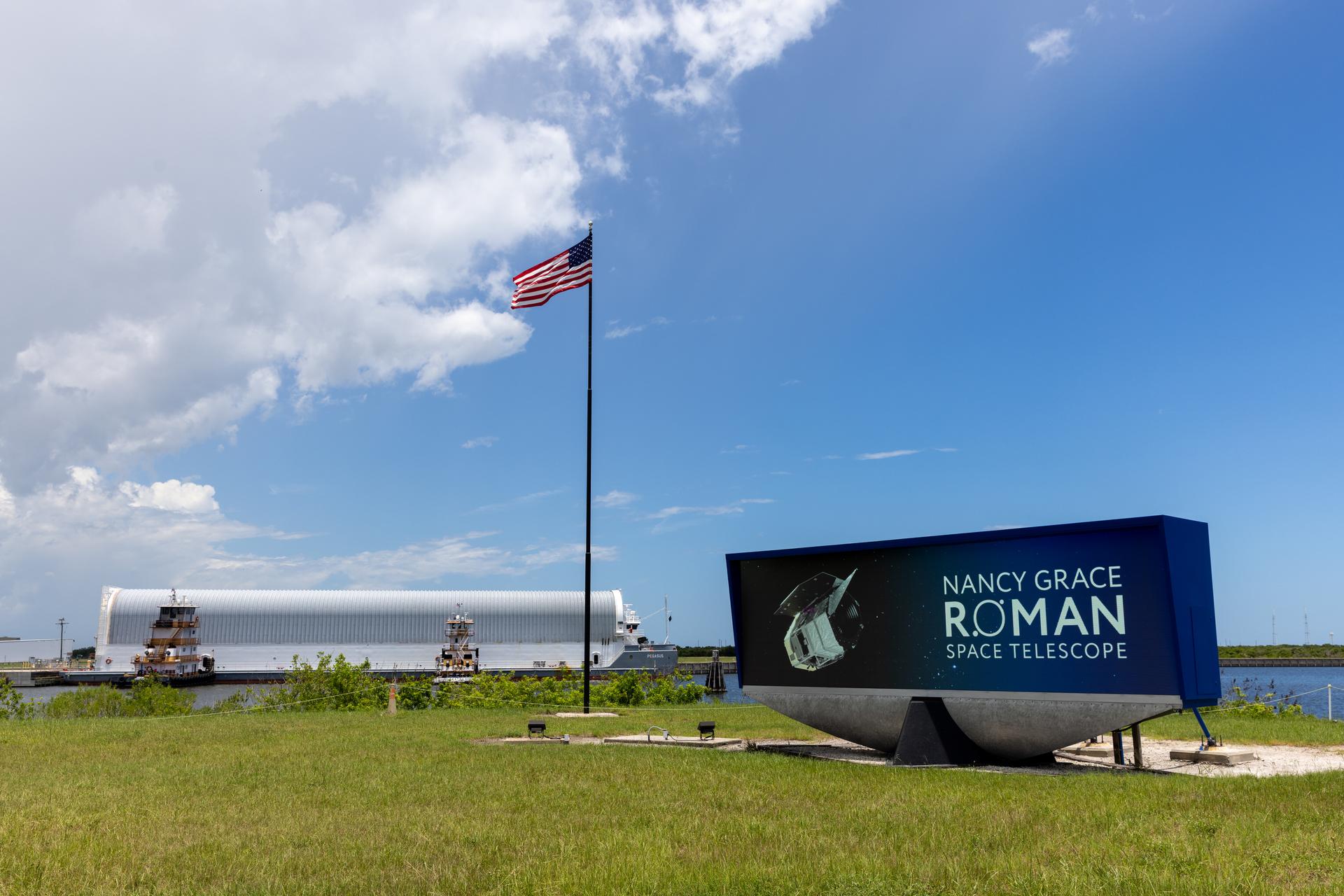
The barge arrived first. NASA's Nancy Grace Roman Space Telescope reached the Kennedy Space Center late Sunday morning aboard the agency's Pegasus barge, sealed inside a transport case the team has nicknamed "the Chariot," and rolled past the Vehicle Assembly Building toward the building where its launch campaign now begins.
The 43-foot observatory disembarked shortly after 7 p.m. Eastern on Sunday, about an hour later than planned after thunderstorms rolled over the Cape. It is headed for the Payload Hazardous Servicing Facility, where engineers will spend roughly 70 days checking it out, loading propellant and finally sealing it inside the nose cone of a SpaceX Falcon Heavy. Liftoff from Launch Complex 39A is set for no earlier than August 30, pulled forward from a September target.
Roman is built to do something Hubble and the James Webb Space Telescope cannot: see wide. Its field of view is far broader than Hubble's at comparable sharpness, which makes it a survey machine, the instrument you point at huge patches of sky to map dark energy's pull on cosmic expansion and to catch planets crossing in front of distant stars.
The name is a deliberate nod to who made that kind of astronomy possible. The telescope honors Nancy Grace Roman, NASA's first Chief of Astronomy, often called the "Mother of Hubble."
"She was a key person in our exploration of space. She understood that in order to better understand the universe, you have to go in space. That's why she's called the 'Mother of Hubble' because she made Hubble possible."
Lucas Paganini, Roman program executive
Getting here early is the unusual part. Large space observatories are famous for slipping right; Webb launched years late and billions over budget, so a mission moving its date up is worth noticing. Inside the servicing facility, the work is mostly plumbing and patience. Crews will load about 290 gallons (roughly 1,100 liters) of hydrazine, mount the spacecraft on its launch adapter and encapsulate it. It is the second time this year the Pegasus barge has made the run to Florida; in late April it delivered a propellant tank section for the Artemis 3 Moon rocket.
What Roman finds will take years to read out, but the science case is concrete: a statistical census of thousands of exoplanets through gravitational microlensing, and a dark-energy survey precise enough to test whether the universe's acceleration is steady or shifting. Paganini credited the team with accelerating the schedule, calling it a credit to this great team
. For now the milestone is physical and on the ground: a barge, a chariot and a 43-foot machine that, if the next 70 days go cleanly, leaves the planet at summer's end.