Webb Finds Salt Clouds on the 'Pink Planet' GJ504b
A faint magenta world too dim for ground telescopes turned out to be hiding clouds of salt — and a lesson about how astronomers read alien skies.
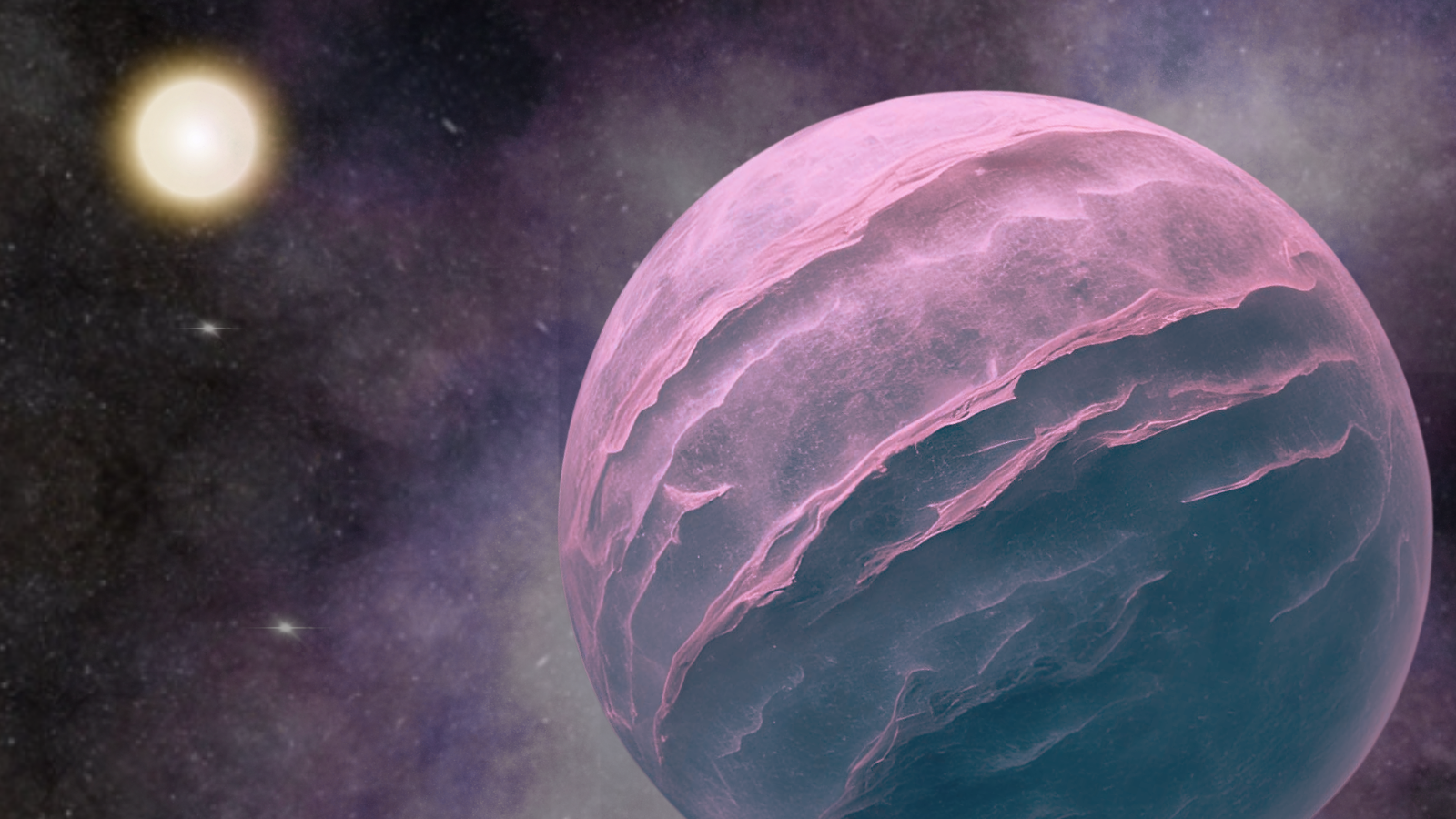
A faint magenta world 57 light-years away has been hiding clouds of salt. Astronomers using NASA's James Webb Space Telescope reported that GJ504b — the so-called "Pink Planet" — carries salt clouds deep in its atmosphere, the first time such clouds have been needed to explain what astronomers actually see when they look at a cold object beyond the solar system.
The finding, led by a team at Northwestern University, published June 18 in The Astronomical Journal, is less about the salt itself than about what it forces modelers to admit: their picture of these atmospheres was incomplete without it.
GJ504b is an odd target to begin with. Discovered in 2013, it orbits a Sun-like star and weighs in at roughly 25 times the mass of Jupiter — heavy enough that astronomers aren't sure whether to call it a giant planet or a small brown dwarf, a "failed star" that never got hot enough to fuse hydrogen. They hedge by calling it a "planetary-mass companion." What makes it valuable is its temperature: about 550 degrees Fahrenheit (290 degrees Celsius), cool by the standards of directly imaged worlds, most of which run between 1,000 and 2,000 F.
That coolness is exactly what defeated ground-based telescopes. The object is too dim for them to study in detail, which is why it sat as a tantalizing curiosity for more than a decade.
"The Pink Planet is the coldest companion ever discovered using ground-based instruments. Many teams all around the world performed follow-up observations to study its light, but it was too faint for ground-based instruments. That made it a perfect target for JWST."
Aneesh Baburaj, Northwestern University, in a statement
Webb needed about two hours to capture a usable spectrum. When the team analyzed it, the light carried fingerprints of water, carbon dioxide, methane and ammonia — and then refused to fit any model the researchers tried. The numbers only resolved once they added clouds of salt: chloride salts such as potassium chloride, possibly sulfide salts such as manganese sulfide, condensing deep in the atmosphere.
Here is the part worth slowing down for. Clouds are a function of temperature. On Earth they are water; on Jupiter, ammonia; on genuinely hot worlds, vaporized rock — silicates. Salt clouds occupy an awkward middle band: too hot for water or ammonia to condense, too cool for silicates. Theorists predicted them more than 15 years ago. GJ504b is the first cold companion where the data demand them.
The honest caveat is that "salt clouds" remains an inference from a model that fits, not a direct image of crystals drifting through an alien sky. But it is a well-motivated one, and Baburaj's team frames the lesson plainly: leave clouds out of the model and you misread the chemistry. For a telescope whose whole purpose is decoding the atmospheres of distant worlds — the same instrument that recently strengthened the case for exotic "black hole stars" — that is a correction worth banking before the next faint target comes along.