Why Satellites Fall From Orbit — and NASA's Race to Save One
A commercial spacecraft is trying to catch a falling NASA telescope before it burns up -- a real-time lesson in why nothing stays in orbit forever.
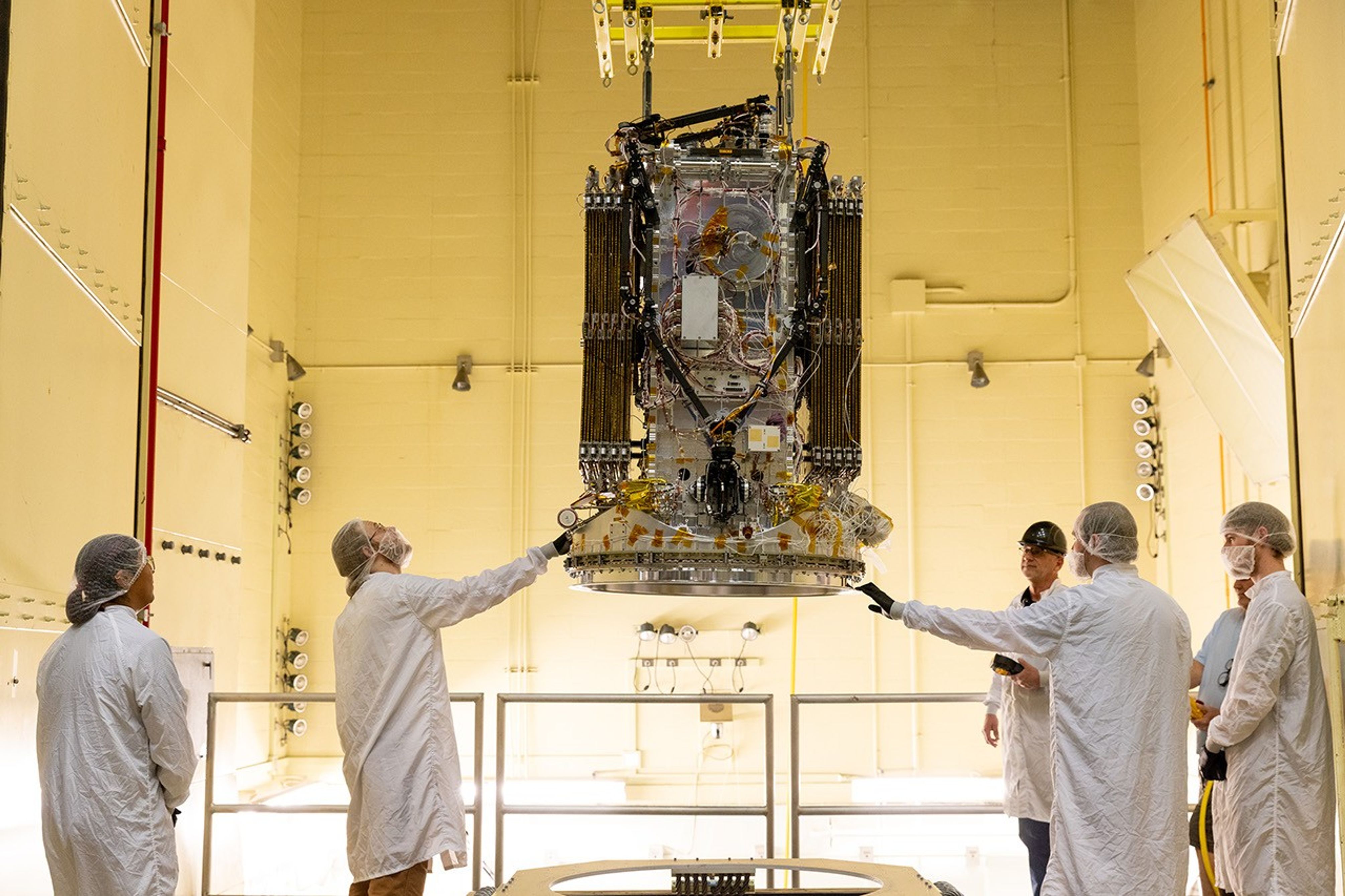
On July 3, a spacecraft about the size of a large refrigerator rode a rocket that was dropped from the belly of a modified airliner, 40,000 feet over the Pacific. Its job: catch a 21-year-old NASA space telescope that is falling out of the sky, latch onto it with three robotic arms, and shove it back into a stable orbit before it burns up in the atmosphere this fall.
That mission is still underway. As of July 10, the rescue craft, built by a small Arizona company called Katalyst Space Technologies, was deep into a multi-week checkout process 373 miles above Earth, quietly proving out a problem most satellites eventually face and almost nobody thinks about until something like this happens: orbits decay. Nothing up there stays put on its own.
Why do satellites lose altitude in the first place?
Even in what looks like empty space, low Earth orbit isn't a vacuum. There's a thin wisp of atmosphere up there, and every satellite that passes through it loses a little momentum to friction, the same way a bicycle slows down on a headwind. Over months and years, that drag pulls a spacecraft's altitude down, a process engineers call orbital decay.
The drag isn't constant. The sun runs on an activity cycle, and when it's more active — the kind of activity that also drives the geomagnetic storms behind stronger aurorae — it heats and puffs up Earth's upper atmosphere, thickening the thin margin satellites fly through. That's exactly what happened to NASA's Neil Gehrels Swift Observatory, a gamma-ray-hunting telescope launched Nov. 20, 2004. Increased solar activity in recent years has puffed up the atmosphere more than engineers expected, dragging Swift down faster than its mission planners anticipated.
Swift never had thrusters of its own. Most science satellites don't; propulsion adds weight, cost and failure points to a mission built to point cameras at the sky, not fly itself around. That design choice is fine for a spacecraft with a normal lifespan, and a problem for one that outlives its expected two-year mission by two decades, as Swift has.
What does it mean to "reboost" a satellite?
A reboost is exactly what it sounds like: firing thrusters, either the satellite's own or a visiting spacecraft's, to add speed and climb back to a higher, more stable altitude. The International Space Station does this routinely using its own docked cargo ships. Swift can't, because it has no engines to fire and nothing built onto it to grab.
That's what makes the current mission unusual. Katalyst's spacecraft, called LINK, weighs about 880 pounds and stands roughly five feet tall — a third of Swift's size. NASA awarded the company a contract in September 2025 to build something that had never flown before: a robot that could rendezvous with a government satellite that was never designed to be serviced, grab it with three articulated arms, and tow it to safety. If the capture and boost succeed, it will be the first time a commercial spacecraft has done that to an uncrewed government satellite.
Katalyst had roughly nine months from contract to launch pad. "In the last nine months, we have gone from a clean sheet to a spacecraft that is currently integrated on a rocket on an airplane, ready to go to Kwaj for launch," Kieran Wilson, LINK's principal investigator at Katalyst, told reporters in June, ahead of launch. "This is an absolutely unprecedented development timeline for this program."
How does the rescue actually work?
LINK launched on Northrop Grumman's Pegasus XL rocket — the first Pegasus flight since 2021 — released from a carrier jet over Kwajalein Atoll in the South Pacific. NASA confirmed teams made contact with the spacecraft the same day. Since then, according to NASA's Swift blog, engineers have deployed its solar arrays, stabilized it after a period of excess momentum, and begun test-firing its three xenon-fueled ion thrusters. That commissioning phase is expected to run a few more weeks.
Once it's done, LINK will approach Swift, survey it up close, then attempt the actual capture — closing to within a few miles before its arms reach out and grab hold of a spacecraft that has spent two decades in orbit and was never fitted with a docking port. Engineers have flagged a real risk here: Swift's insulation blankets have baked in sunlight for 21 years and could be brittle enough to crack when the arms make contact. If the grab works, LINK will spend several months slowly towing Swift back up to a safer altitude, roughly doubling the height it had fallen to.
"Frankly, I have to be honest: No one thought it was going to be possible," Shawn Domagal-Goldman, NASA's Astrophysics Division director, said of the mission in June. "No one thought we would get as far as we've already gotten today."
What has Swift actually found, and why save it?
Swift's instruments are built to swing toward gamma-ray bursts — the most energetic explosions known, typically the death cries of massive stars or the collision of neutron stars — faster than almost anything else in orbit. Swift principal investigator Brad Cenko has said the observatory has detected more than 2,000 of these bursts "all the way out to the edge of the visible universe," including the 2017 event that helped confirm heavy elements like gold and platinum are forged in neutron-star collisions.
Building a replacement telescope with that same rapid-response capability would cost vastly more than paying a startup to keep the old one flying. If the boost succeeds, NASA expects Swift could operate for five or more years longer than it would have otherwise.
Is this the only satellite facing this problem?
No — it's a routine hazard of low Earth orbit, just usually invisible to the public. The ISS gets reboosted periodically by its own docked spacecraft for the same reason Swift is sinking: atmospheric drag never stops pulling. What's new here isn't the physics; it's the idea of sending a separate, purpose-built robot to rescue a satellite that was never designed for anyone to visit. Katalyst has already used the momentum to raise $12 million toward a follow-on spacecraft, Nexus, aimed at a U.S. Space Force satellite in a far higher orbit next year — a bet that Swift's rescue is a preview of a business, not a one-off stunt.
For now, the near-term outcome hinges on a checkout process happening 373 miles up, one thruster test and one instrument check at a time.