Voyager 1 Reaches a Light-Day Nov. 18; Its Two-Day Silence Is Unexplained
The light-day changes a radio delay by about two minutes. The 48-hour silence in October, still unexplained, touches the thrusters that keep the antenna pointed at Earth.
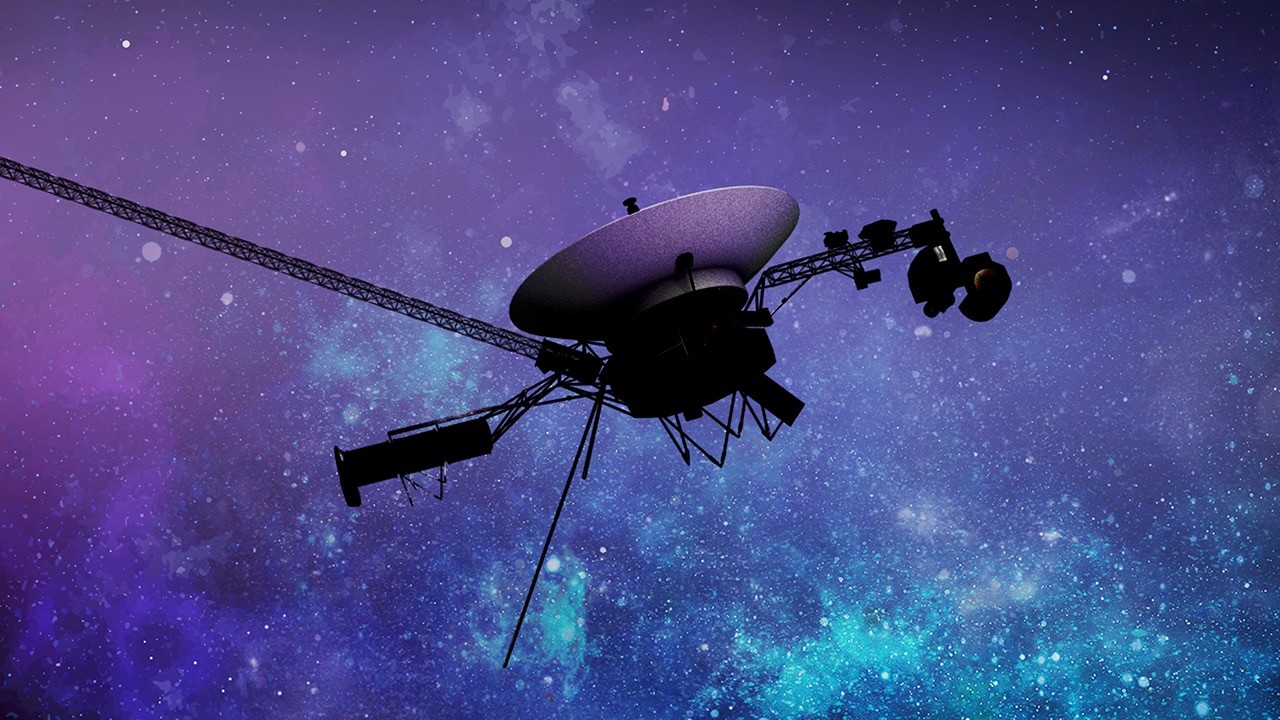
Voyager 1 is 23 hours and 58 minutes away by radio as of Tuesday, Nov. 3. On Wednesday, Nov. 18, NASA says, it will be 24 hours away. That is a change of about two minutes, and NASA itself says nothing aboard the spacecraft will change when it happens.
The milestone, in other words, is a date on a calendar. The news is the silence that came a month before it, and the fact that nobody outside the mission can yet say why it happened.
NASA's mission page puts the crossing at 2:16:07 a.m. PST on Wednesday, Nov. 18, which is 5:16:07 a.m. EST and 10:16:07 UTC. At that instant Voyager 1 will be 16.094 billion miles (25.902 billion kilometers) from Earth, the distance light travels in 24 hours, and NASA says it will be the first human-made object to get that far. The JPL release lists 16.09 billion miles and 25.89 billion kilometers, the same distance, truncated.
Today the probe sits 25.87 billion kilometers (16.07 billion miles) out, with 36.7 million kilometers still to go, according to Daybreak Wire's arithmetic from JPL's Horizons ephemeris, the public database of where solar-system objects are and will be. It is moving at 38,000 mph (61,155 kph). NASA's description of the moment is modest: The spacecraft will not detect any change in its environment when it passes one light-day, nor will anything change aboard the spacecraft.
A light-day is a date, and it has two answers
A light-day is exactly what it sounds like: the distance light, and therefore radio, covers in 24 hours. Multiply 299,792.458 kilometers per second by 86,400 seconds and you get 25,902,068,371 kilometers, or 173.14 astronomical units. An astronomical unit is the Sun-to-Earth distance, which light crosses in about 8.3 minutes. So a light-day is roughly 173 trips from the Sun to Earth, laid end to end.
Science News, reporting on Oct. 14, called 25.9 billion kilometers "more than four times the distance from the sun to Pluto." The same report recalls that Voyager 1 crossed the heliopause, the edge of the Sun's wind and the start of interstellar space, on Aug. 25, 2012, at about 18 billion kilometers. For the 1990 "Pale Blue Dot" portrait it was about 6 billion kilometers out. In radio time, roughly 16.7 hours and 5.6 hours.
Here is the wrinkle the coverage has skipped. NASA's 2:16 a.m. PST is a same-instant measurement: the straight-line distance between Earth and the probe, frozen at one moment. But radio does not travel in frozen moments.The first signal received on Earth that left Voyager 1 a full 24 hours earlier arrives at roughly 02:17 UTC on Nov. 19, which is about 6:17 p.m. PST (9:17 p.m. EST) on Wednesday, Nov. 18.
The two definitions are 16 hours apart. Neither is wrong, and both land on Nov. 18 in the United States. NASA has published only the first, so that is the one to put on a calendar.
Nor does the delay march steadily upward, because Earth swings around the Sun while the probe recedes. By the same ephemeris, the one-way time was 23 hours 32 minutes on April 24, 2026, and it peaks near 24 hours 4 minutes on Jan. 21, 2027. It does not fall back below 24 hours through the end of 2027, so Nov. 18 is a one-time crossing. Measured from the Sun instead of Earth, Voyager 1 will not be a light-day out until early February 2027, which means any headline calling Nov. 18 a light-day "from the Sun" has the wrong center. Future positions are predictions, not measurements. Voyager 2 is not expected to reach a light-day from Earth until November 2035, CNN reported, and probably will not be operating then.
What NASA has said about the silence, and what it hasn't
NASA's Jet Propulsion Laboratory said on Oct. 29 that the Deep Space Network, the set of large antennas at three sites around the globe that talks to far-flung probes, could not detect a radio signal from Voyager 1 during two scheduled attempts, 24 hours apart. Those were Sunday, Oct. 18, and Monday, Oct. 19. The signal reappeared on Tuesday, Oct. 20, and the team has kept contact since. JPL says the loss resolved itself after 48 hours, before engineers sent any troubleshooting commands.
The release also reports that one group of thrusters on the spacecraft went offline and their backups turned on. That swap is programmed to happen automatically when the onboard computers sense a problem with the active thrusters. That response is called fault protection: the spacecraft puts itself in a safe configuration and pauses normal operations, buying engineers time to diagnose.
Kareem Badaruddin, Voyager mission manager at JPL, put the unusual part plainly.
"This is the first time we've seen the spacecraft do something like this, but we are also at a point in the mission where we have to expect the unexpected."
Kareem Badaruddin, Voyager mission manager, JPL
Now the list of what NASA has not said. As of the Oct. 29 release, and with no later NASA update surfaced by Nov. 3, it has not said what caused the signal loss. It has not said why the thrusters went offline, which Deep Space Network antenna was listening, or whether the transmitter or the antenna's pointing changed. NASA presents the thruster swap and the silence together; a proven cause is not in the record. Badaruddin added: We're relieved to be back in contact with Voyager 1 and are eager to understand what happened.
One piece of arithmetic explains why the team could not have rescued anything in real time. On Oct. 18 the one-way radio time was about 23.9 hours, per Daybreak Wire's calculation from Horizons, so a round trip took about 47.8 hours. A command sent in reaction to the missed Oct. 18 window could not have been answered before about Oct. 20, which is why the 48-hour gap and the recovery land on the same date. Suzanne Dodd, the Voyager project manager, told CNN last December how that feels in practice: If I send a command and say, 'good morning, Voyager 1,' at 8 a.m. on a Monday morning, I'm going to get Voyager 1's response back to me on Wednesday morning at approximately 8 a.m.
The silence is the latest in a run of scares. The table sets them side by side.
| When | What happened | Out of contact or unreadable | How it ended |
|---|---|---|---|
| 2004 | Primary roll thrusters stopped working after two small internal heaters lost power | Not a communications loss; the backup roll thrusters carried the mission | Heaters fixed and primary roll thrusters revived March 20, 2025 |
| Nov. 14, 2023 to April 20, 2024 | Readable science and engineering data stopped; flight data subsystem memory chip failed | 158 days without usable health data | Code split across other memory; health data back April 20, 2024 |
| Oct. 16-24, 2024 | Heater command triggered fault protection, which turned off the X-band transmitter and switched to the S-band | Signal not detected Oct. 18; reconnected Oct. 24 | X-band reactivated November 2024; science resumed week of Nov. 18, 2024 |
| Feb. 27, 2026 | Power fell unexpectedly during a routine roll maneuver | None; LECP shut off to avoid triggering undervoltage protection | LECP instrument turned off April 17, 2026 |
| Oct. 18-20, 2026 | One group of thrusters went offline, backups turned on; signal not detected | 48 hours (two scheduled attempts) | Signal returned by itself Oct. 20; cause under investigation |
Read down the right-hand column and a pattern shows, though it is an inference, not NASA's conclusion: each episode involved the spacecraft's hardware, or its own protection reacting to thin margins, and engineers answered with workarounds on 1970s-era equipment, though the latest one ended on its own. (The 2024 signal was also lost on an Oct. 18, a coincidence and nothing more.)
The 2004 line is the one that sticks. The primary roll thrusters, which control the spacecraft's roll so its star tracker stays on a guide star (seen from Earth, the roll "rotates the antenna like a vinyl record"), quit that year, and engineers have leaned on the backups since. Badaruddin, speaking in 2025, said And, frankly, they probably didn't think the Voyagers were going to keep going for another 20 years.
When the team revived the thrusters in March 2025, it saw heater temperatures rise within 20 minutes. Todd Barber, JPL's propulsion lead, called it such a glorious moment
and, separately, yet another miracle save for Voyager.
JPL had warned in May 2025 of a buildup of residue in the active thrusters' fuel tubes that could stop them working. NASA has not tied it to the October silence, and nothing here should be read as saying the two are related.
The mission now runs on three clocks
The argument, then. Voyager 1's remaining life runs on power, pointing and latency, and they tick at very different speeds.
Power is the slow, schedulable one. Each of the three radioisotope generators, which turn the heat of decaying plutonium into electricity, produced about 158 watts at launch; both Voyagers lose about 4 watts a year. Of the 10 science instruments Voyager 1 launched with, NASA's status table lists only two still on: a magnetometer and a plasma wave instrument. The cosmic ray subsystem went off Feb. 25, 2025, and the low-energy charged particles experiment on April 17, 2026, after power fell unexpectedly on Feb. 27.
That is what the early-September "Big Bang" was for. Engineers swapped three devices that help keep the spacecraft warm for lower-power alternatives, six weeks after the same swap on Voyager 2. JPL says that without it, the mission would have needed to turn off another Voyager 1 instrument as early as summer 2027. NASA said in April there was even a chance the low-energy instrument could be switched back on, though it has not announced that it will be. Science News quotes estimates that the power sources will run dry in 10 to 15 years. That is one estimate, but it is a timetable, and a timetable is something engineers can plan around.
Pointing is not. The thrusters keep the dish aimed at Earth, and Dodd told CNN what a failure would mean: if propellant lines freeze and the antennas point elsewhere, "we would lose the mission because we could no longer get a signal to the spacecraft." That can end suddenly, without a schedule. NASA reported the thruster swap alongside the silence, and has not yet said why. Inference, labelled as such: the investigation of that thruster swap matters more to the mission's future than anything that happens at 2:16 a.m. on Nov. 18.
Latency is the clock that turns every fault into a long wait. Voyager 1 sends data at 160 bits per second, which Dodd likens to dial-up internet. A problem is seen a day after it happens, and any reply takes two days to land. Inference again: that means the spacecraft's own fault protection handles the first two days of any emergency on its own. Dodd described the design this way: If they get something going wrong, they can put themselves in a safe state so that they can wait until we're able to talk to the spacecraft and figure out what the problem is and resolve that issue.
NASA describes the thruster swap as that system's automatic response; it has not said whether the silence was part of it. It was also something the team had not seen before.
Hubble, another ageing NASA spacecraft, has its own problems. For Voyager 1, the next real thresholds are the investigation's findings and the 50th anniversary of launch on Sept. 5, 2027, which is 306 days from today.
For anyone who wants to mark the day, NASA's skywatching guide lists Nov. 17 as "Shine Bright for Voyager's Light-Day activation," with details at nasa.gov/voyager, and NASA's mission page runs a countdown to 5:16 a.m. EST on Nov. 18. Voyager 1 lies toward the constellation Ophiuchus; NASA's chart shows its direction on Nov. 17 around 5 p.m., toward the western horizon, and shows direction only.
At the milestone itself, a message from Earth needs 24 hours and about 7 seconds to reach the probe. A "hello" sent at 2:16 a.m. PST on Wednesday, Nov. 18 would be answered around 2:16 a.m. PST on Friday, Nov. 20.