Two Archaea From a Gas Well Hint Complex Cells' Ancestor Was Plain Inside
Two archaea grown in Japan have no nucleus, live on peptides and need a methane-making partner. They narrow how complex cells may have begun, but they rest on two strains from one well.
The microbes that one Japanese team places nearest to complex life have no nucleus, no lasting internal compartments, and no ability to live on their own.
On Wednesday, Oct. 28, 2026, Nature published the open-access paper in which Hiroyuki Imachi and Masaru K. Nobu of the Japan Agency for Marine-Earth Science and Technology (JAMSTEC) in Yokosuka report growing two strains, called HC1 and SC1, of an archaeal group named Heimdallarchaeia. Archaea are single-celled organisms, distinct from bacteria, that form one of life's three great domains. The authors place this group close to eukaryotes, the branch that holds animals, plants and fungi. The result is strong and narrow. It shifts weight toward partnership first and complexity later, but it cannot reach the ancestor.
A gas well that erupts like a geyser
The cells came from gas production well KTG3 in the Southern Kanto gas field, Chiba Prefecture. The team sampled a biofilm on the wall of the separator discharge outlet, 20 to 40 centimeters below the water surface, after brine eruptions on Aug. 29, 2019, July 16, 2020, and May 11, 2023.
It is an odd home for an oxygen-averse microbe. Brine erupts "akin to geysers," the authors write, and the water level drops every few hours, so the biofilm is intermittently exposed to air.
Growing them took patience and a deliberately thin diet: filtered brine, methane, magnetite, casamino acids and powdered milk at 0.005 percent each, five antibiotics, and no oxygen-scavenging chemicals at first. "Three years after the original sampling," the paper says, the team had a purified co-culture with a single methane-making partner.
Neither strain is alone. HC1 grows with one methanogen, Methanocalculus sp. MC2; SC1 was isolated in a tri-culture with two. HC1 takes 25 to 35 days to fill out a culture, SC1 about 60.
Complicated outside, plain inside
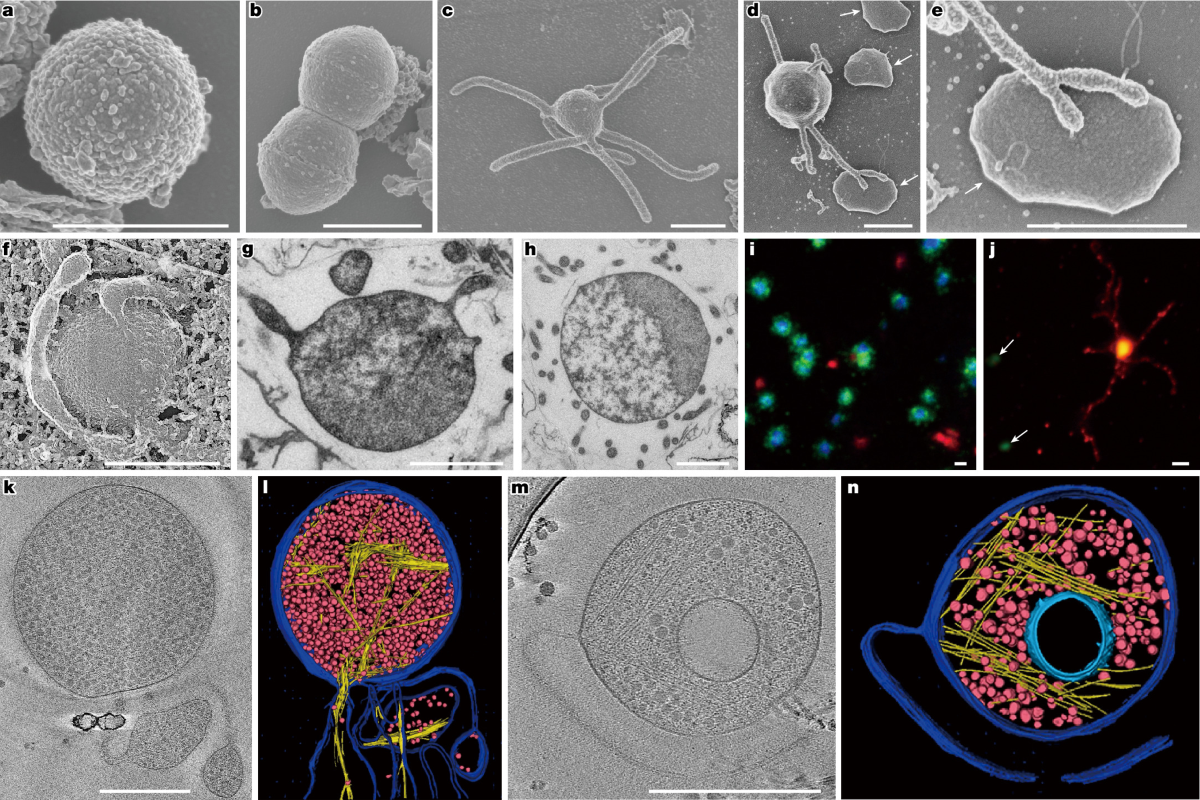
"No nucleus" is the headline, but the surface is what surprises. Most cells past mid-growth carry protrusions about 370 nanometers wide that branch and swell into bulbs, often making up more than half a cell's volume. They were absent in cells that appeared to be dividing, and they physically attach to the partner methanogens.
Inside, the picture is plain. The authors "did not observe any persistent internal membrane structures shared among all HC1 or SC1 cells." A few cells showed faint vesicle-like pockets, of unclear meaning. Yet nearly every cell kept its DNA and its ribosomal RNA apart with no membrane around either, for reasons the authors have not pinned down.
The genes tell a more tempting story. HC1 and SC1 carry 27 and 29 types of eukaryotic signature proteins, genes whose products resemble eukaryotic ones, putting them in the top quartile of their lineage.
A note on the pictures: the cryo-tomography of HC1 rests on 11 recorded images, and formaldehyde fixation tended to snap off protrusions. The protrusions sway by Brownian motion, meaning random jostling; Jiji Press's claim that they "allow them to move" overstates what this paper shows. Active crawling was reported in a separate Nature paper on Sept. 30, 2026, with Imachi and Nobu among its authors.
The strangest observation is how HC1 responds to more food. When yeast extract rose tenfold, the doubling time barely moved (7 days versus 6). The cells did not hurry. They got bigger and more elaborate, which the authors call "a trend that is atypical of prokaryotes."
On protrusions as nutrient storage, the authors stay cautious: Although tempting to speculate, it remains unclear whether these physiological functions are evolutionarily related.
A peptide eater that needs a partner
Two long words in the title carry the logic. A peptidotroph feeds on peptides, short chains of amino acids. Non-protein foods did not stimulate growth, and neither strain grew when peptides were swapped for a mixture of 20 amino acids.
Syntrophy is eating at someone else's table and returning the favor by clearing it. In the paper's definition, the organism's hydrogen- or formate-yielding metabolism is "thermodynamically inhibited by these products" until a partner scavenges them. Plainly: the archaeon ferments peptides, gives off hydrogen or formate, and a methane-making neighbor eats them before they stall the reaction.
The evidence is direct. A methanogen inhibitor, 2-bromoethanesulfonate at 10 millimolar, "completely suppressed growth." So did adding high concentrations of hydrogen gas or formate. The authors conclude both strains are "obligately syntrophy-dependent peptidotrophic archaea."
Why is that a clue rather than a curiosity? A cell that cannot feed alone, and grows long arms to grab its partner, looks built for a relationship. On the authors' reading, the archaeal ancestor of eukaryotes could likewise have been simple inside and elaborate outside, with the nucleus and other compartments arriving later. That is their interpretation, not a demonstrated fact. It also approaches from the opposite side the question behind a Minnesota lab's synthetic cell that grows and divides: what does a cell minimally need? Nature here supplies one that needs a neighbor.
There is a tension worth stating. These cultured archaea make hydrogen for a partner to consume. In the hydrogen hypothesis, as defined in a 2025 Nature analysis by Zhang and colleagues, the host does the consuming: it is an "H2-consuming archaeal host" paired with an "H2-producing protomitochondrion." The Imachi paper describes a "H2-evolving" ancestor and does not name the hypothesis. That contrast is a reading, not the paper's claim, and the two address different questions, tree placement versus living cultures, so it is tension rather than refutation.
Oxygen, and the bacterium that moves in
In HC1 co-cultures, 1 percent oxygen in the headspace meant no growth. But HC1 grew when aerobic bacteria were present to use the oxygen up, though its yields did not rise. In the authors' phrase, HC1 "is not stimulated by oxygen but can tolerate continuous exposure to oxygen when aerobic organisms are present and scavenging oxygen."
So the mitochondrion's ancestor may first have mattered as a bodyguard, not a power plant. The authors write of "early interactions between the archaeal host and mitochondrial ancestor probably occurring under low-oxygen conditions and at least partially mediated by oxygen detoxification."
HC1 expresses oxygen-using enzymes, but it "lacks the capacity to completely couple peptide degradation and oxygen respiration," and a classifier predicted every analyzed Heimdallarchaeia genome to be anaerobic. That argues against a February Nature paper by Appler and colleagues, which found hallmark proteins of an aerobic lifestyle in the group and proposed that hydrogen production and aerobic respiration may both have been present in the ancestor. Imachi's team cites that survey and reads the genes as oxygen defense.
What two strains from one well cannot settle
Start with the count. The authors write that "All microscopically studied Hodarchaeales and Heimdallarchaeales—albeit three strains only—consistently lack conserved, persistent eukaryote-like organelles." Two come from this paper, both from one biofilm. The earlier cultures, such as Promethearchaeum syntrophicum MK-D1, sit in a different class that the paper calls "still distantly related to eukaryotes." "This is what these two cells look like" is solid. "This is what the ancestor looked like" is an inference.
Then the word "closest." JAMSTEC's release says "closest known archaeal relatives" flatly, and the paper's title and abstract also say "closest." Its introduction is more careful: Heimdallarchaeia or its order Hodarchaeales "may branch as a sister group to eukaryotes." A 2023 Nature study by Eme and colleagues placed eukaryotes as a sister lineage to Hodarchaeales; Zhang's team inferred instead that eukaryotes evolved before all sampled Heimdallarchaeia diversified. A January 2026 Nature paper by Tobiasson and colleagues argues that key features of eukaryotic cell organization evolved in the Asgard lineage before the bacterium was captured. That sits uneasily with a plain-inside host, though it rests on gene analysis, not microscopy.
There is also a history of the text. The same work went up as a preprint posted in February 2025, 609 days before the Nature version, or 20 months and two days. Acceptance came Sept. 15, 2026, and publication 43 days after that. The final text is more hedged: the preprint deduced that the ancestor "was an anaerobic, syntrophic, peptide-degrading, mesophilic archaeon," whereas the paper says it "may have had such physiological features."
Post by @miangoar
Nature says reviewer reports are available; they were not part of this comparison. No independent expert reaction turned up in the coverage found as of Oct. 29: JAMSTEC's release repeated by Mirage News and other relays, one short Jiji Press report and a Nature research briefing. The authors' most candid sentence concerns their own ceiling:
"Although this suggests the possibility that LAECA also lacked persistent internal cell structure, the genomic composition of LAECA remains to be resolved."
Hiroyuki Imachi, Masaru K. Nobu and co-authors, Nature, Oct. 28, 2026
LAECA is the last common ancestor of the archaeal lineage and eukaryotes.
The two strains now live in culture on peptide mixes at 0.005 percent each, doubling every 7 to 12 days (HC1) or 14 to 20 days (SC1), each tethered to a methane-maker. Those jars can show how a living cousin behaves. What the ancestor's genome held, in the authors' words, "remains to be resolved."