Why Train Wheels Never Need to Steer
No one steers a train around a curve. A 19th-century trick of geometry, the conical wheel, does that job instead, and railroads are still refining it.
Grady Hillhouse built a tiny model railroad to make a point. He put plastic wheels on aluminum rails, pushed the car forward, and watched a wheel fall off the track. No flanges, no guidance, nothing to stop it from wandering off the steel. Then he added the lip that every real train wheel carries on its inner edge, tried again, and the wheels bound up going around a curve instead. It took a third fix, shaping the wheel like a shallow cone rather than a cylinder, before his little car finally held the rails through a turn. That third fix is the one riding under every train on Earth right now, and almost nobody who rides one has heard of it.
A locomotive engineer doesn't turn a wheel to follow a curve. There is no equivalent of a car's steering column in the cab. The rails do that job entirely, and they can only do it because the wheels riding on them are engineered to want to stay centered, a piece of 19th-century mechanical cleverness that modern railroads are still quietly improving.
How a Cone-Shaped Wheel Steers Itself
Train wheels are fixed to a solid axle, so both wheels on one axle always spin at exactly the same rate. There's no differential like a car has, letting one side turn faster than the other. That's fine on straight track, but it should be a serious problem on curves, where the outer rail is measurably longer than the inner rail. Two identical wheels spinning at the same speed would have to slip and scrub to cover different distances, chewing up steel with every curve.
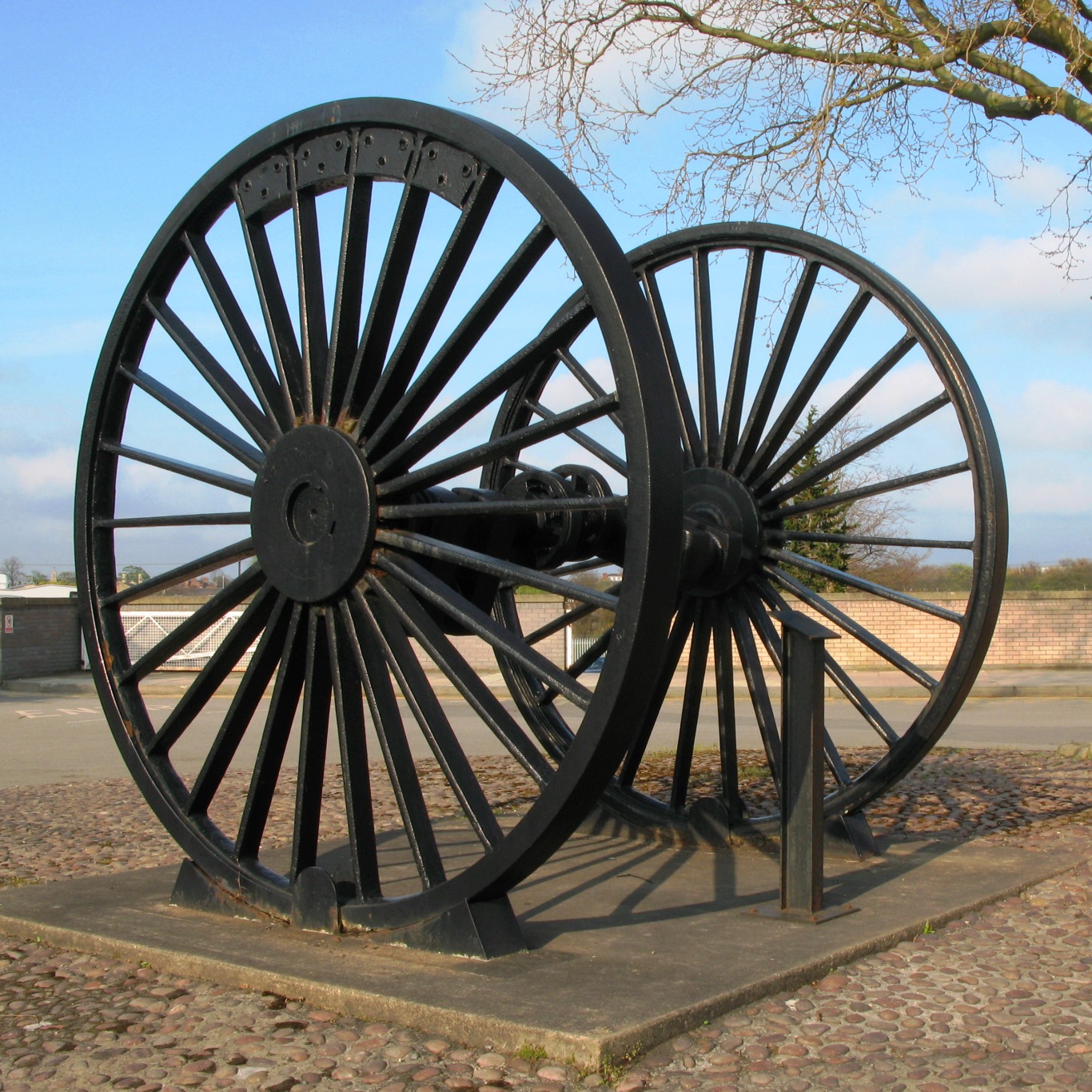
The fix is that train wheels aren't flat cylinders. The tread is machined into a shallow cone, wider near the flange and narrowing toward the outer edge. Practical Engineering, the civil-engineering YouTube channel run by Hillhouse, walks through why that shape matters more than the flange itself: a wheelset with conical wheels will naturally tend to self-center itself between two rails.
On a straight stretch, a wheel that drifts slightly high on one rail rolls on a wider part of its cone there, effectively grows in diameter, and gets nudged back down. That's also why a train's ride has a faint side-to-side sway, if you pay attention to it.
On a curve, the same geometry solves the speed-mismatch problem. Turning forces push the wheelset toward the outer rail, so the outer wheel rides on its wider tread, a bigger effective diameter with more distance covered per rotation, while the inner wheel rides on its narrower tread and covers less. One solid axle, two different effective wheel sizes, no slipping. Most vehicles need a differential gearbox to manage that; a train just needs the right cone angle. The U.S. standard tapers the tread about a quarter of an inch, or 6 millimeters, from inside to outside. Riders never notice a difference that small. It's large enough to steer a 100-ton railcar all the same.
Why the Flange Sits on the Inside, Not the Outside
The flange, that raised lip everyone assumes is doing all the work, is really a backup system. It only earns its keep when the cone's self-centering runs out of room, catching the wheel before it climbs off the rail entirely. So why is it on the inside of the wheel rather than the outside, where it might seem easier to spot from a platform?
Trains.com's Ask Trains column, answering a reader question from modeler Gerald Roberts, lays out a few reasons that have stuck for more than a century of railroad practice. Casting is simpler when the flange sits on the wider, inner part of the cone rather than the narrow outer edge. More importantly, with the flange on the inside, the sideways force from the rail pushes the wheel inward, onto the axle. Flip the flange to the outside and that same force would push the wheel outward, off the axle: exactly the kind of failure mode a 100-ton vehicle moving at speed cannot afford. Track switches factor in too. Inside flanges let the diverging rail curve away gradually before the flangeways have to cross, keeping the gap in the rail small at exactly the point wheels pass over it.
When the Trick Runs Out
The system isn't foolproof at speed. Push a train fast enough, especially with light or empty cars, and the gentle side-to-side sway that keeps wheels centered can amplify into a violent side-to-side slam called hunting oscillation, strong enough in the worst cases to derail a car. Railroads spend real engineering effort on wheel and truck (or "bogie," in British usage) profiles specifically to push that hunting threshold higher, so it doesn't cap how fast a train can safely run.
Tight curves expose a different limit of the same design. When a curve is sharp enough that the cone's self-centering can't fully match the outer and inner wheel speeds, the flange starts grinding against the rail edge instead of riding free. That grinding is the source of the sharp squeal transit riders hear on tight subway bends, a sound Daybreak Wire has covered separately. Railroads on the sharpest curves respond by using harder steel rail and sometimes greasing the rail edge, trading a little more maintenance for a lot less shriek and wear.
None of this is finished business. North American freight railroads updated their standard wheel profile a few years ago to the current AAR-2A shape, and Practical Engineering notes the change was tested at roughly 40% less wear than the profile it replaced: less friction, better fuel economy, and rail that lasts longer before it has to be replaced. A 19th-century idea, still getting machined a little sharper.