Are Restaurant Credit Card Surcharges Legal? It Depends on the State
A record 34% of merchants now surcharge credit card transactions, but the legal limit changes wildly by state — banned outright in three, capped in a dozen others.

The check arrives, and so does a line item that wasn't on the menu: a 3% or 4% credit card surcharge, tacked on because you tapped a card instead of pulling out cash. It's not your imagination, and it's not just one stingy restaurant. It's a fast-spreading, legally messy trend — and whether that charge is even allowed depends entirely on which state you're sitting in.
According to J.D. Power's 2025 U.S. Merchant Services Satisfaction Study, 34% of merchants are now adding surcharges for customers who pay by credit card — up from just 20% a year earlier, according to a 2024 State of the Industry Report from the payments consultancy CMSPI. The same J.D. Power study found that 41% of card users have walked away from a purchase, at a large or small business, specifically because of a surcharge.
The money behind the trend is real. Interchange fees — what card networks charge merchants every time a customer swipes, taps or types in a card number — hit a record $187.2 billion last year, or roughly $1,200 per American family, according to a news release from the Merchant Payments Coalition. For restaurants specifically, card fees now rank as the third-highest expense after food and labor, according to the National Restaurant Association.
Doug Kantor, general counsel of the National Association of Convenience Stores and a longtime advocate against card fees, put it bluntly to Payments Dive: The fees have gone up more than 70% since COVID, which is just an unsustainable pace for restaurants and other retailers.
He called the shift toward surcharging a sign of desperation.
The baseline rule, before state law even enters the picture
Under the rules Visa and Mastercard require of any merchant that surcharges, the fee can't exceed whichever is lower: the business's actual cost of accepting the card, or 3% of the transaction, according to Experian. Merchants also have to notify their card network and processor at least 30 days before starting to surcharge, post clear signage at the entrance and the register, list the surcharge separately on the receipt, and refund it if the purchase is refunded. None of that applies to debit cards — surcharging debit is not allowed anywhere in the country.
Layer state law on top of that, and the picture gets complicated fast.
Where it's flatly illegal
Three states ban credit card surcharging outright: Connecticut, Maine and Massachusetts. Connecticut's law goes further than a simple ban — it prohibits a business from listing a lower cash price and then adding a fee at checkout, meaning a menu can't show one number and the register another. Violations there carry a $500-per-instance fine.
California doesn't ban surcharging by name, but Senate Bill 478 — the state's 2024 "junk fee" law — effectively bars most businesses from listing a surcharge as a separate line item; the total has to be baked into the advertised price, with fines up to $1,000 per violation. Restaurants, notably, are carved out of that particular ban, so a California diner can still see a distinct credit card line on a restaurant check even though a California retailer generally can't.
Where it's legal but capped
A cluster of states allow surcharging only up to a specific ceiling, or only up to what the merchant actually pays in processing costs — whichever is lower. Colorado caps it at 2%. New York, New Jersey, Nevada, South Dakota, Nebraska and Georgia all require that the surcharge not exceed the merchant's real cost of acceptance, and New York additionally requires the total credit card price to be shown "clearly and conspicuously," with $500 fines for violations. Oklahoma flipped from banned to legal-but-capped on November 1, 2025, when a 2% ceiling took effect.
Minnesota updated its rules twice in recent years: as of January 1, 2025, a surcharge is allowed only if a customer can reasonably avoid it — by paying cash, for instance — and any charge that can't be avoided has to be folded into the sticker price. A separate 2025 law, HF 3438, bars restaurants and hotels from tacking on assorted "service fees" and similar mandatory add-ons at all, though mandatory gratuity survives as an exception if the money goes directly to staff and the percentage is disclosed up front. Penalties there run as high as $25,000 per violation.
Texas is its own case study in legal limbo. State law technically bans surcharging, but federal courts have ruled that ban unconstitutional, so in practice Texas merchants surcharge anyway — while the Texas Restaurant Association separately argues card fees now siphon more than $10 billion a year out of Texas' economy.
Why restaurants specifically
The restaurant industry has had a rough stretch — nine straight months of declining customer traffic through October, by the National Restaurant Association's count, layered on top of rising food and labor costs. Vanessa Sink, a spokesperson for the association, told Payments Dive that adding a visible surcharge is, in a sense, restaurants trying to be transparent rather than sneaky: Adding a surcharge for credit card swipe fees could be how restaurant operators are choosing to be more transparent with their customers about their rising costs of accepting credit cards, instead of just raising menu prices, which customers typically watch closely.
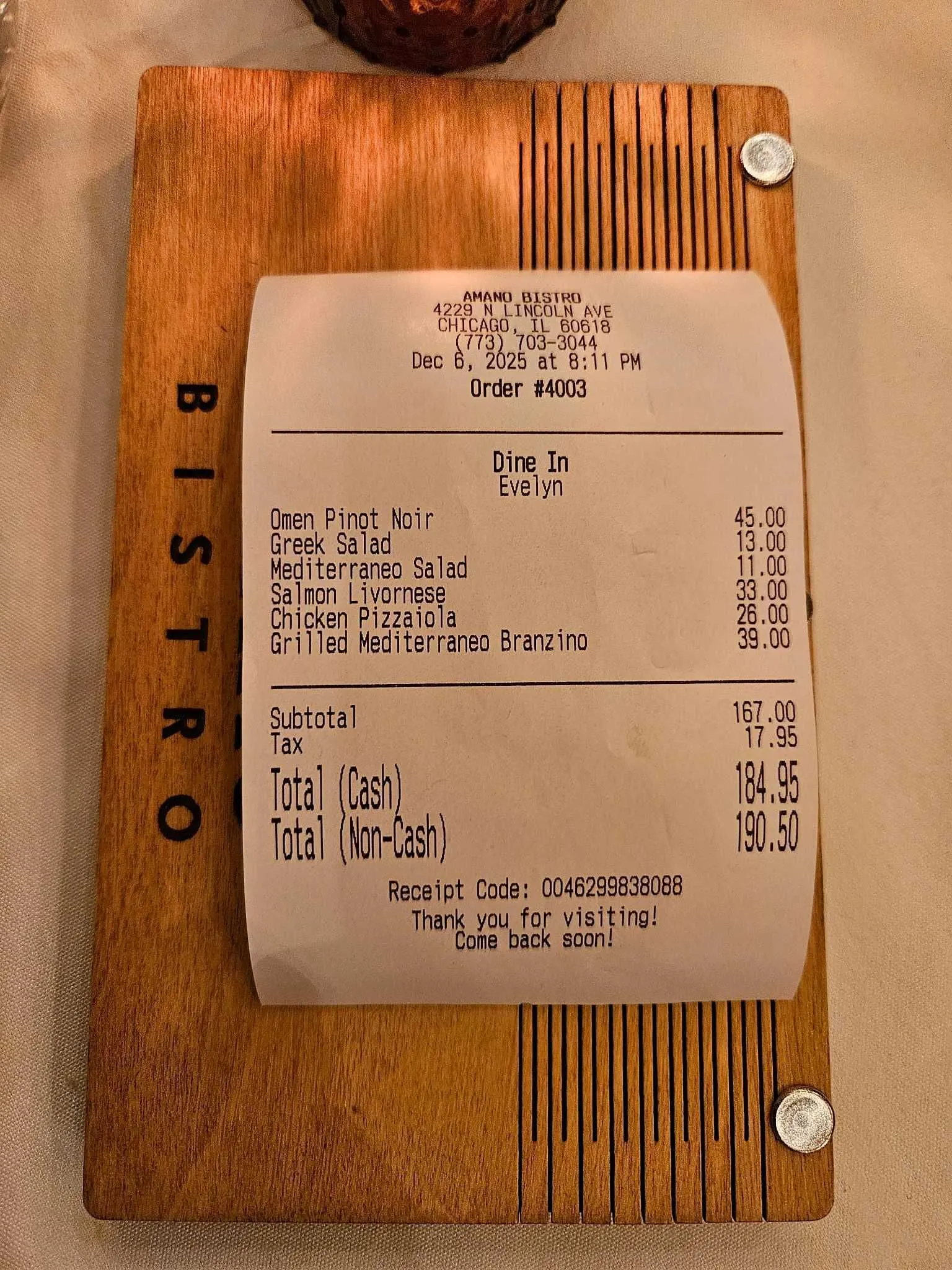
Some operators are skipping the surcharge label entirely and going with dual pricing instead — a cash price and a separate, higher card price, similar to what's long been standard at gas stations. At Amano Bistro, an Italian restaurant on Chicago's North Side, manager Nick Menicanin said the switch barely registers with customers. "It totally doesn't matter because 99.9% of the people pay with credit cards," he told Payments Dive. "I rarely see cash in the restaurant."
Not everyone is willing to eat it
Don Apgar, who directs the merchant payments practice at Javelin Strategy & Research, sees the trend running up against its own limits. We're approaching a tipping point where consumers are actively saying they won't pay the surcharge,
he said. Even so, he doesn't expect the practice to retreat: Surcharging was few and far between … but now it's becoming de facto.
Part of what's driving the arms race is that rewards cards keep getting richer, and richer rewards cost merchants more in interchange to accept. John Cabell, who leads payments intelligence at J.D. Power, told NerdWallet that U.S. cardholders have an insatiable appetite for rewards and benefits,
with card issuers under constant pressure to widen cash-back percentages and bonus categories — costs that eventually land on the business side of the counter.
Congress has a bill aimed at the underlying interchange fight — the Credit Card Competition Act, which would force more competition into how card transactions get routed — and it was reintroduced yet again in January 2026 after stalling in prior sessions.
What to do if a charge looks wrong
If a surcharge shows up somewhere it shouldn't — a banned state, an uncapped percentage, or with no advance disclosure — Experian recommends reporting it to the state attorney general's office or the local district attorney, since violations can trigger fines even when no criminal case follows. A surcharge that doesn't break state law can still violate Visa or Mastercard's own merchant rules, in which case a complaint to the card network itself is the faster route; businesses that ignore those rules risk losing the ability to accept that brand's cards at all.
None of that helps in the moment the check lands on the table. The more durable fix is knowing, before the meal, that a card that earns 3% back on dining will roughly cancel out a 3% surcharge — while a flat 2% card, run through a state with no surcharge cap, quietly loses money every time.
.png?crop=100.0p%2C100.0p%2Cx0.0p%2Cy0.0p&auto=webp&width=1200&height=675)