Elusive Goblin Shark Filmed Alive in the Deep Sea for the First Time
Researchers have published the first confirmed footage of a goblin shark alive in its deep-ocean habitat, captured near Jarvis Island and in the Tonga Trench.
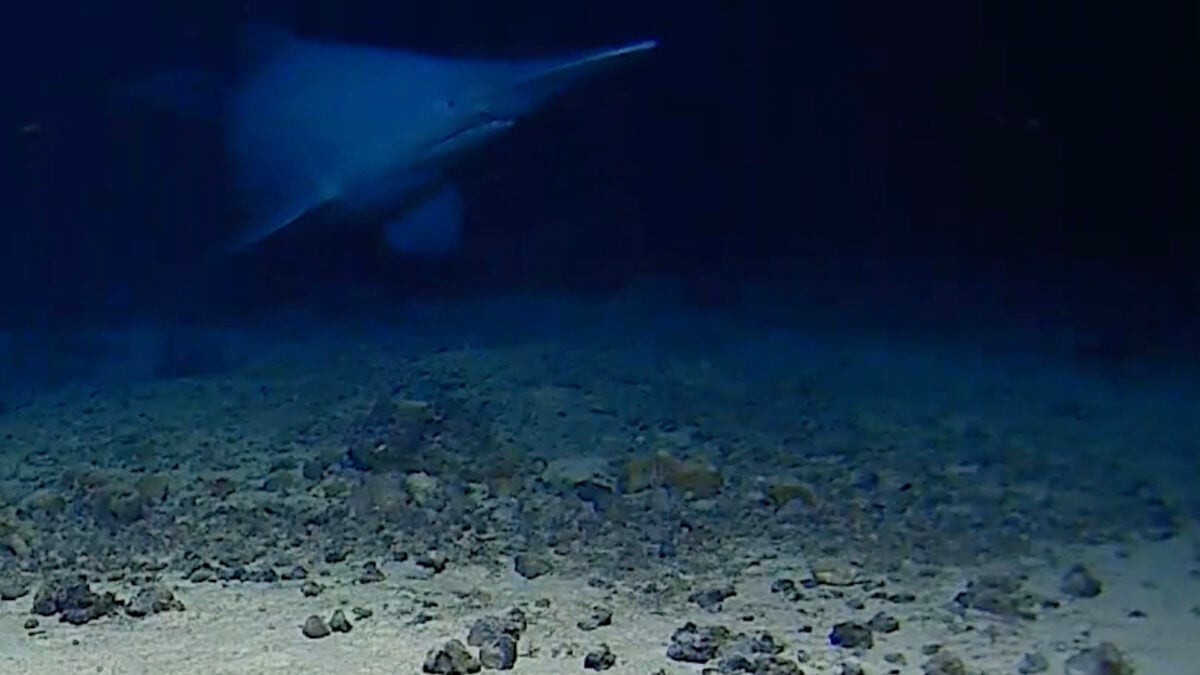
For a fish that has outlived the dinosaurs, the goblin shark has been remarkably good at dodging the camera. Nobody had ever filmed one alive and swimming in the deep sea where it actually lives. Now somebody has.
A team led by oceanographers at the University of Hawai'i at Manoa has published the first confirmed footage of Mitsukurina owstoni in its natural habitat, in a paper in the Journal of Fish Biology. Two sightings, years apart, are all it took to rewrite what scientists thought they knew about where the animal lives.
The first was captured in 2019 along an unnamed seamount northwest of Jarvis Island, 4,058 feet (1,237 metres) down. The second came in 2024, deeper still, at 6,552 feet (1,997 metres) on the slope of the Tonga Trench.
Here is the catch that makes the footage worth a paper. Every previous "live" goblin shark was one hauled to the surface on a fishing line, where researchers could look at it briefly before it died. Watching one move at depth, under its own power, is a different kind of data. It tells you how the animal hangs in the water, how it uses the protrusible jaw that snaps forward to grab prey, the feature that earned it the nickname "living fossil."
It is worth being precise about what the study is and is not. Two observations are two observations, not a population survey. The researchers are not claiming the goblin shark is common in the Central Pacific, only that it is there, deeper than the records said, and that the gear now exists to catch it on camera. As Smithsonian magazine noted in its write-up, the species' habits remain mostly a mystery.
That gap is the real story. We have detailed maps of Mars and a patchy guide to the slope of an ocean trench a few thousand metres down. The goblin shark spent decades as a creature known mainly from corpses and museum jars. It took two lucky frames of video, captured five years apart by cameras pointed into the dark, to confirm the obvious thing nobody could prove: it was down there the whole time, going about its business, waiting to be seen.