The Hurricane Cone Doesn't Show a Storm's Size
Most people assume the white cone on a hurricane graphic shows where the damage will land. It doesn't, and that mix-up has already cost lives.
Every hurricane graphic tells two lies of omission at once. Daybreak Wire covered the first one earlier today: the category number measures wind and nothing else, so a Category 1 storm can still drown a coastline while a Category 4 spares it. The second lie lives in the cone right next to that number — the white funnel tracking a storm's likely path — and it fools people in the opposite direction.
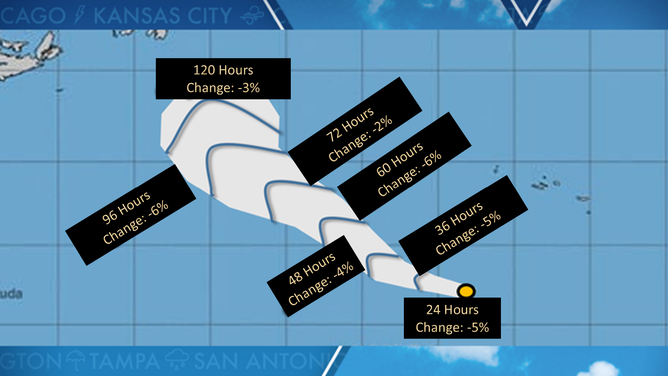
Most people assume the cone shows how big the storm is, or where its damage will reach. It shows neither. The cone is a probability map for one single point: the storm's center. Nothing more.
The National Hurricane Center builds the cone from its own track record. Circles are plotted along the forecast path at 12, 24, 36, 48, 72, 96, and 120 hours out, and each circle's radius is set to enclose two-thirds of the agency's forecast errors from the previous five years. Smooth the outer edges of those circles together and the familiar funnel shape appears — narrow near the coast, wide five days out, because FOX Weather notes forecast errors "increase with time," and the circles have to grow to keep covering that same two-thirds probability further into an uncertain future. The center of an active storm ends up somewhere inside that shaded area roughly 60 to 70% of the time — never guaranteed, and never necessarily dead in the middle.
What the cone was never built to show is impact. Storm surge, rain bands, and tropical-storm-force winds routinely extend well past the shaded edge, sometimes by well over a hundred miles, because the graphic encodes zero information about a storm's physical size. A compact, intense hurricane and a sprawling, weaker one can be drawn with the exact same cone.
Hurricane Ian turned that gap from an abstraction into a body count. Five days before its September 2022 landfall, the cone was centered on Southwest Florida — accurate, as it turned out, though the projected track line inside it swung as far north as the Florida Panhandle before curving back south toward an eventual landfall in Lee County. Tampa, sitting outside a direct hit for a century, drew the most attention and evacuated correctly. Lee County, in the storm's actual path the entire time, waited. By the time officials called a mandatory evacuation there, residents had barely more than 24 hours to leave. More than 100 people died, many in Ian's record storm surge. Reporting from the Miami Herald captured what a University of Miami study later confirmed in surveys: most Floridians believed the shaded cone showed where the storm's damage would land. Athena Masson, a meteorologist and Flagler College adjunct professor, described the resulting mental shortcut bluntly: "The public begins to think 'it's going to be this tiny little area. Everything outside that is safe.' That's wrong."
The hurricane center hasn't ignored the criticism. A 2017 revision added orange and red shaded rings that separately mark the reach of tropical-storm- and hurricane-force winds, an attempt to show size information the base cone was never designed to carry. Acting NHC director Jamie Rhome, responding to the Ian backlash, wrote that "all the recent additions to our forecast suite, including new storm surge warnings and maps, were driven by social science to help us communicate hazards — something the cone was never intended to do." For 2026, the agency went further, expanding the cone graphic to display every land-based tropical storm and hurricane watch or warning across the continental U.S., Hawaii, Puerto Rico, and the U.S. Virgin Islands, not just the coastal alerts it used to show.
None of the added layers replace the basic habit worth carrying into this season: the cone is a bet on where a storm's eye might go, not a boundary line between people who need to prepare and people who don't. Rhome himself has resisted promising a full redesign. "It's tempting to want to engineer a quick fix to the cone," he wrote, "but we need to be scientifically disciplined and wait for the body of evidence to come forward." Until that happens, the wind-radii shading and the watch-and-warning overlays are the real answer to "am I safe" — the white funnel in the middle was never built to answer that question at all.