Why Rotten Tomatoes Scores Split Critics From Audiences
The Tomatometer counts positive reviews, not review quality. The audience score averages self-selected fans. When 'Melania' hit a 92-point gap in 2026, both mechanisms were on full display.
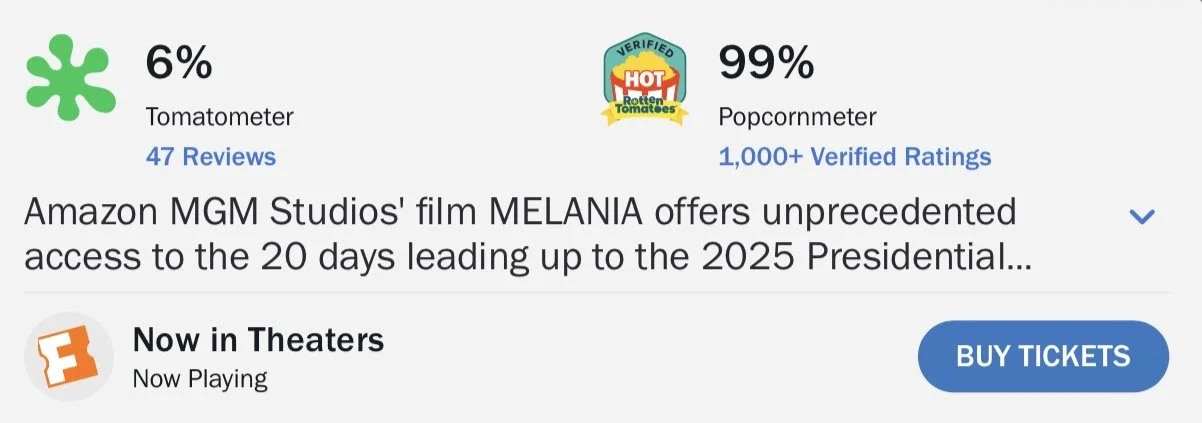
Ninety-nine percent. Seven percent. Those are the two Rotten Tomatoes scores sitting side by side for "Melania," the 2026 Amazon MGM documentary about the first lady — and the 92-point gap between them is the widest the review-aggregation site has ever recorded.
It's an extreme case, but the pattern behind it shows up constantly, on movies nobody would call politically charged. A comedy pulls 30% from critics and 85% from ticket-buyers. A prestige drama does the reverse. Rotten Tomatoes displays both numbers on every title, side by side, and leaves audiences to sort out what the gap means. Understanding what the two scores actually measure explains why they so often disagree — and why neither one is simply "right."
What the Tomatometer actually counts
The critics' score, officially the Tomatometer, isn't an average of anything. A small team of human curators at Rotten Tomatoes tracks down reviews from a large pool of pre-approved critics for each release, then makes a subjective call on each one: positive, or "Fresh," versus negative, or "Rotten." The Hustle reported, citing Wired's reporting on the process, that the Tomatometer is simply the share of reviews sorted into the Fresh pile — a film needs 60% or more Fresh reviews to be certified "Fresh" itself; anything under that line is "Rotten."
That binary sorting is the whole trick, and the whole limitation. A critic who calls a movie "a flawed but worthwhile two and a half stars" and a critic who calls it "a total triumph" both register as one identical "Fresh" vote. The Tomatometer records whether critics liked a film, not how much they liked it — which means a movie greeted with mild enthusiasm by 90% of reviewers can outscore a movie adored intensely by 65% of them.
What the audience score measures instead
The audience number works on a different axis entirely. Rather than a binary count, it's a straight average of star ratings — half-star increments from 0.5 to 5 — submitted by anyone who marks themselves as having seen the film. No credentials, no editorial filter, no curator deciding what counts.
That structural difference does most of the work explaining why the two scores split. Critics are a small, credentialed, relatively homogenous group reviewing through a professional lens — craft, direction, originality measured against genre history. Audiences are self-selected in a different way entirely: the people who bother to rate a movie tend to already be the ones who wanted to see it, which can push scores toward enthusiasm the general public wouldn't share, or, in the other direction, toward review-bombing from people who never intended to watch it at all.
How "Melania" broke the record
The documentary's gap is the sharpest illustration of both dynamics working against each other at once. Reporting from World of Reel noted that Amazon MGM declined to hold advance screenings for critics, meaning reviewers had to buy a same-day ticket to see the film at all — a distribution choice that sharply limited how many critics reviewed it in the first place. With only a handful of reviews counted toward the Tomatometer, the score was unusually easy to move in one direction.
The audience side saw the opposite dynamic: a built-in, motivated fanbase showing up specifically to rate a film it already knew it would support. The combination produced the 99-7 split. It isn't unprecedented in shape, only in degree — the 2024 documentary "Reagan," starring Dennis Quaid, drew an 18% critics score against a 98% audience score, a similarly lopsided gap that went largely unremarked at the time simply because it wasn't a record.
What a wide score gap is actually telling you
None of this makes either score meaningless. It makes them measurements of two different things wearing the same tomato-shaped icon. A high Tomatometer paired with a low audience score often flags a movie critics respected on craft grounds that general audiences found cold, slow, or simply not to their taste. The reverse pattern — low critics, high audience — often flags a crowd-pleaser critics judged by a stricter bar than casual viewers apply. It's the same underlying gap that shows up in why so few movie remakes beat the original: professional and popular judgment simply don't move in lockstep, and there's no reason they should.
Rotten Tomatoes became powerful enough for any of this to matter almost by accident. The site started in 1998, built by graduate students who wanted a way to rank Jackie Chan movies, and passed through the video site Flixster, then Warner Bros., and finally Comcast NBCUniversal's Fandango before its scores started appearing automatically on Google search results, Apple's storefronts, and DirecTV listings. A survey cited in that reporting found roughly a third of Americans check Rotten Tomatoes scores before deciding what to watch, and that nearly two-thirds of those people have skipped a title entirely because of what they saw there — a lot of weight resting on a percentage that, on the critics' side, is really just a headcount of who leaned positive.
That's the real story behind the tomato icon: not a verdict on quality, but two separate polls of two separate populations, measured two separate ways, printed on the same page. The next time the numbers don't match on a movie worth the price of a ticket, the disagreement is doing exactly what it's built to do — showing that critics and crowds don't always want the same thing from a film, and never really have.