King Charles Marks His Official Birthday With Trooping the Colour
The choreography barely changes, and that is the point: a monarchy staging its own permanence on Horse Guards Parade, one year at a time.
Just after half past ten on Saturday morning, the household cavalry's hooves found the gravel of Horse Guards Parade, and London performed one of its oldest set pieces again. Trooping the Colour marked King Charles III's official birthday — the fourth of his reign, and the latest instalment of a ceremony that has saluted the sovereign's official birthday for more than 260 years.
The timing is itself a tradition. Charles was born in November; like the sovereigns before him, he keeps a separate "official" birthday in summer, when the weather is kinder to a parade. The custom goes back generations, and the June date has become the fixed point around which the ceremonial year turns.
The choreography barely changes, which is rather the point. The royal family came down The Mall from Buckingham Palace, the Prince of Wales, the Princess Royal and the Duke of Edinburgh on horseback, the King and Queen Camilla following with the Princess of Wales and the three Wales children in carriages. Charles, as head of the armed forces, took the salute as a battalion of Foot Guards trooped its colour through the massed ranks.
View on Instagram
The Household Division said more than 1,350 soldiers, drawn from the division and the King's Troop Royal Horse Artillery, and more than 300 musicians were due to take part, with the King's Birthday Parade stepping off at 10.30am and a Royal Air Force flypast timed for 1pm. The BBC carried it live, as it does every year.
Strip away the scarlet and the bearskins and Trooping the Colour is a piece of theatre about continuity — a monarchy staging its own permanence once a year, in formation, to a metronome. That it looks almost identical to last year, and to the years Elizabeth II rode out in uniform, is not a failure of imagination but the whole argument: the institution is meant to outlast the person at its centre. A king who came to the throne late, after the longest apprenticeship in the institution's history, has reason to lean on a ritual whose message is simply that the line holds.
It is also a military display, and a soft-power one. The Foot Guards who mount the ceremony are working soldiers; the pageant doubles as recruitment, tourism and diplomacy, a reminder that the crown still sits atop the armed forces even where its political power is now ceremonial. The crowds along The Mall and the cameras overhead are part of the design, not a by-product of it.
None of this is free of argument. Each year the parade reopens a familiar debate about cost, relevance and who the spectacle is really for, and each year the Palace's answer is the parade itself: unchanged, on schedule, immaculately drilled. The continuity is not a side effect of the ceremony. It is the message.
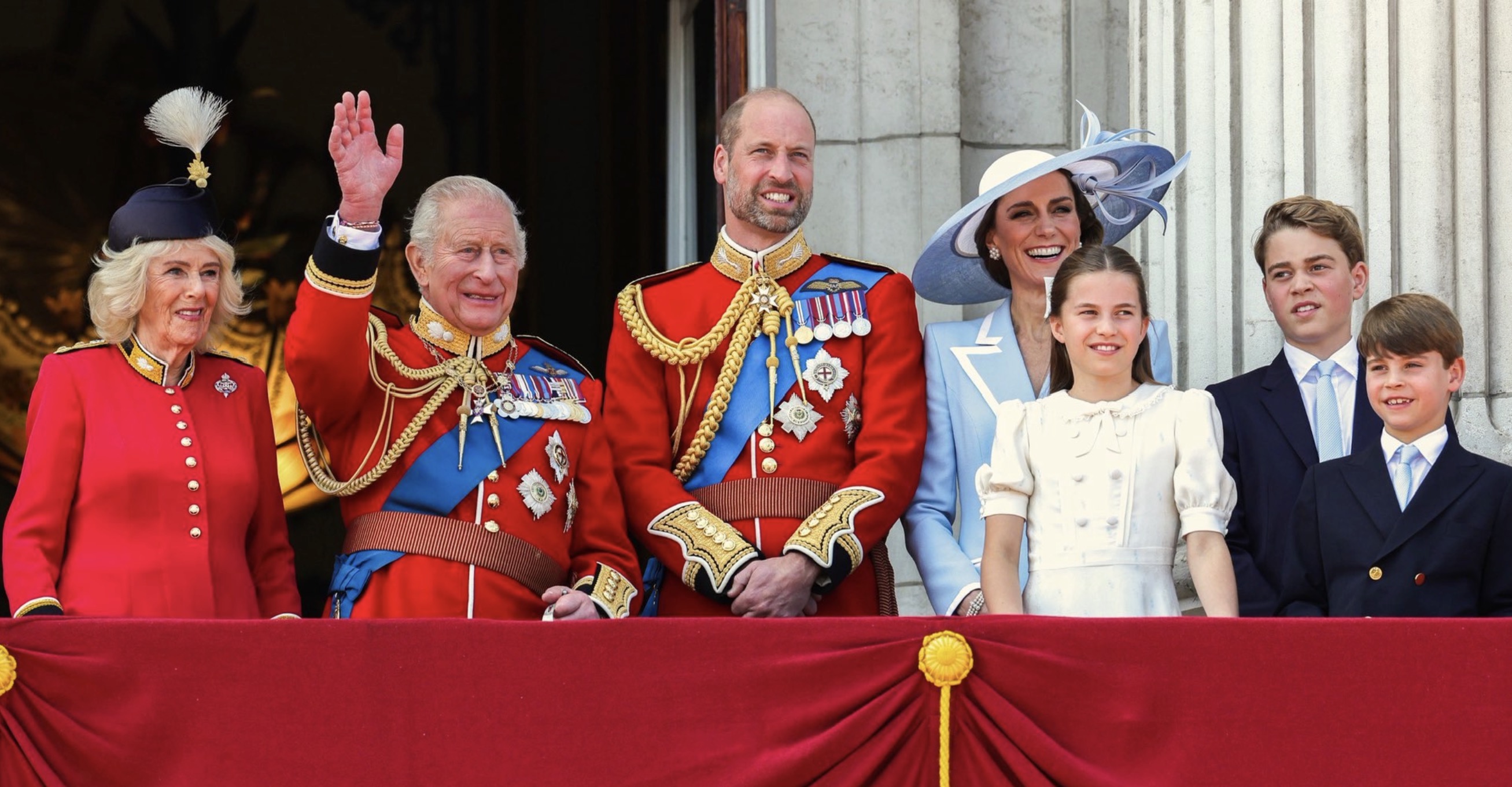
The day ended the way it always does: the family back on the Buckingham Palace balcony, faces tilted up as the flypast crossed the sky, the national anthem, then the dispersal. Nothing was announced, nothing was decided. That is the point of a ceremony whose job is to insist that some things, this year as every year, simply carry on.