Trump vs. His Own Candidates on Data Centers: Follow the Power Bills
PJM's market monitor ties $29.4 billion in capacity costs to data centers, and several battlegrounds on its grid saw some of this year's sharpest home power price increases. No candidate's fix touches costs locked in through May 2028.
From January through July, the average price of home electricity in Ohio ran 13.0% higher than in the same months of 2025. In Georgia, it rose 4.5%. Ohio is also where a Republican Senate committee memo calls data centers "the anchor hanging around Husted's neck."
That gap sits under a split three weeks before the Tuesday, Nov. 3 midterms. President Donald Trump keeps defending the AI data centers rising across the country. A growing number of his party's nominees are campaigning against them, and campaigns have spent more than $45 million on ads mentioning data centers since January, according to AdImpact data analyzed by NPR. Most coverage treats the backlash as a mood. The federal government's own price figures suggest it is also a map.
Where battleground bills rose fastest
The Energy Information Administration's state price data, released Sept. 24, show the average residential price up 13.6% in Maryland and 13.1% in Virginia for January through July, compared with a year earlier. Ohio rose 13.0% and Pennsylvania 12.5%. The national average rose 6.9%, about half Ohio's pace, while Texas, Georgia and Nevada stayed between 2.6% and 5.7%.
Every state on that chart with an increase of 12.5% or more sits on the PJM Interconnection, the grid operator that coordinates wholesale electricity "in all or parts of" 13 states and the District of Columbia. Michigan, at 8.8%, is on that list too. So is New Jersey, where prices rose a slower 8.7%, but from the highest starting point in this group.
For every 1,000 kilowatt-hours a household uses (a round number for illustration, not an average home), this year's increase adds $25.50 in Maryland and $21.50 in Ohio. Pennsylvania's adds $23.40. In Nevada, it is $3.40.
Retail prices move for several reasons, and the EIA table does not apportion blame. What sets the PJM states apart is one specific cost that their grid's own watchdog has traced to data centers.
A grid auction voters never see
PJM runs capacity auctions, which pay power plants to be ready to run in a future year: insurance against shortages, with the premium passed to customers as the capacity charge on an electric bill. When demand forecasts jump, so does the premium.
Capacity prices went "from $29 per megawatt-day to the statutory cap of around $330 in just a few years," Heatmap reported in March. The 2028/2029 auction, announced Tuesday, July 14, cleared at the $325 cap, the third straight at the ceiling, and still came in 6,831 megawatts short of PJM's reliability requirement. Without the price collar, PJM estimated $554.72.
How much of that is data centers? PJM's independent market monitor, Monitoring Analytics, answered in its 2026 first-half report, as Utility Dive reported on Aug. 27. Over the last four capacity auctions, existing and forecast data center load "resulted in a combined total increase in capacity market revenues of $29.4 billion."
That figure is new. In March, the monitor's estimate stood at $23.1 billion over three auctions; with a fourth auction included, the estimate has grown by $6.3 billion. Through July, data center load made up 9% of PJM's wholesale power price, or $10.48 per megawatt-hour, and that counts capacity alone, not energy or transmission. In its March annual report, the monitor put the timing plainly:
"Large data center load additions have already had a significant and irreversible impact that will be paid through May of 2028 and will have additional significant impacts on other customers as a result of higher transmission costs, higher energy market prices and higher capacity market prices."
Monitoring Analytics, PJM's independent market monitor
So the honest version of the map is this: several of the fastest home price increases this year are in PJM states, where the grid's own monitor ties billions in capacity costs to data center demand. That is not the whole bill. It is the part voters can be told, accurately, they are paying on someone else's behalf. The monitor's preferred cure is for data centers to bring their own new generation, or face curtailment when the grid is stressed.
Trump holds, his nominees break
Trump has not moved. At a rally in a school gym in Vandalia, Ohio, on Saturday, Oct. 3, he pitched the facilities as an economic prize:
"Look, there's so much money to be made for Ohio. You can't just turn them off. They'll go to China."
President Donald Trump, Vandalia, Ohio
The Associated Press reported the crowd was "far more muted during the data centers remark." In a Truth Social post reported Aug. 31, Trump wrote that "the only reason that communities throughout the U.S.A. should not want Data Centers is if they want to end up being backwards and poor."
His candidates are moving the other way. In Michigan, Senate nominee Mike Rogers backed a one-year ban on data center construction in August. "I think we need to take a pause, probably, and make sure that we're answering all the questions that people have on them," he said. Ohio governor nominee Vivek Ramaswamy promised to "issue an executive order on my first day in office to immediately halt the approval of any new data center project announcements in Ohio." In Texas, Gov. Greg Abbott paused environmental permits and grid connections for new data centers while facing Democrat Gina Hinojosa in a close race.
Geography explains the urgency. Cleanview Research data cited by CBS show 68% of operating data centers were in red states by 2025, and 80% of those now in planning are in predominantly Republican states. The backlash lands in Republican territory because the buildings do.
Ohio's Senate race is where it bites. Sen. Jon Husted, appointed to the seat JD Vance vacated, has been branded by Democrat Sherrod Brown as "the face of data centers." NRSC chair Sen. Tim Scott calls it "right at a dead-even race" and draws a line: "You got to remember, Sherrod Brown was for data centers, and Jon Husted is for data centers being responsible." A New York Times/Siena poll, cited by CBS, found voters favor Brown by 11 points on the issue.
Two parties, nearly one promise
Line the proposals up and the partisan divide nearly disappears. Almost everyone says data centers should pay their own way. The differences are in mechanism: a mandate or a suggestion, a moratorium or local control.
| Race | Republican | Democrat |
|---|---|---|
| Ohio governor | Vivek Ramaswamy: day-one order halting approvals until an "Ohioans-First" law requires free electricity for nearby residents | Amy Acton: "conditional moratorium" requiring companies to pay all utility costs and build on industrial sites |
| Ohio Senate | Jon Husted: Ratepayer Protection Act; further decisions to local leaders | Sherrod Brown: centers pay for their own energy and meet strict environmental standards |
| Michigan Senate | Mike Rogers: one-year construction ban | Abdul El-Sayed: no ban; strict federal "terms of engagement" |
| Texas | Gov. Greg Abbott paused permits; Senate nominee Ken Paxton would end the sales tax break | Senate nominee James Talarico: Washington should step in |
| Georgia governor | Rick Jackson: leave it to local officials | Keisha Lance Bottoms: temporary moratorium |
Neither Ohio nominee backs an outright ban. Democratic governors are acting on their own. On Tuesday, Aug. 18, Pennsylvania Gov. Josh Shapiro said projects would lose permit priority and their tax exemption unless they meet standards; Stateline reports both he and Republican Stacy Garrity have "distanced themselves from their previous support for data centers." Maryland Gov. Wes Moore signed an order creating an accountability task force and said he will work to repeal the data center sales and use tax exemption.
"It's such a consensus issue it's really impossible to take the other side," said Chris Millay, a data center analyst at Greenmantle.
The fix that stalled at 57 votes
The federal answer was the Ratepayer Protection Act, sponsored in the Senate by Husted after it passed the House in September. On Wednesday, Sept. 30, Senate Democrats blocked it, 57–43, with four Democrats voting with Republicans. The bill requires state regulators to "consider" a federal standard making data centers cover their grid costs. It does not require them to adopt it.
That verb is the fight. "This bill is the only game in town," Husted said. Senate Minority Leader Chuck Schumer countered: "Here we need some real action on data centers and what does the Republican senator from Ohio come up with? Something that is optional."
Washington's reach is limited anyway. On Thursday, June 18, the Federal Energy Regulatory Commission ordered PJM and five other grid operators to show safeguards against data center cost shifting, or create them. Texas's grid, outside federal jurisdiction, was not included. FERC sets wholesale rules; retail rates are set by state regulators. That helps explain why governor's races carry about $32 million of the $45 million in data center ads, according to NPR's analysis of AdImpact data.
Georgia shows where the map runs out. Its governor's race led all contests at $12.8 million, yet its price rise was a modest 4.5%. Six of its nine data center ads targeted Burt Jones in the GOP primary over alleged corruption, NPR found, and Republican nominee Rick Jackson pitches data centers as a property-tax windfall, CBS reported.
Voters are not waiting for Washington. A Bowling Green State University poll of 1,000 likely Ohio voters found 78% favor a temporary moratorium. A UMBC poll found 80% of likely Maryland voters expect a mostly negative effect on household electricity costs. Even in Nevada, where prices barely moved, Emerson College found "nearly 59%" opposed building near their communities: the map explains intensity, not the whole mood.
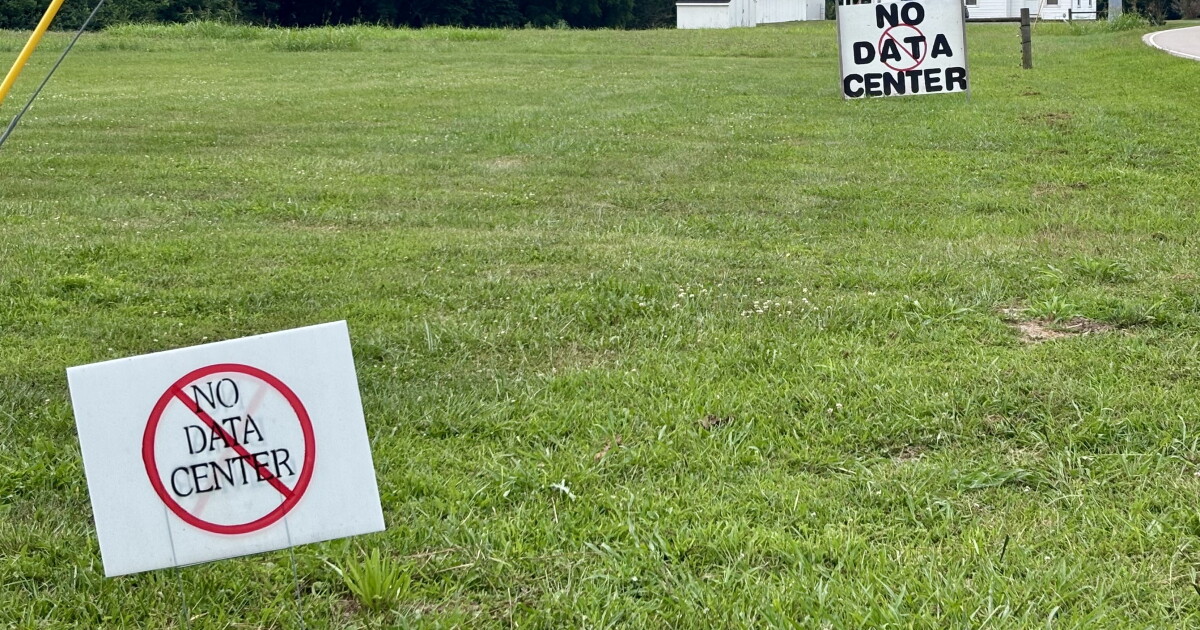
In St. Bernard, Ohio, Danielle Mitsch fears a data center that could go into an old factory near her house will push her bill higher. "I have no savings. I work two jobs and I'm in school full time. I already cannot afford my electric bill," she told WVXU. In Trenton, "No data center" signs stand along Woodsdale Road near Prologis's planned Project Mila site. Ohio municipalities will vote on 21 data center measures this fall, Stateline reports.
The industry's best case deserves a hearing. "(Voters) want the jobs in their communities, they want the revenue, but they want the risks and downsides mitigated and addressed," said Josh Vlasto, co-leader of the pro-AI super PAC Leading the Future. In Georgia, Effingham County, where OpenAI plans a $20 billion data center, has pledged some of that revenue to cut homeowners' property taxes. Vice President JD Vance argues data centers that put "power back into the grid" are not that controversial, and that "99% of the backlash to data centers has come in areas where building a data center means higher utility and higher electricity (prices) for the people on the ground."
Read closely, Vance's argument concedes the map. Every proposal on the ballot, from moratoriums to ending tax breaks, applies to future projects and future auctions. None reaches capacity costs already scheduled. Whoever wins on Nov. 3, those charges keep arriving through two more winters.
EIA publishes its next state price update on Oct. 23, 11 days before Election Day. Whatever it shows, no vote that day can unwind a bill the monitor says runs through May of 2028.