Stanford Drug Regrows Knee Cartilage in Mice by Blocking an Aging Protein
Blocking the enzyme 15-PGDH regrew hyaline cartilage in old mice and stalled arthritis after ACL-type injuries. Human tissue responded too — but this is still a mouse study.
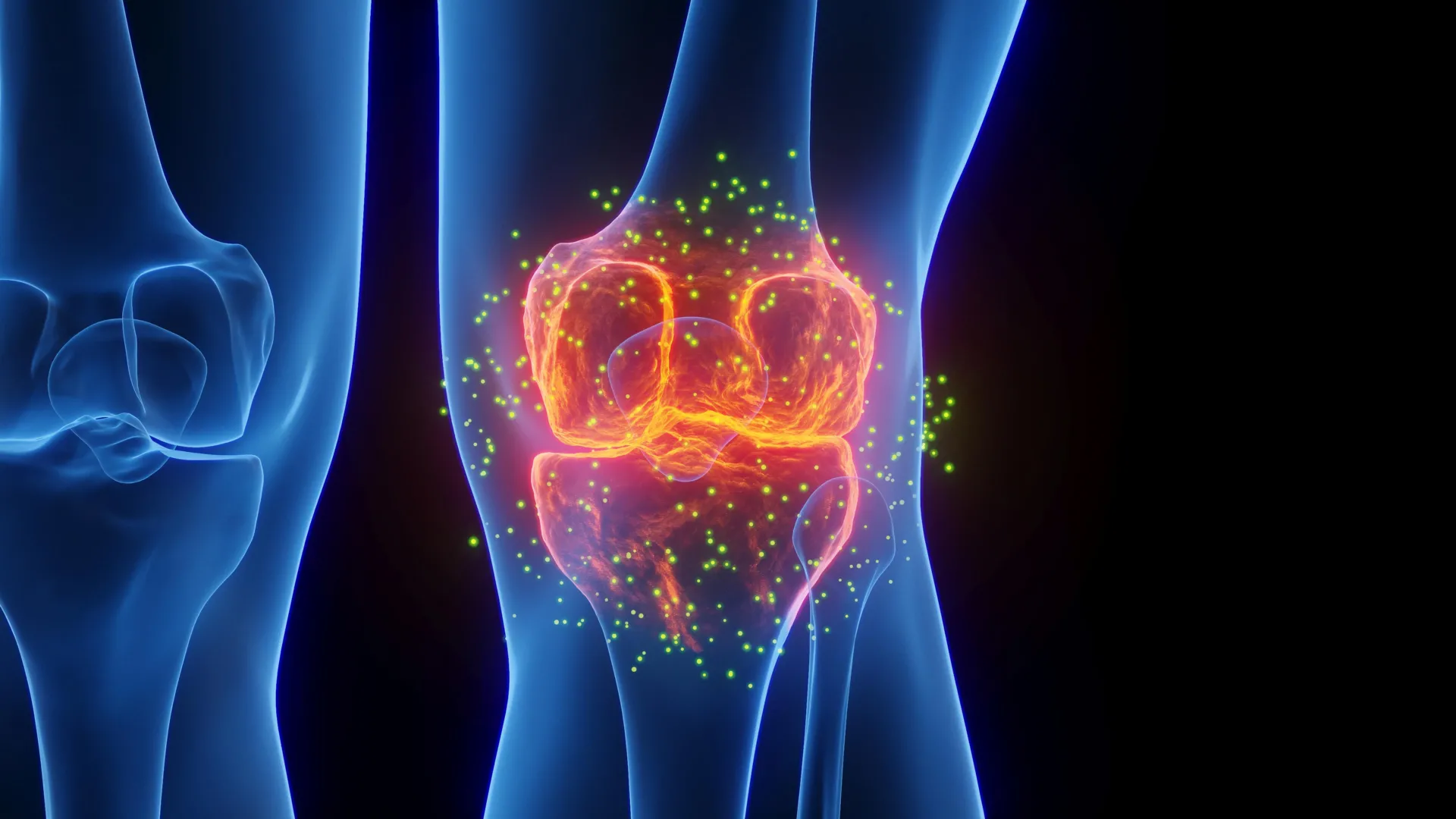
In old mice, a twice-weekly injection did something cartilage is not supposed to do on its own: it grew back. Thicker, across the joint surface, and of the slippery hyaline type that lets a knee bend without grinding — not the inferior scar-like fibrocartilage that usually fills in.
That result, reported by a Stanford Medicine–led team in the journal Science on June 12, is the strongest claim yet that the cartilage loss behind osteoarthritis might be reversed rather than just managed. The work targets a protein called 15-PGDH, which the researchers classify as a "gerozyme" — an enzyme that grows more abundant with age and drags down tissue function across the body, part of a wider hunt for drugs that act on the biology of aging. When they blocked it with a small-molecule drug, aging joints rebuilt themselves.
The mechanism is the genuinely surprising part, and it is worth slowing down on. Most tissue regeneration runs through stem cells that multiply into new specialized cells. Cartilage didn't. Instead, the resident cartilage cells — chondrocytes — appear to have shifted their own gene activity back toward a younger program.
"This is a new way of regenerating adult tissue, and it has significant clinical promise for treating arthritis due to aging or injury. We were looking for stem cells, but they are clearly not involved. It's very exciting."
Helen Blau, PhD, professor of microbiology and immunology at Stanford and a senior author of the study
The numbers behind that shift are concrete. In treated mouse cartilage, a group of chondrocytes producing 15-PGDH and cartilage-degrading genes dropped from 8% of cells to 3%. A fibrocartilage-linked group fell from 16% to 8%. Meanwhile, cells building healthy hyaline cartilage and its supporting matrix climbed from 22% to 42%. A second experiment used a mouse model of an ACL-type tear — the pivoting injury common in soccer, basketball, and skiing, after which roughly half of people develop arthritis within about 15 years. Mice given the inhibitor for four weeks after injury were far less likely to develop osteoarthritis; untreated animals showed 15-PGDH levels about twice as high and developed it within four weeks.
Here is where the engineer's skepticism earns its keep. This is overwhelmingly a mouse study. The disease it targets is enormous — osteoarthritis affects about one in five U.S. adults and drives an estimated $65 billion in direct health-care costs a year, with no approved drug that slows the underlying breakdown — which is exactly the kind of unmet need that makes a flashy preclinical result travel faster than its evidence. "Breakthrough," the word in most headlines, is doing more lifting than a single Science paper can bear.
What keeps this above the usual mouse-cure noise is the human tissue. Cartilage taken from people during knee-replacement surgery, then exposed to the 15-PGDH inhibitor for a week, showed fewer cartilage-degrading cells, lower activity of breakdown genes, and the early generation of new articular cartilage. It is a dish, not a patient — but it is human cells responding the way the mouse cells did.
There is also a real path to people already moving. An oral 15-PGDH inhibitor is in clinical trials for age-related muscle weakness, and co-author Helen Blau said Phase 1 results have shown it to be safe and active in healthy volunteers.
That lowers one barrier — basic human safety of the drug class — even though no trial has yet tested it for cartilage.
Two caveats belong on the record. The team first described gerozymes in 2023 and has linked 15-PGDH to muscle, nerve, bone, and blood regeneration, so the protein's reach is broad and not fully mapped; blocking a master regulator everywhere is not the same as fixing one joint. And several authors, Blau included, are inventors on Stanford patent applications licensed to Epirium Bio, where Blau is a co-founder and holds equity. None of that makes the data wrong. It is the context a reader deserves before "regrow your own cartilage" hardens into something it hasn't yet earned.
Nidhi Bhutani, the orthopedic surgeon who co-led the work, was candid about being caught off guard by how much cartilage came back: Cartilage regeneration to such an extent in aged mice took us by surprise. The effect was remarkable.
The honest version of the finding is that a stubborn assumption — that articular cartilage essentially cannot repair itself — just took a serious hit in mice and a hint of one in human tissue. The leap from there to an injection that spares a knee replacement is the experiment nobody has run.