Webb Tells Dawn From Dusk on Scorching Planet WASP-121b
On a tidally locked gas giant, Webb told dawn from dusk, finding the evening edge hotter and the air chemistry different across the planet's two faces.
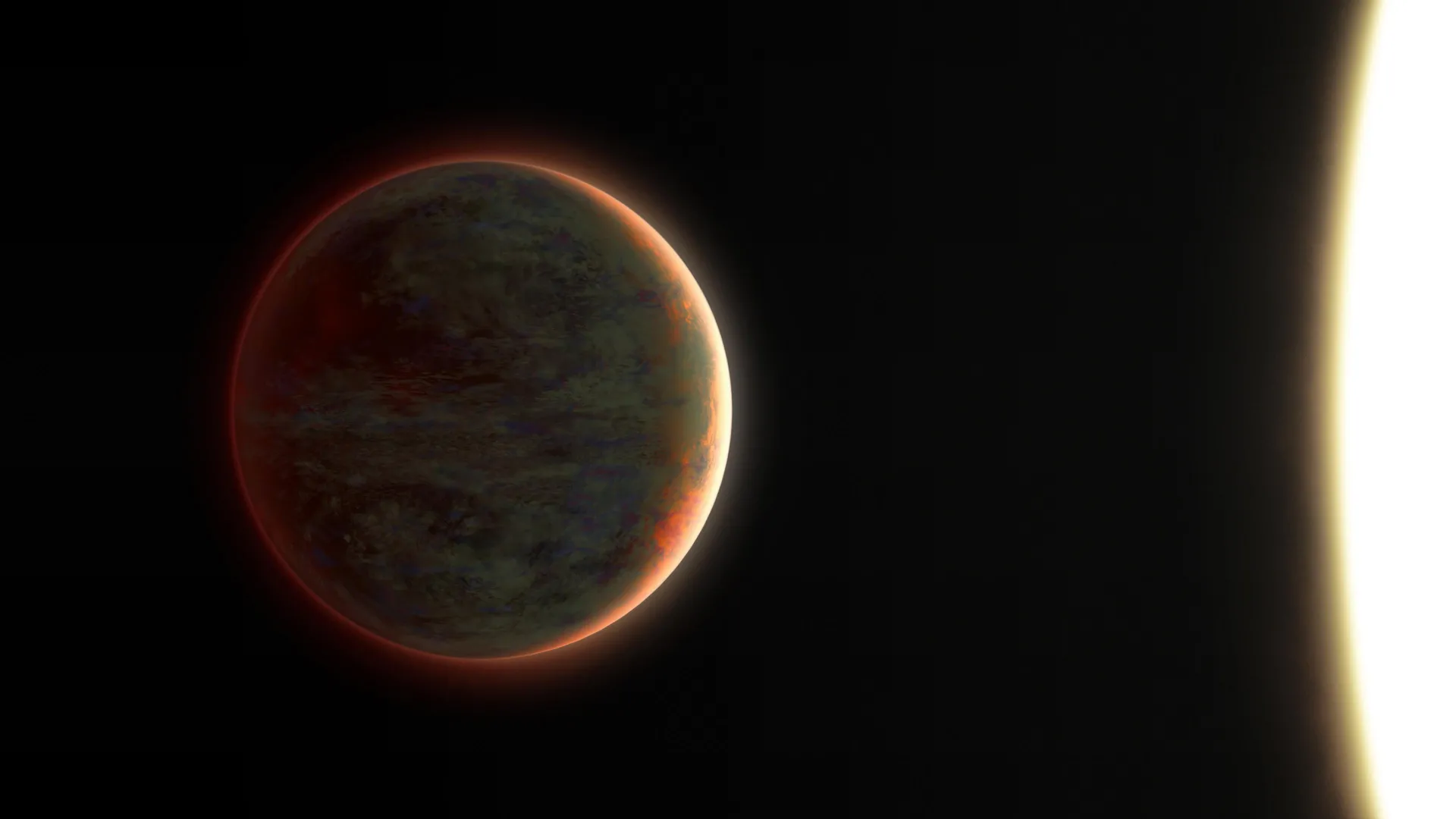
On WASP-121b, a gas giant so hot that its mornings and evenings are different worlds, the James Webb Space Telescope has done something delicate: it told the planet’s dawn apart from its dusk.
Astronomers led by Cyril Gapp of the Max Planck Institute for Astronomy report that the two edges of this ultra-hot Jupiter, the thin boundary zones where permanent day meets permanent night, hold measurably different temperatures and chemistry. The work, published in Nature Astronomy, confirms with hard data what atmospheric models had only predicted.
The trick is timing. WASP-121b is tidally locked, one face roasting under its star forever and the other in permanent dark, and as it crosses in front of that star it turns by about 30 degrees. Webb watched starlight filter through the atmosphere during the crossing and let the signal shift as the planet rotated, in effect reading the air longitude by longitude. “By measuring how star light absorption changes as WASP-121 b rotates, we probe its atmosphere longitude by longitude,” Gapp said.
The evening edge absorbed more light than the morning edge, the signature of a hotter, more puffed-up atmosphere. Strong eastward winds, the team says, drag heat off the dayside and pile it onto the evening side. Webb’s NIRSpec instrument also caught water thinning out in the hottest regions, where temperatures run high enough to tear the molecules apart, and a carbon monoxide signal that strengthens with heat rather than with any real change in how much gas is there.
The extremes are hard to picture. “WASP-121b is particularly extreme, with average temperatures on the dayside hemisphere being around 2770 Kelvin, while those on the nightside are closer to about 1000 Kelvin,” said co-author Tom Evans-Soma of the University of Newcastle in Australia. That is roughly 2,500 degrees Celsius on the lit face and about 725 on the dark one, hot enough on the day side to vaporize rock.
One thing does not fit. The measured asymmetry was stronger than the models could reproduce, a gap that hints at something the simulations leave out, most likely clouds, though not the watery kind. On the cooler morning side there may be clouds of minerals such as silicates, blocking infrared light from below and making the region read colder than it is. When the team approximated that effect, the models lined up better, but the researchers stop short of calling the clouds confirmed.
The bigger prize is the method. By letting a transiting planet’s own rotation smear its atmosphere across time, astronomers can now sketch the three-dimensional weather of worlds they will never visit, and the team has already lined up other ultra-hot giants to read the same way. Webb is a joint project of NASA, ESA and the Canadian Space Agency.