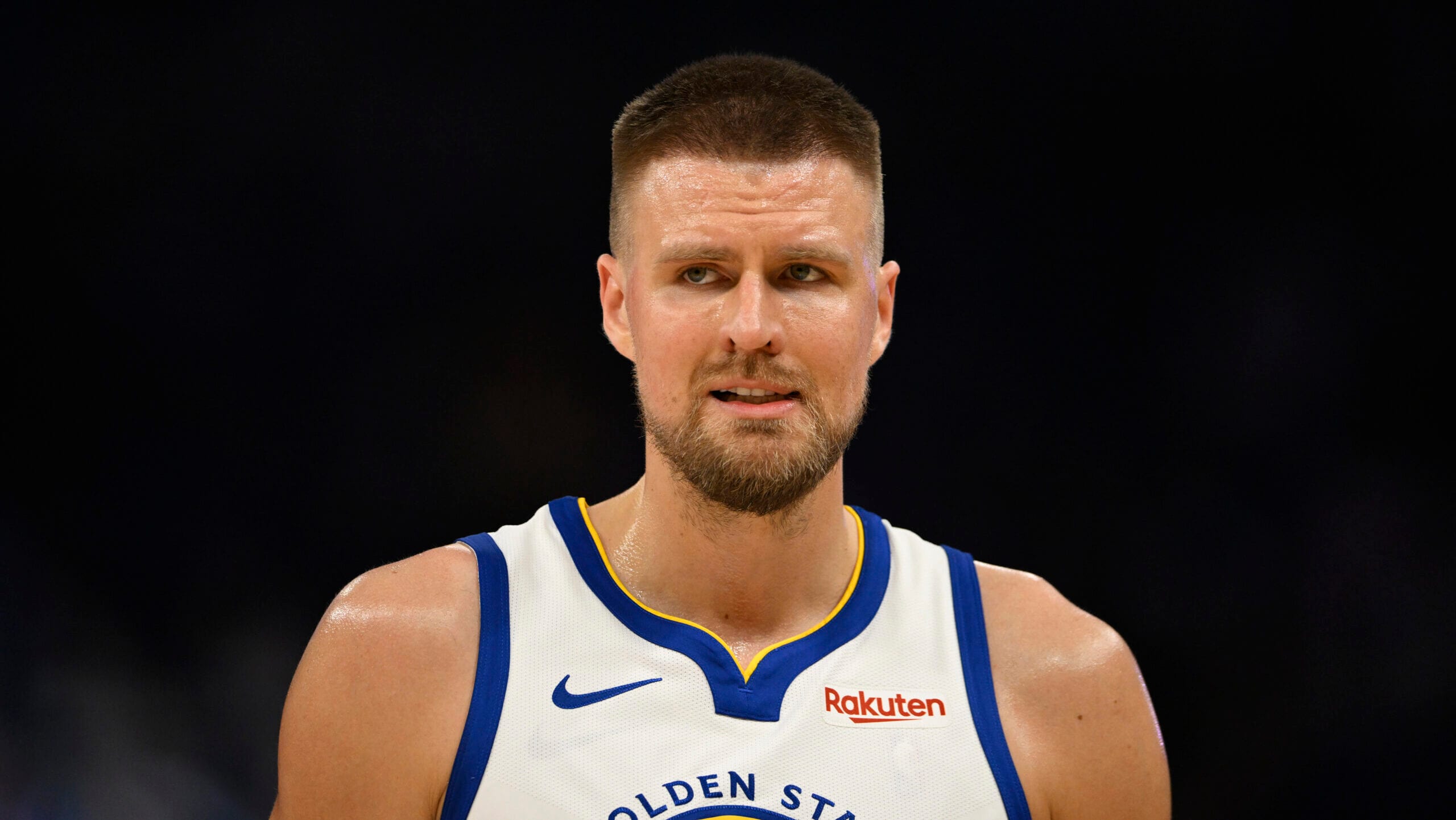
Porzingis Stepped Away, and His $20M Still Counts on Golden State's Cap
Kristaps Porziņģis did not retire, and the Warriors' $20 million cap figure did not move. What the labor agreement says about pay, the cap and the four exits and which ones actually move the number.
The post is a praying-hands emoji and a picture link. Everything Kristaps Porziņģis had to say sat inside the attached image, and the word "retire" is not in it.
— Kristaps Porzingis (@kporzee) November 6, 2026
What he did write, on Friday, Nov. 6, at about 1:11 p.m. Pacific, was that he wanted to "work with them to find a solution that makes sense." Them is the Golden State Warriors.
Stepping away is not a retirement, and it does not touch the $20 million the Warriors carry for him on the salary cap. What it can set in motion, under Article VI of the NBA's collective bargaining agreement, is a deduction of $218,341 for each game he misses.
A step away is not a retirement
"At this point, I've made the decision to prioritize my health and step away from the game I love. In this situation, I want to show the utmost respect for the Golden State Warriors and work with them to find a solution that makes sense."
Kristaps Porziņģis, Warriors center
Around them he wrote I'm doing good, but I know what it takes, and I'm not where I want to be
to perform. The San Francisco Chronicle reported that he told The Athletic in 2025 he had been diagnosed with postural orthostatic tachycardia syndrome, and that he has not publicly confirmed whether his current health issues are related. He has not said what the issue is.
Retirement is a separate matter. The Chronicle: "This was not a retirement announcement, as multiple sources with knowledge of Porzingis' thinking told the Chronicle." The AP said he "didn't make it clear as to whether he'll resume playing." He is 31, on his sixth team in 11 seasons, and under contract.
The distinction has teeth. The San Francisco Standard says a player who officially retires under contract forfeits his salary while the contract still counts against the team's cap, a claim not independently confirmed in the CBA text. Porziņģis has not taken that step, so something else governs his pay.
What the agreement lets a team take
ESPN's Shams Charania and Anthony Slater reported this week that the Warriors were not delivering the semimonthly payments on his $20 million salary and were pursuing a trade. ESPN reported Porziņģis was not actively disputing it, and the union had no plans to. "Withholding" is the headline word; Article VI calls it a reduction. Article VI, Section 1(a)(i) applies it when a player "fails or refuses, without proper and reasonable cause or excuse, to render the services required by a Player Contract or this Agreement," his
"Current Base Compensation ... shall be reduced by 1/91.6th of the player's Base Compensation for each missed Exhibition, Regular Season, Play-In, or playoff game."
NBA/NBPA Collective Bargaining Agreement, Article VI, Section 1(a)(i)
Divide $20 million by 91.6 and you get $218,341 a game, rounded.
Failure to render services is costing Kristaps Porzingis $218,341 (1/91.6 per game).
— Bobby Marks (@BobbyMarks42) November 4, 2026
His $20M salary continues to count against the cap/tax/apron.
The Chronicle's "roughly $219,780 for each game missed" divides by 91; the agreement says 91.6, so that figure runs $1,439.61 high a game.
The Warriors have played nine games since opening night, Wednesday, Oct. 21, going 6-3. If the formula applied to each, the total would be $1,965,069, or 9.83% of his pay: roughly a tenth of the year, on paper. Nobody has reported whether the team is deducting game by game, holding whole $833,333.33 installments or using escrow. The agreement does not say whether the team holds the money back in the interim; it does say that, if he files a grievance that meets Article XXXI, Section 14, the withheld amount goes into an interest-bearing account pending the result. Its text counts missed exhibition, play-in and playoff games too, so 82 is no ceiling.
Whether the deduction holds depends on one phrase: "proper and reasonable cause or excuse." That is a judgment, not arithmetic. The Uniform Player Contract says nothing in its suspension paragraph "shall authorize the Team to suspend the Player solely because the Player is injured or ill," yet it obliges a player to give "prompt notice of any injury, illness, or other medical condition." Its injury-pay clause is written around injuries that result directly from playing for the team. The Chronicle reads the withholding as a sign the organization is "no longer on the same page with Porzingis." Which reading wins is not for a bystander to say.
How much explanation has flowed is clear from the coach. Asked on Tuesday, Nov. 3, whether he had been given one:
"I haven't been given one," Kerr said, "nor am I asking for one."
Steve Kerr, Warriors head coach
A grievance is possible, though not planned. A source told the Chronicle he "doesn't want to challenge right now," and the paper later reported he has told the union he isn't filing one. The Athletic said "no current plans." That is a position, not a waiver. In 2021-22 Philadelphia withheld nearly $20 million from Ben Simmons, he filed, and the settlement, per CBS Sports, "saw Simmons recoup a portion of the withheld salary." The difference, per Jake Fischer: Simmons demanded a trade, and Porziņģis has not.
The part no headline carried comes next. Article VII, Section 3(i) is titled "Player Conduct-Related Compensation Reductions":
"The computation of a player's Salary shall be made without regard to any reduction made (or to be made) to his Compensation in accordance with Article VI, Section 1 or Article XLI, Section 4(e)."
NBA/NBPA Collective Bargaining Agreement, Article VII, Section 3(i)
In plain terms, every dollar deducted still counts as his salary for cap purposes. The Chronicle wrote that it keeps "counting against the organization's cap room, even if the Warriors never pay Porzingis for his services this season."
That matters because the Warriors have no room. The San Francisco Standard put them roughly $300,000 shy of the second apron, a payroll line they are prohibited from exceeding, and $20.4 million over the luxury tax. Jingletree counted about $350,000 under it, with $56.8 million tied to Jimmy Butler, who is recovering from a torn ACL. In any trade the Warriors cannot take back more salary than they send out.
So the slot is worth more to them than the cash. The Standard noted that forfeited salary would save money, but losing a $20 million slot would be "robbing Peter to pay Paul." A trade lets them send out $20 million and take back players who can play. And only $3 million of 2027-28 is guaranteed on the two-year, $40 million contract the Warriors gave him this summer (Hoops Rumors calls the rest a player option), so he is an expiring deal in practice. One personnel source told the Chronicle the price would be "at minimum one (first-round pick) but likely would need more." Slater wrote on X that the announcement "doesn't change his status/situation with the Warriors as a usable trade chip leading up to deadline, per source."
Timing is murky. Jingletree says the market for re-signed players does not truly open until Dec. 15, though Porziņģis "is not under any trade restriction himself." Hoops Rumors cites Jake Fischer that the Warriors want a deal by Dec. 16.
Four exits, and what each does to the books
Four moves touch the books: trade, waiver, official retirement and medical exclusion, all laid out in the San Francisco Standard's rundown of the Warriors' levers. Only two take the number off, and each carries a price and a date.
| Move | What it does to his pay | What it does to the Warriors' cap | The clock |
|---|---|---|---|
| Stay as is (stepped away, under contract) | Per-game reductions of $218,341 while the Warriors judge he is not rendering services; a grievance stays possible | His full $20 million still counts (CBA Art. VII, s3(i)) | Team sources say they will not void it |
| Trade | Obligation presumably moves to the new team; sources say he would be open to a buyout afterward | The $20 million slot goes out; incoming salary cannot exceed outgoing; Warriors are roughly $300,000 to $350,000 below the second apron (per SF Standard, Jingletree) | Feb. 11, 2027 deadline; reports differ on Dec. 15 |
| Waive | Warriors remain responsible for his remaining salary (SF Standard) | Still counts in Team Salary (Art. VII, s4(a)(1)(i)); no in-season waive-and-stretch (SF Standard) | Any time; stretch deadline passed Aug. 31 |
| Official retirement | Forfeits salary (SF Standard) | Contract still counts against the cap (SF Standard) | His choice; not what he announced |
| Medical exclusion (Art. VII, s4(h)) | Contract must first be terminated by waiver | Salary comes off Team Salary only after a jointly selected physician finds a career-ending injury or illness; team barred from re-signing him | Earliest application a year after his last game (April 15, per SF Standard) |
| Disabled Player Exception | None | Lets a team sign a replacement for up to the lesser of 50% of his salary ($10 million) or the non-taxpayer mid-level; SF Standard says it likely would not help the Warriors | Apply by Jan. 15, 2027 |
A waiver frees a roster spot, not a dollar of room: Article VII, Section 4(a)(1)(i) counts salaries "paid or to be paid to players whose Player Contracts have been terminated pursuant to the NBA's waiver procedure."
Medical exclusion is the one route that removes salary without a trade, and it is slow by design. Section 4(h) covers a player "who suffers a career-ending injury or illness, and whose Contract is terminated by the Team in accordance with the NBA waiver procedure." A physician "selected jointly by the NBA and the Players Association" makes the call, and if granted the team "will be prohibited from re-signing or re-acquiring that player at any time." That describes a mechanism, not him, and nobody has said it applies.
The clock has two readings. The Standard says a team must wait a year after a player's last game, which for Porziņģis was April 15, making the earliest petition Thursday, April 15, 2027. The CBA text adds a second condition: a team "may not apply ... prior to the first anniversary of the date of the first Regular Season game that the player is on the Team's roster under the Contract in question." Read literally with an Oct. 21, 2026 first game, that would be Oct. 21, 2027. No outlet has said which date governs. That is the text's wording, not a ruling.
The Disabled Player Exception, open "from July 1 through January 15," would not clear his $20 million either way, and the Standard says it "likely wouldn't apply" to a team hard-capped at the second apron.
Meanwhile the games go on. The Warriors beat Miami 120-100 on Thursday, Nov. 5, with Stephen Curry scoring 29. The Chronicle wrote on Nov. 4 that "for all intents and purposes, 36-year-old Draymond Green is now the Warriors' full-time starting center." Green is 6-foot-6 and said on Oct. 26, "I'm comfortable playing the 5. Al's comfortable playing the 5." Al Horford is 40. Reserve Charles Bassey "has dealt with knee tendinitis," and two-way rookie Graham Ike "can be active with the Warriors for a maximum of 50 games this season."
Horford won the 2023-24 title with Porziņģis in Boston and had texted him weeks earlier. Asked on Nov. 4 whether he had heard that he was OK, he said: "It's something that, at this point, we have to just respect what's going on and just kinda wait for him to say what he has to say."
The Warriors host Orlando on Saturday, Nov. 7, the 10th game; the disabled-player window closes Jan. 15; the trade deadline falls Thursday, Feb. 11, 97 days after the post.