ICJ's Myanmar Judgment Nov. 19: Three Outcomes and What Each Would Order
The International Court of Justice has never held a state responsible for committing genocide. On Nov. 19 it rules on Myanmar, and the outcome turns on how the court weighs intent and evidence.
The International Court of Justice has delivered two judgments on the merits of genocide cases, and in neither did it hold a state responsible for committing genocide. The third arrives on Nov. 19.
On Thursday, Nov. 19, at 10 a.m. in The Hague, the ICJ will rule on whether Myanmar is responsible under the Genocide Convention for its 2016-2017 military operations against the Rohingya, a Muslim minority, as The Gambia alleges. Myanmar denies it and calls the operations counter-terrorism responses to attacks by the Arakan Rohingya Salvation Army (ARSA). The judgment settles a state's responsibility, not any person's guilt, and it is final.
The reading begins at 10 a.m. in The Hague, which on that date is 09:00 GMT, 4 a.m. US Eastern, 3 p.m. in Dhaka and 3:30 p.m. in Yangon. Reuters gave 8:00 GMT, so confirm the hour on the court's docket, which lists the case as "The Gambia v. Myanmar: 11 States intervening." The January hearings are archived on UN Web TV and on the court's site, and the court's site is where to check for a Nov. 19 stream.
The Gambia filed on Nov. 11, 2019, "on behalf of the 57 members of the Organisation of Islamic Cooperation," in the wording of the UN Independent Investigative Mechanism for Myanmar, under Article IX of the Genocide Convention. Human Rights Watch (HRW) says it was the first time a country with no direct connection to the alleged crimes used its Convention membership this way.
On Jan. 23, 2020, the court issued provisional measures (urgent orders that hold until judgment), telling Myanmar to "take all measures within its power" to prevent acts under the Convention. Myanmar has filed 12 reports; Gambia says they give "no reason to conclude" it complied. On July 22, 2022, the court rejected all of Myanmar's preliminary objections. Merits hearings ran from Jan. 12 to Jan. 29, 2026, in 23 sittings, four of them closed.
A test built to be hard to meet
The Convention defines genocide through "intent to destroy, in whole or in part, a national, ethnical, racial or religious group." Lawyers call this dolus specialis. In plain words: it is not enough that the acts happened or that each was deliberate. The state must have aimed, beyond each act, at destroying the group as such.
The court's own overview of its 2015 judgment in Croatia v. Serbia sets the bar. The aim "must be the physical or biological destruction of the protected group, or a substantial part of that group," and intent can be inferred from a pattern of conduct only "when this intent is the only inference that can reasonably be drawn from the acts in question."
"the ICJ has never ruled that a state itself was responsible for committing genocide, because the court has historically set the bar very high for that kind of finding."
Reed Brody, International Commission of Jurists
That bar is deliberate. Barrister Khan Khalid Adnan calls the "only reasonable inference" approach "structurally designed to make genocide findings institutionally rare."
The Croatia passage matters most here. There the court found killings and serious harm, but concluded that "the aim of the crimes committed against ethnic Croats appeared to have been the forced displacement of the majority of the Croat population in the regions concerned, not its physical or biological destruction." Displacement, in that ruling, was not destruction. More than 700,000 people fled to Bangladesh, according to HRW, so the same question sits at the center of this case.
Gambia accepts the test. It relies on the Croatia formula and argues that "the only inference that can reasonably be drawn from the facts" is intent to destroy the Rohingya, pointing to the brutality of the attacks, tolerance of hate rhetoric and a failure to investigate. Gambian Justice Minister Dawda Jallow told the court on Jan. 12 that the Rohingya "have been targeted for destruction."
Myanmar answers on the evidence. Its position, as HRW summarizes it, is that there is "no direct evidence" of genocidal intent and that UN, NGO and media material has little evidentiary value, and that the UN fact-finding reports, which Myanmar describes as the centerpiece of Gambia's case, should not be given weight.
Myanmar's agent, Ko Ko Hlaing, put the stakes in national terms on Jan. 16, 2026: A finding of genocide would place an indelible stain on my country and its people.
UN News reported that he acknowledged civilians were killed and large numbers of people fled to Bangladesh.
So the fight is over what the evidence can carry. A UN fact-finding mission concluded the 2017 offensive "included 'genocidal acts,'" which the court must weigh for itself. Gambia's counsel Paul Reichler says the reports rest on interviews with more than 1,200 people. Juliette McIntyre of the University of Adelaide says relying on them poses "a few potential problems." The judges' questions show the same concern: Judge Hmoud asked whether the intent required of a state differs from a person's, Judge Cleveland what weight NGO reports deserve, and Judge Gomes Robledo whether adverse inferences may be drawn from a refusal to admit international investigators, according to Opinio Juris authors Filipo Tarakinikini, Geert-Jan Alexander Knoops and Gregory Rose.
Those answers will travel. Reuters writes that the outcome "is likely to shape future genocide cases at the ICJ, including South Africa's 2023 case accusing Israel of committing genocide in Gaza, a charge Israel denies." The same authors add that because the court has no appellate chamber, What it decides in Myanmar will not be legally corrected; it will be cited.
Three ways it can go, and what each orders
The three outcomes below are drawn from the court's own precedents and Gambia's submissions, not a forecast. First, the clock. Computed from the court's published hearing and judgment dates:
| Case | Hearings ended | Judgment | Days | What the court held |
|---|---|---|---|---|
| Bosnia v. Serbia | May 9, 2006 | Feb. 26, 2007 | 293 | Srebrenica was genocide; Serbia not shown to have committed it, but breached its duties to prevent and to punish; no compensation; declarations of the breaches as satisfaction |
| Croatia v. Serbia | Apr. 1, 2014 | Feb. 3, 2015 | 308 | Killings and serious harm established, genocidal intent not; claim and Serbia's counter-claim both dismissed |
| Gambia v. Myanmar | Jan. 29, 2026 | Nov. 19, 2026 | 294 | Judgment due at 10 a.m. in The Hague |
The gap is close to the court's two earlier genocide merits judgments (293 and 308 days), so the date alone says little about the result.
Responsibility for committing genocide. This would be a first for the court, and it would open the door to Gambia's full package: orders to legislate, prosecute and suppress incitement, and reparations including safe and dignified return, property and "the right of the Rohingya to identify as such." Gambia's final submissions, as quoted by Verfassungsblog, add "full and equal citizenship" and trial "including before an international penal tribunal." Adnan sees both as fault-lines for the court; in his view it "cannot realistically order the creation or use of an international penal tribunal."
A breach short of committing it. The court could find a failure to prevent, a failure to punish or conspiracy. Bosnia v. Serbia is the template. In 2007 the court found the killings at Srebrenica were genocide but that the evidence "did not prove" the acts could be attributed to Serbia, which it still found had violated its duties to prevent and to punish. It refused compensation because it had not been shown the genocide "would in fact have been averted," and held a declaration was appropriate satisfaction.
Adnan's phrase for that result is monumental findings, thin repair.
The claims rejected. The court could decide that intent to destroy is not the only reasonable inference. Croatia shows this can sit beside findings that killings and harm occurred, because the court distinguished displacement from destruction. Gambia's separate claim that Myanmar ignored the 2020 order is a different question and could be decided on its own.
A court with no police
The ICJ has no means of carrying out its own judgments. Under Article 94(1) of the UN Charter, each member "undertakes to comply with the decision of the International Court of Justice in any case to which it is a party." Under Article 94(2), if a party fails to comply, the other "may have recourse to the Security Council," which may "make recommendations or decide upon measures."
Then the vote. Under Article 27(3), non-procedural decisions need nine votes "including the concurring votes of the permanent members," so any permanent member can block. HRW says the Council "has never acted upon this discretionary power." HRW adds that the General Assembly can build political support for compliance.
Two other tracks run separately. According to HRW, the International Criminal Court has investigated crimes against the Rohingya since November 2019, and judges "have yet to issue a public decision" on the prosecutor's November 2024 request for an arrest warrant for Min Aung Hlaing. (For the court's own U.S. sanctions, see Treasury's licenses cushion ICC sanctions, but the main one ends April 7.) An Argentine court issued warrants for 25 people in February 2025 under universal jurisdiction. HRW's question-and-answer document lays out both.
Myanmar has taken part at every stage, though its military rulers seized power in 2021; HRW alleges Min Aung Hlaing "installed himself as president through fraudulent elections held in December 2025 and January 2026." On Jan. 14, 2026, state media carried a Foreign Ministry statement calling the allegations "flawed and unfounded in fact and law" and saying the government is cooperating "in good faith." It never used the word Rohingya; it referred to "persons from Rakhine state." Myanmar told the court it has complied with its orders and remains committed to repatriation.
1,206,528 people, and no change of address
The people most affected will not see Nov. 19 change where they sleep. UNHCR's latest dashboard, with the Government of Bangladesh and dated Sept. 30, 2026, counts 1,206,528 Rohingya refugees in 251,635 families. Fifty-two percent are under 18.
The camps are not shrinking. The population has risen 34.2 percent since December 2018 and passed 1 million in 2023. Some 155,560 are new arrivals who fled what UNHCR calls "an upsurge in generalized violence in 2024 in Rakhine as well as targeted violence," biometrically identified but "not considered fully registered." Bangladesh's Md Kamruzzaman, head of the foreign ministry's Myanmar wing, told Kaladan Press, reported March 18, that "approximately 30,000 to 35,000 children are born annually in the Rohingya camps."
The money is moving the other way. UN News reported on June 2 that the 2026 appeal for Rohingya refugees and host communities is $710.5 million, "26 per cent lower than last year's funding request." UNHCR said conflict, persecution and insecurity in Myanmar continue to prevent the safe return of refugees.
Gambia asks for safe and dignified return as a remedy. The conditions it would depend on are another matter. Amnesty International researcher Joe Freeman said in September 2025 that northern Rakhine is "nowhere near ready for Rohingya to return safely." HRW says the Arakan Army now controls most of Rakhine State and alleges grave abuses by both it and the military against Rohingya civilians.
A judgment can declare, order and assign responsibility. It cannot, by itself, open a border or fund a ration. HRW's Maria Elena Vignoli says rights-respecting countries "need to act decisively to support them, promote justice for atrocities, and ensure their safe and voluntary return." After Nov. 19 the weight sits with states and the Security Council, not with the bench.
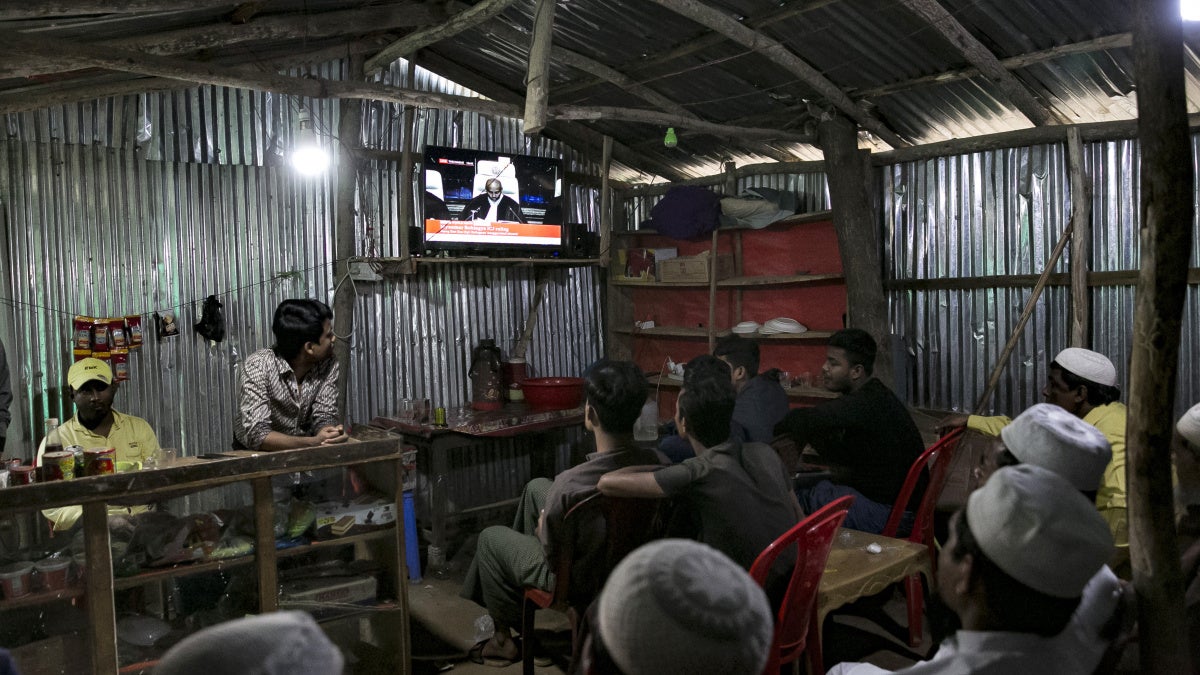
When the court first ruled in the case, on Jan. 23, 2020, men in a Cox's Bazar camp restaurant watched it on a television. Mohammad Sayed Ullah, 33, a former teacher with the United Council of Rohingya, told AFP in January he hoped the court would bring "solace." On Nov. 19 the reading starts at 10 a.m. in The Hague, 3 p.m. in Dhaka and 3:30 p.m. in Yangon.