RAP vs. IBR: What Your New Student Loan Bill Actually Costs
The federal government's new Repayment Assistance Plan went live July 1. Here's what the payment formulas actually mean for three different borrowers' monthly budgets.
A single borrower earning $50,000 a year with $40,000 in federal loans now pays $167 a month under the government's new Repayment Assistance Plan. Put that same borrower on the older Income-Based Repayment plan, and the bill jumps to $228 — a $61-a-month gap that, stretched over a year, is roughly a car payment.
That gap is the whole story of what changed on Wednesday, July 1, 2026, when the U.S. Department of Education activated the Repayment Assistance Plan, or RAP, the income-driven plan created under President Trump's Working Families Tax Cuts Act. Every current and future federal borrower now faces a genuinely narrower menu: the new Tiered Standard plan or RAP for anyone taking out a loan from here on, and a choice between RAP and the older Income-Based Repayment plan for borrowers already in the system. Anyone still parked on legacy plans like SAVE, PAYE or ICR has until July 1, 2028 to pick one of the two survivors.
How RAP actually prices your payment
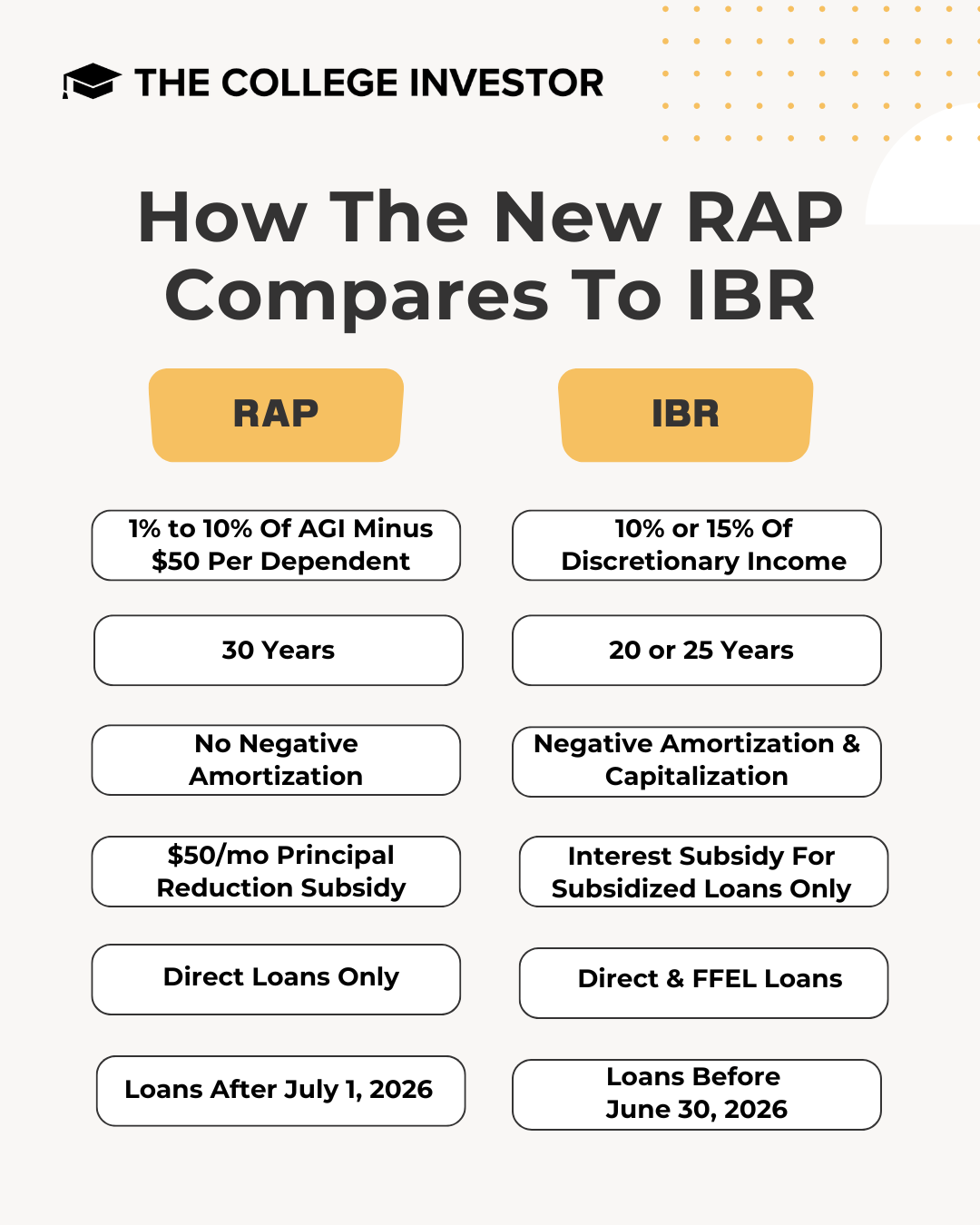
RAP throws out the old idea of shielding a slice of income before charging anything. The Department of Education puts the formula plainly: monthly payments run between 1% and 10% of a borrower's adjusted gross income, on a sliding scale tied to how much they earn, and payments can be as low as $10 a month for the lowest earners. Every dependent claimed on a tax return knocks $50 off that bill.
Two features set RAP apart from every income-driven plan that came before it. First, unpaid interest is waived each month a borrower pays on time, so the balance doesn't grow just because the bill is too small to cover the interest charge. That's the trap that let balances balloon on older income-driven plans. Second, if a borrower's payment reduces principal by less than $50, the government kicks in up to $50 itself toward the balance. Stay current, even on a $10 payment, and the loan is guaranteed to move.
The tradeoff is time. RAP forgives whatever balance is left after 30 years of qualifying payments, no matter when the loan was first taken out.
IBR still shields your first dollars, but it caps out
IBR runs on the older logic: it exempts roughly 150% of the federal poverty line for a borrower's family size before charging anything, then bills 10% or 15% of what's left, depending on when the loan originated. Borrowers with loans from before July 1, 2014 pay 15% of discretionary income and wait 25 years for forgiveness; those with loans issued after that date pay 10% and forgive at 20 years.
IBR also carries a ceiling RAP doesn't have: it can never charge more than a borrower would owe on the 10-year Standard plan. RAP has no such cap. It's the kind of hard ceiling that shows up in other corners of consumer finance, too, the same logic behind a dental plan's flat annual maximum, which doesn't move no matter how the cost of care climbs. Here, the cap works in the borrower's favor: for a high earner with a shrinking balance, IBR's ceiling can make it the cheaper plan even though RAP is the one being marketed as the affordability option.
Three borrowers, three different answers
Numbers change everything here. Consider three scenarios run against a $40,000 loan balance, calculated by The College Investor:
| Borrower | IBR payment | RAP payment |
|---|---|---|
| Single, $50,000 income, no children | $228/month | $167/month |
| Married, $100,000 income, two children | $443/month | $650/month |
| Single, $80,000 income, one child | $411/month | $417/month |
The pattern holds broadly across incomes: RAP tends to be the cheaper monthly payment for borrowers earning under about $80,000. Cross roughly $90,000 in adjusted gross income, and IBR usually becomes the lower bill, while also reaching forgiveness five to ten years sooner.
Who's actually locked into which plan
Eligibility rules do a lot of the deciding before a borrower ever opens a calculator. Anyone taking out their first federal loan on or after July 1, 2026 gets only two choices for the life of that loan: the Tiered Standard plan or RAP. IBR isn't on the table for them at all. Existing borrowers keep access to both RAP and IBR, but only until July 1, 2028, after which anyone still sitting on a legacy plan gets moved by their servicer.
The Tiered Standard plan is new too, not just a rebrand. Instead of one fixed 10-year term, it now runs 10, 15, 20 or 25 years depending on how much a borrower owes. Larger balances get longer terms and, in theory, a smaller fixed payment.
The Parent PLUS wrinkle
Parent PLUS borrowers got the roughest deal in the redesign. They are not eligible for RAP under any circumstance, consolidated or not. Their only route into an income-driven plan is IBR, and that door only stays open if the loan was consolidated onto an income-driven repayment plan by June 30, 2026. Miss that date, and a Parent PLUS borrower is stuck on the Tiered Standard plan, with no income-based option and no forgiveness clock running at all.
For parents who consolidated ahead of the deadline, the loan becomes eligible for the older Income-Contingent Repayment plan first, then IBR, before the July 1, 2028 cutoff. For parents who didn't, the fix, if there is one, is a second consolidation, and even student loan attorney Stanley Tate's own guidance calls that path narrow and easy to get wrong.
Is RAP better than IBR?
Neither plan wins across every income level. RAP tends to produce the lower monthly bill under roughly $80,000 in income and protects against a growing balance no matter how small the payment is. IBR tends to win for higher earners, for households the tax return doesn't fully capture (IBR counts a domestic partner or a parent you support; RAP counts only the dependents claimed on your 1040), and for anyone close enough to the finish line that RAP's extra years would cost more than the interest waiver saves. Run both numbers through the Education Department's own repayment calculator before deciding.
What happens to my Parent PLUS loan if I missed the deadline?
It stays on the Tiered Standard plan, with a fixed payment based on the balance and no income-driven option or forgiveness timeline attached, unless a fresh consolidation reopens the door down the line.
Does switching from IBR to RAP cost my forgiveness progress?
No. Qualifying months already earned under IBR or another income-driven plan, including credit from the one-time account adjustment, carry forward into RAP. The transfer doesn't run in reverse, though, so a borrower who later wants back into IBR can't necessarily reclaim RAP-only progress the same way.
None of this is a decision borrowers get to set and forget. Family size changes, incomes rise, and the crossover point between RAP and IBR shifts every time a dependent ages out or a raise lands. Anyone still riding a legacy plan has through July 1, 2028 before a servicer makes the choice for them — the smarter move is running the numbers now, while there's still a choice left to make.