Why Movie Credits Grew From a Single Card to a 10-Minute Scroll
From "The Graduate's" near-silent ending to "Dune's" eight-minute scroll, here's why movie credits ballooned, and why the industry keeps making them longer.
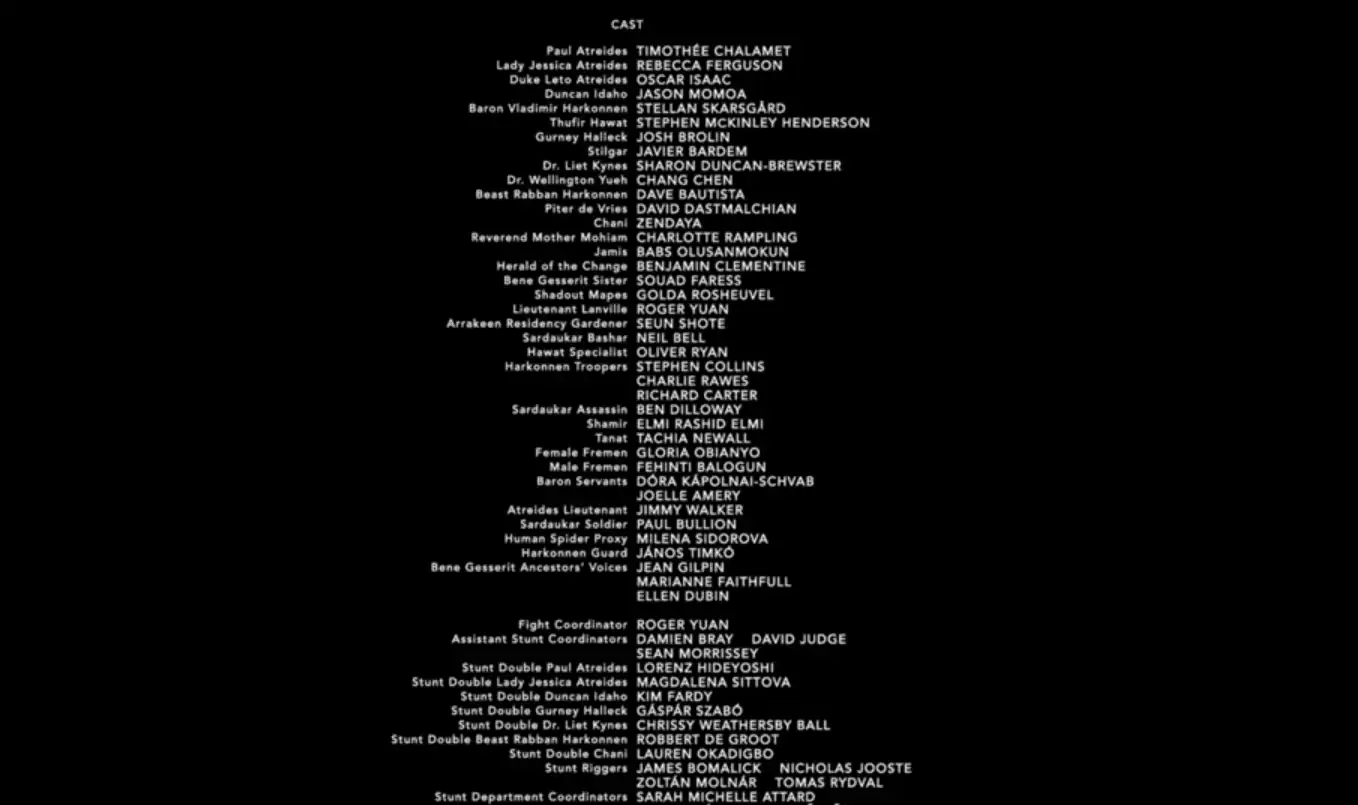
"The Graduate" ends in 1967 with barely any credits at all: a few names, then black. Fifty-some years later, 2021's "Dune" sends audiences out of the theater after nearly eight minutes of scrolling text, and plenty of modern tentpoles run longer still. Somewhere in between, Hollywood decided that finishing a movie meant naming almost everyone who ever touched it.
When did movie credits get so long?
Before the 1910s, films frequently listed no cast or crew at all, just the title, and sometimes a production company's logo tucked into a shot as an anti-piracy measure, according to Shelley Stamp, a film and digital media professor at the University of California, Santa Cruz. That changed once audiences started falling for specific performers. Fans wanted to know who "the Biograph Girl" actually was. She turned out to be the actress Florence Lawrence, and studios began naming names to feed the appetite.
Opening credits became standard through the middle of the 20th century: title card, stars, director, screenwriter, a handful of department heads. Endings stayed simple. Plenty of 1930s and '40s films still closed on nothing more than a card reading "The End." Even by the 1960s there was no consistent rule. 1963's "Cleopatra" wraps with little more than the production company's name, while the same decade's "Romeo and Juliet" and "2001: A Space Odyssey" run noticeably longer closing lists, though nowhere near what audiences sit through now.
The 1970s scroll, and the union math behind it
The real shift, according to David Bordwell's book "The Way Hollywood Tells It," landed in the 1970s, when closing credits began running several minutes. Kate Fortmueller, an entertainment and media studies professor at the University of Georgia, ties that shift to labor: guild agreements began requiring on-screen credit for a widening list of positions, right as the industry moved toward independent, freelance-driven production, meaning workers needed that public credit to land their next job.
Credit is a way to gain power within the capitalist media system,
Fortmueller told Marketplace. So any kind of gain, or any kind of larger credit, has to do with how well you or someone else negotiated for you.
By the 1980s, the modern split had settled into place: tight opening credits naming the stars and key creatives, followed by a much longer closing crawl covering everyone else.
Visual effects broke the scale entirely
Digital effects work is what pushed credits from minutes into double digits. A single VFX house can staff 300 to 400 specialists on one film for up to a year and a half, and modern blockbusters routinely farm work out to several VFX vendors at once. Data compiled by endcredits.pro puts the standard studio blockbuster at 8 to 12 minutes of credits, with VFX-heavy or animated films regularly running 10 to 15. "Avengers: Endgame" is a useful extreme: more than 2,500 individual visual-effects shots, of which only about 80 went untouched by the effects team, meaning modelers, riggers, animators, compositors and pipeline engineers touched each one of the rest.
How long are movie credits on average?
Across 440 films analyzed by the credit-production platform Endcrawl, the average sequence runs about 227 seconds, under four minutes, though that figure is pulled down by smaller productions. A typical studio feature runs 7 to 12 minutes; an indie drama with a 40-person crew might wrap in three or four. At the far edge, Sergio Leone's "Once Upon a Time in the West" and Richard Donner's "Superman" once shared the record for longest sequence at roughly 12 minutes, a mark 2016's "Assassin's Creed" later beat with nearly 15. The Argentine art film "La Flor," running more than 13 hours total, closes with an unofficial-record 37 minutes of credits, proportional, at least, to everything that came before it. Even Marvel's post-credits scenes keep pace: "Thunderbolts" holds the franchise record at 174 seconds for a single bonus scene alone.
Why the industry keeps making the list longer, not shorter
It would be easy to read the crawl as vanity or bureaucratic bloat. Fortmueller argues the opposite: shorter credits historically meant erasing labor, not simplifying it. Costume design credit, for instance, used to go only to the department head. The reality is, they weren't doing all that work,
she said. I think that what you lose when you only have one person in these credits is you don't really have a sense of who that department labor is.
That argument cuts against the culture's other instinct: to treat the crawl as dead time. Streaming platforms auto-play the next episode before the list even finishes, and most theatergoers are already in the lobby by the time the fortieth compositor's name scrolls past. The credits keep growing anyway, because for the people in them, that scroll is still the only public record they were there at all, even if, for the audience walking out, the story itself ended several minutes before the screen let on. The mismatch between the industry's math and the audience's patience shows up elsewhere in the multiplex too, from how theaters quietly manufacture your actual showtime to why the cut you get on a flight isn't the one that played in theaters.