How NASA's Wind Tunnels and the ISS Shaped the World Cup Ball
Knuckling shots aren't luck. NASA's wind tunnels and space-station experiments explain how the four-panel Trionda ball swerves through this World Cup.
A free kick dips, swerves, then wobbles unpredictably in the last few yards before goal. Players call it knuckling. Aerospace engineers call it unstable airflow across the seams of a sphere, and it turns out the people who study it most carefully do not work for a football club. They work for NASA.
As the World Cup moves into its knockout rounds this week, the space agency is running an exhibit at the FIFA Fan Festival in Houston, open free to the public through July 19, that lays out a connection most fans never think about: the same physics that governs a tumbling satellite also governs the ball at their feet. NASA spelled out the link in a feature tied to the tournament.
The starting point is the seam. Engineers at NASA's Ames Research Center in California once put Adidas' Brazuca ball, built for the 2014 World Cup, through the wind tunnels of the Fluid Mechanics Laboratory. They measured exactly where a low-spin kick stops behaving and starts knuckling, the speeds and airflow conditions at which the surface lets the ball lurch off its line. The lesson for ball makers was concrete: panel shape, seam depth and surface texture decide whether a ball curls, dips or holds true.
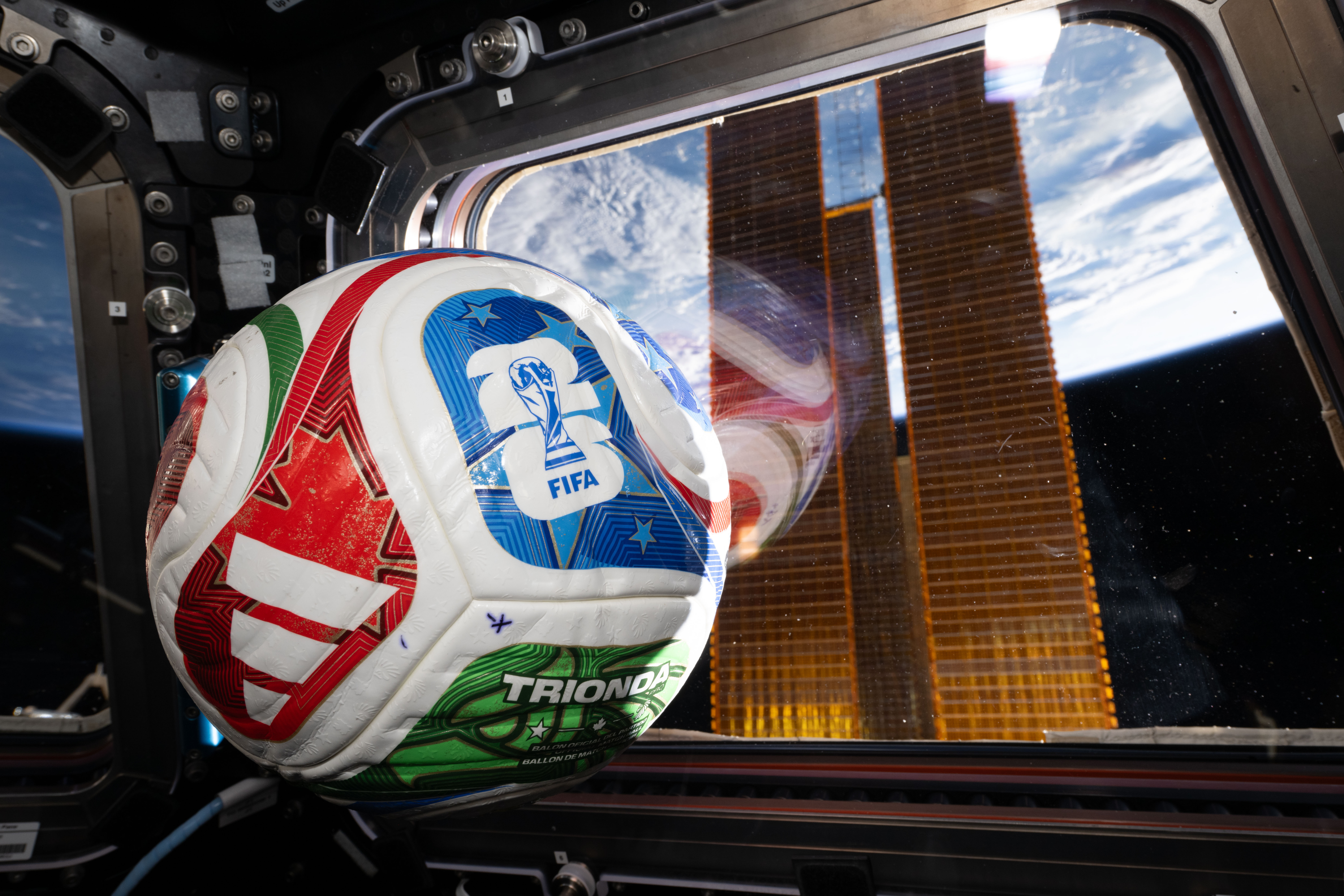
That research has a direct bearing on Trionda, the official 2026 match ball. It is built from just four panels, the fewest ever used at a World Cup, a long way from the 32-panel stitched balls that were standard for decades. Fewer seams change how air clings to and separates from the surface, which is precisely the variable those wind-tunnel runs were probing.
The other half of the story moved off the ground entirely. In a 2019 study with the ISS National Laboratory, researchers used the weightlessness aboard the International Space Station to isolate how a ball's internal mass affects its motion, stability and spin. Why bother in orbit? Because on Earth, gravity masks the subtle effects of where mass sits inside an object. Strip gravity away and the relationship between an object's center of mass and its geometric center becomes visible. That relationship is the same one engineers use to predict how spacecraft, satellites and aircraft behave.
It is not an abstract concern for modern footballs. Since 2022, Adidas has embedded electronics inside its top match balls to track speed, position and contact in real time for officiating and broadcasts. Those sensors are useful, but they also add weight at specific spots, and uneven mass can nudge how the ball flies. The space-station work helped quantify how much that embedded hardware shifts stability and rotation in real play.
None of this guarantees a particular result on the pitch, and the engineers would be the first to say so. Aerodynamics sets the stage; players still have to perform on it. But the next time a strike from distance flutters past a goalkeeper in the rounds that decide this tournament, from the veterans chasing one more run to the forwards lighting up the group stage, the wobble is not luck. It is the behavior of air over a four-panel sphere, mapped years ago in a wind tunnel built to test things meant to leave the planet.