Nikon Banned 'AI Generated' Video Without Defining the Term
Nikon disqualified the first-place Small World in Motion video over generative AI under a rule that never defines the term, 14 days after The Scientist reported it had called the same AI step compliant. Journals and Nikon's own software pages draw the line the contest did not.
"AI generated videos are not permitted and Sponsor holds the right to request the original video for verification." That is 18 words, and as of Saturday, Oct. 10 it is the sentence on the contest's official rules that speaks most directly to AI-generated video. On Friday, Oct. 9, Nikon Instruments said the first-place entry in its Small World in Motion microscopy contest broke "the competition rules regarding generative AI," and took the prize away.
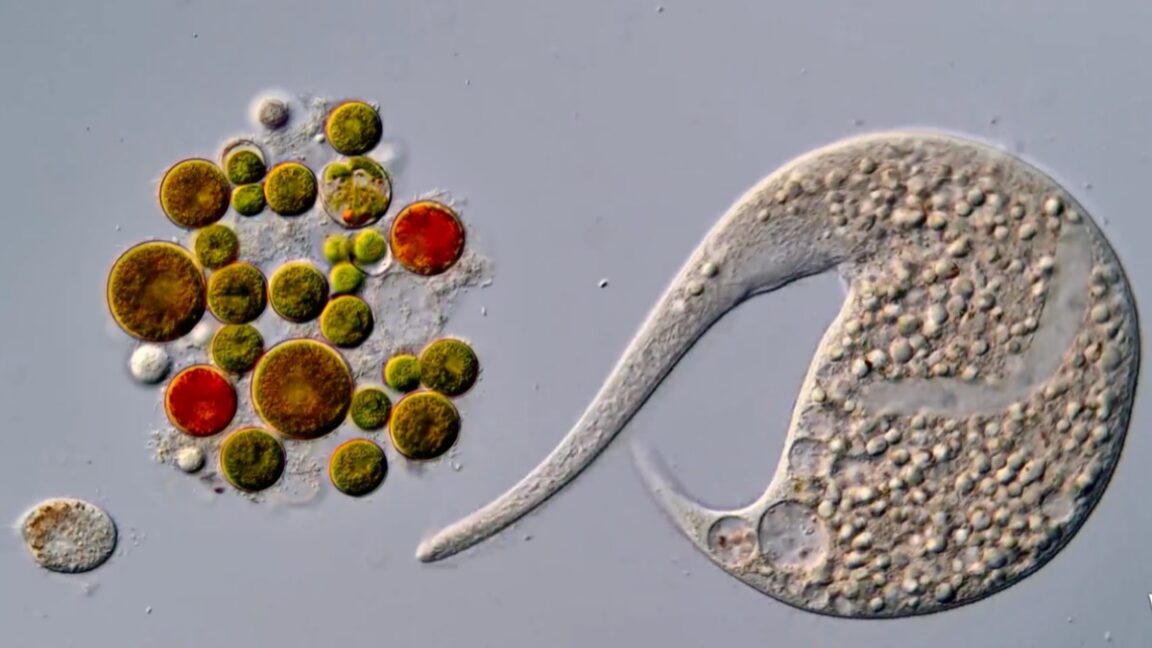
The wording in Nikon's statement is short: "After thoroughly re-evaluating the video and supporting materials and consulting with members of our judging panel, Nikon has determined that the winning video did not comply with the competition rules regarding generative AI." Nguyen Nam Nhat of Vietnam, whose clip of a tiny roundworm and a single-celled Dileptus had been second, is now first. Every other finalist moved up one place, and Dr. Igor Adameyko, an honorable mention in September, is now fifth. The field of 347 entries from 40 countries is unchanged.
The statement does not name the disqualified entrant or say what role generative AI played. He is Ning Xu, an optical engineer, and his video claimed to show cilia, the hair-like structures that line the airways and beat in coordinated waves to clear mucus. It was captioned as showing them beating abnormally in a sample from a child with primary ciliary dyskinesia (PCD), a rare genetic disorder. Nikon adds that its decision "should not be interpreted as a judgment of the entrant's professional reputation, scientific contributions, or intent."
A one-sentence rule, and a first ruling that went the other way
Read the sentence again for what it leaves out. It never says what "AI generated" means, and the page does not mention AI-assisted processing, denoising, colouring or disclosure. Elsewhere it says "Submissions generated by AI, script, macro or other automated means are void," but it offers no line between a cleaned-up recording and a made-up one. Apart from punctuation, the sentence matches the rule Tbreak, citing DPReview, reported for this year's contest.
Beside it sits the scoring: "Creativity/Originality, Informational Content, Technical Proficiency, Artistic and Visual Impact." An entrant is told to avoid AI-generated video and, in the same document, rewarded for visual impact. The entry form does ask for the make and model of the equipment and "a description of each video submitted," which is where an AI step could have been declared.
The dates marked "reported" in the table below rest on single outlets: Nature for Sept. 22, The Scientist's publication date for Sept. 25, and CNN's "on Saturday" for Sept. 26.
| Date (2026) | Day | What happened |
|---|---|---|
| Wed., Sept. 16 | 0 | Nikon announces the winners; Ning Xu's cilia video takes first |
| Tue., Sept. 22 | 6 | Nikon's blog post on the entry is updated to say an "unsupervised" AI model was used in post-processing (per Nature) |
| Fri., Sept. 25 | 9 | The Scientist reports Nikon found the AI use "in compliance" with the rules |
| Sat., Sept. 26 | 10 | Nikon says on LinkedIn that Xu is "respectfully complying" as it re-reviews the entry (per CNN) |
| Thu., Oct. 8 | 22 | Researchers and PCD groups publicize an open letter asking for the original recording |
| Fri., Oct. 9 | 23 | Nikon rules the video "did not comply" and promotes Nguyen Nam Nhat to first |
The swing that matters is the 14 days between the Sept. 25 report and the Oct. 9 ruling. A Nikon spokesperson told The Scientist: "Nikon determines this particular use of AI—as a tool for enhancement of microscopy-generated source data, not for image generation from scratch—to be in compliance with the rules set forth by the competition." The company said it found the methods "technically legitimate and consistent with established microscopy practices."
Fourteen days later, after "re-evaluating the video and supporting materials," Nikon reached the opposite conclusion about the same video. It has not said what changed. Its spokesperson told The Scientist it conducted "a thorough, additional review involving the entrant and the judges," and "We are unable to comment further on the details of those checks or discussions."
What the first ruling does show is that Nikon read its own rule as enhancement versus generation, a distinction the sentence on the page never supplies. And the entry's blog post, as updated, said the AI model was used "to distinguish and visualize features in the grayscale data, creating a more vivid and visually engaging video," a purpose that reads uncomfortably like the fourth scoring criterion.
Biologists read the biology, and a watermark was reported
Early objections came in the comments under Nikon's LinkedIn post of the video, according to CNN. Edward Phelps, a bioengineering researcher at the University of Florida, wrote that there were "many serious problems with this video," and that blue structures that look like nuclei "do not behave as nuclei." Per the Telegraph and ABC, he said cilia "appear from nowhere and do not match the known size."
Robert Hirst, lead scientist at the NHS centre for PCD diagnosis at the University of Leicester, told The Scientist on Sept. 25 that the video "created this substratum underneath the cilia which is wrong in scale, wrong in biology, and just looks completely fabricated." After the disqualification he told the BBC he "knew immediately that the video was fabricated," and gave the basis for that judgment:
"I have been diagnosing PCD for 20 years by examining their cilia waveform, length, cell size and shape."
Robert Hirst, lead scientist, NHS centre for PCD diagnosis, University of Leicester
Christophe Leterrier, a CNRS neuroscientist and former Small World jury member, made the same point from the imaging side: "You have something very nice and very engaging visually but then it's absolutely not representing a biological reality." He told the Telegraph the video showed "hallucinated substructures displaying a completely wrong size, localisation, and movement."
Then came the file. CNN reported that Ian Donovan, a PhD student at UT Southwestern Medical Center, wrote that it has "an embedded SynthID watermark identifying synthetic/AI-generated content." SynthID is a watermark pioneered by Google's DeepMind lab and since adopted by many AI firms.
A reasonable reading, and it is reasoning rather than reporting, is that a watermark shows a watermarking AI tool touched the file. It does not show how much of the picture the tool changed, and Xu has said AI was used. The biologists' objection is the sharper one, because it asks whether the structures exist at all. Gizmodo adds a caution: without a watermark, "it can be difficult or impossible to determine an image's provenance with complete certainty." Here it was a diagnostician of 20 years' standing, not a detector, who named the problem.
Xu's account deserves its full weight. He has said his team used diffractive super-resolution microscopy, a family of techniques for seeing finer detail than ordinary light microscopy allows, on a custom instrument, which The Scientist described as yielding "data in greyscale." In his words: "AI was not used to generate the experimental movie, the cilia, or their motion." And: "It was applied afterwards to the reconstructed grayscale data to distinguish and color structures with similar morphology." On LinkedIn he wrote, as Nature reported, that his team made no "anatomical claims about what those rendered features represent," and, as the Telegraph reported, that the regions beneath the cilia "were rendered mainly to improve the visual presentation."
He did not respond to Nature or Gizmodo, and CNN said it had tried to reach him; as of Saturday, Oct. 10 no response from him to the disqualification has been found. He has said a fuller description of the optics and a quantitative analysis of the ciliary motion are being prepared for publication.
Where assisted ends and generated begins
Both sides use the same vocabulary. "Post-processing," "visualization" and Nikon's own "rendition" can each describe cleaning up a recording or adding to it. A better question is what the software does to the pixels.
Nikon itself sells tools on one side of that line. Its Denoise.ai "automatically removes noise from the image," and Clarify.ai "automatically removes out-of-focus fluorescence signal from widefield fluorescence images." Convert.ai goes further and "predicts images in a given channel from patterns identified in a transmitted light channel." The same Nikon page warns: "It is important to understand that the results are not the ground truth." Even the vendor's tools produce estimates, and the vendor tells users to treat them that way.
The authors of the open letter, researchers and PCD groups posting through FocalPlane, accept that: "AI already does much of the heavy lifting in our field: denoising, segmentation, unmixing and reconstruction." Then they draw the other boundary: "generative AI now makes it remarkably easy to create compelling biological structures that no microscope ever recorded." Melanie White, a developmental biologist at the University of Queensland, supplied the principle to Nature. "Scientific images are not just illustrations," she said, and then:
"They are data, and we need to be able to trust that what we are seeing is grounded in the underlying measurement."
Melanie White, developmental biologist, University of Queensland
To The Scientist she separated using AI "to enhance information that was already present or captured" from using it "to interpret and create new information that was not initially there." Markus Sauer, who studies super-resolution microscopy at the University of Würzburg, told Nature, in its paraphrase, that visualizing experimental data with AI is not automatically a problem; it becomes one when images or videos misrepresent, exaggerate or alter findings.
Put together, those views suggest one test that fits a denoised image and a coloured one alike: does every structure on screen trace back to a signal the instrument recorded? Noise removal passes. Disclosed colouring passes, because it changes how a recorded structure looks without adding one. A layer of structures the sensor never saw does not, however well it is rendered. Nikon's review answered that question in one direction, but the public cannot check the answer, because the recording has not been released.
Journals already build on this test. Nature Portfolio's image-integrity rules accept that "a certain degree of image processing is acceptable," but "the final image must correctly represent the original data." Pseudo-colouring "must be disclosed," and editors "may request the unprocessed data files." Elsevier's policy does not permit generative AI or AI-assisted tools "to create or alter images," unless the AI is part of the research method and is "described in a reproducible manner"; authors may be asked for "pre-AI-adjusted versions." The pattern is disclosure, a reproducible method note and raw data on request. Nikon's sentence has only the last, and as a right rather than a duty.
What a contest can ask for
None of this is a demand; each option follows from policies already in view. First, use the right the rule grants. "Sponsor holds the right to request the original video for verification," and nothing stops a sponsor from exercising it for every finalist before an announcement. The open letter said three weeks on that the original recording "has still not been made available for scrutiny."
Second, pair the file with a processing description; the entry form already asks for one. Third, say in words which AI steps are allowed (noise and blur removal, segmentation, disclosed colouring) and which are not (adding structures the instrument did not record). Fourth, publish the outcome of any review and correct captions while it runs, as the letter asks. Fifth, do not lean on watermarks, since provenance can be impossible to establish without them.
The people with most at stake are not the entrants. Hirst's worry, voiced on Sept. 25, was that "PCD patients will see this video and think, 'My cilia look like this, and my cells look like this,' and they just don't, unfortunately." The letter, as ABC quotes it, says "a potentially misleading portrayal of PCD is shaping public understanding of an already poorly understood rare disease," and calls the episode unfair to "the hundreds of entrants who submitted real footage."
Contests have met AI before. Amateur Photographer recalls that the Creative Open winner of the 2023 Sony World Photography Awards was revealed as an AI construct, and that a Hasselblad Masters 2026 finalist was removed for AI use. Those were disputes about authorship. This one is about measurement, whether the thing shown was ever there, which is closer to checking machine-assisted output against a ground truth, as with OpenAI's math papers. It gets harder as plausible synthetic images get cheaper, as with Google's Nano Banana 2 Lite.
Much remains unknown. Nikon has not said what role generative AI played, what its review checked, whether the raw recording will be public, or what its revised rules will say. And an open letter to Nikon, planned for delivery on Tuesday, Oct. 13, may or may not still go out.
Nikon says it will "revisit rules and evaluation procedures." Meanwhile entries are open until April 30, 2027, 202 days from today, under a rules page that still carries the same 18 words.