Nuclear Clock vs. Atomic Clock: What Vienna and Beijing Actually Built
Two labs have made a thorium nucleus steer a laser on its own. Here is what that proves, why the "six times steadier" claim needs a footnote, and how far nuclear clocks remain from beating atomic ones.
Inside the nucleus of thorium-229, two forces measured in millions of electronvolts pull against each other and very nearly cancel. What survives is a step of about 8.4 electronvolts, small enough for a laser to reach. José R. Crespo López-Urrutia of the Max Planck Institute for Nuclear Physics in Heidelberg, who was not involved, pictured it this way: it is like placing a different oil tanker on each arm of a set of scales, and finding that their weights coincide to within one kilogram.
That leftover kilogram now steers a laser. On Wednesday, Oct. 7, 2026, Nature published two independent papers describing clocks that lock a laser to a transition inside the thorium-229 nucleus, built by a Vienna team led by Thorsten Schumm of TU Wien and Ekkehard Peik of PTB, Germany's national metrology institute, and a Beijing team led by Shiqian Ding of Tsinghua University. Neither clock beats the best atomic clocks yet. By Daybreak Wire's arithmetic, their short-term stability sits 5,000 to 30,000 times behind the state of the art.
A laser that takes orders from a nucleus
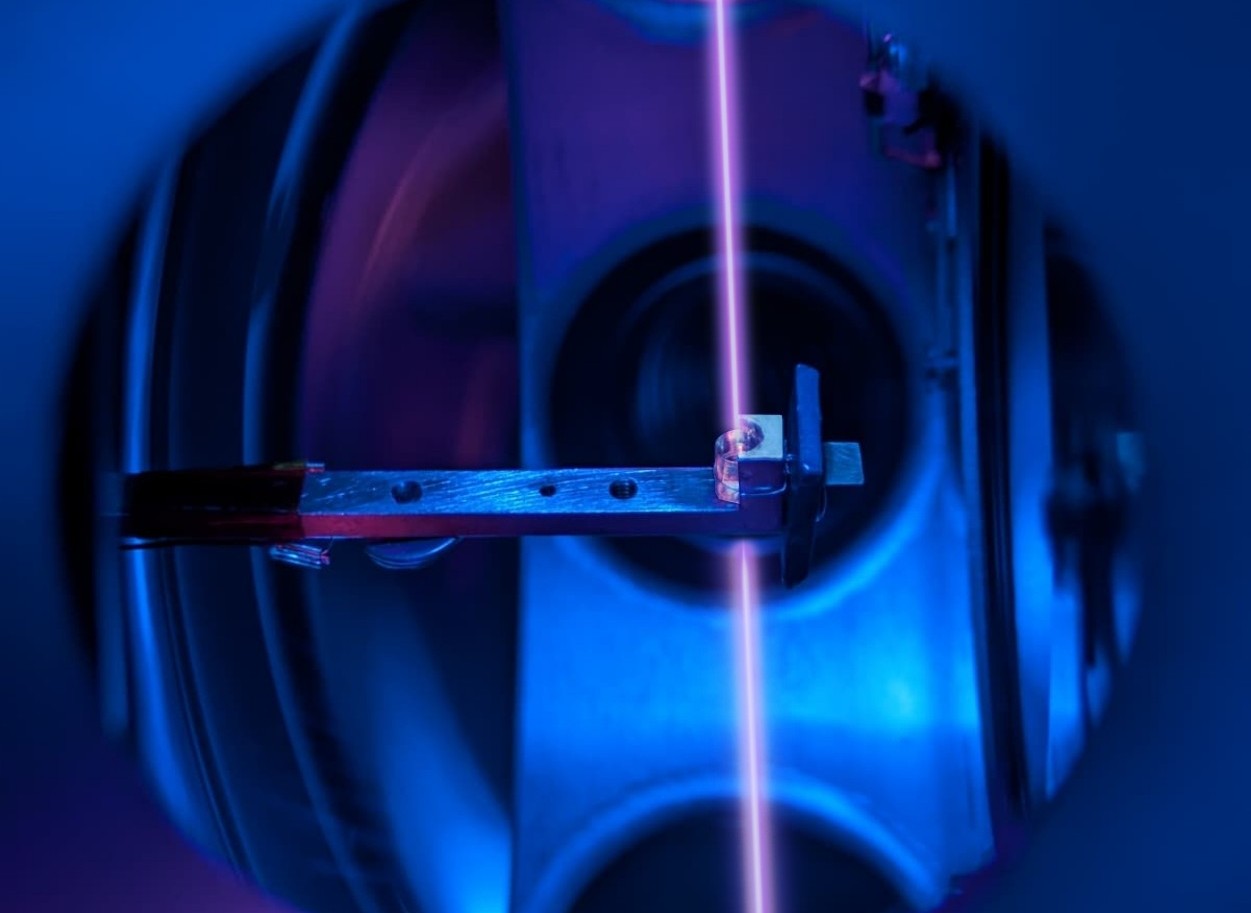
Both teams embedded thorium-229 in millimeter-sized calcium fluoride crystals and shone continuous vacuum-ultraviolet light through them at 148 nanometers. They measured absorption, meaning how much of that light the nuclei soaked up, and fed the result back to keep the laser on the nuclear resonance.
"The basic idea is simple: you have a laser and you have thorium. The laser changes the energy state of the thorium nuclei, and the thorium nuclei are used to stabilize the frequency of the laser."
Thorsten Schumm, physicist, TU Wien
Absorption is the quiet engineering win. Earlier experiments, Peik said, irradiated a crystal for two minutes and then watched it glow, with "a time constant of around 10 minutes", far too slow for a clock.
The labs took different roads to the same light. Vienna quadruples a 1,187-nm laser to 297 nm and doubles it again, leaving 65 picowatts at the detector. Beijing makes 10 microwatts by mixing laser beams in cadmium vapor inside an oven at 600 °C.
Peik and Christian Tamm proposed the thorium clock in 2003. In April 2024, PTB and TU Wien first excited the nucleus with a laser, and that September a JILA-led team measured its frequency against a strontium atomic clock, a set-up TU Wien called "the world's first nuclear clock" at the time. This week's claim is narrower and sturdier: in 2024 an atomic clock measured the nucleus, while now the nucleus steers the laser by itself.
An atomic clock counts electron jumps; a nuclear clock counts a change inside the nucleus, which packs "more than 99.9% of the atom's mass into much less than .01% of the atom's volume", in the words of NIST's own assessment. That tiny target "is much better shielded from environmental disturbances than its electrons are".
The tick is also faster. Beijing's measured frequency corresponds to an 8.356 eV photon, while the ytterbium-ion clock Vienna checked against ticks with a 2.85 eV photon. By Daybreak Wire's arithmetic, the nucleus oscillates about 2.9 times faster, and NIST notes that a higher frequency can "divide time far more finely".
Why thorium-229 alone? Switching a nucleus normally takes "at least a thousand times more energy than the photons of a laser have", as TU Wien put it in 2024. The Tsinghua paper calls thorium-229 "the only known nuclear transition that can be addressed directly with current laser technology". The cancellation that makes it reachable also makes it twitchy: its frequency should be highly sensitive to the fine-structure constant (the strength of electromagnetism), the strong-force scale and quark masses. Theory cited in the Vienna paper predicts that sensitivity will beat the best atomic clock transitions "by several orders of magnitude", though exact values "cannot at present be calculated".
"Nuclear" here means only where the tick comes from: these clocks are not powered by fission or fusion, and have nothing to do with the Doomsday Clock.
Stability is the only score on the board
NIST scores clocks two ways. Accuracy is "how close a clock comes to measuring the ideal 'true' time, also known as systematic uncertainty". Stability is "how efficiently a clock can measure time", or how fast repeated readings settle. Both papers report stability. Neither reports a full accuracy budget, so calling these clocks highly accurate overreaches.
Stability is quoted as a number divided by the square root of τ, the averaging time in seconds; the smaller the number, the faster noise shrinks. Vienna's is 3 × 10^-12 and Beijing's 5 × 10^-13. Divide one by the other and you get the "six times" figure that the South China Morning Post's coverage made the headline.
The comparison is shakier than the arithmetic. Vienna checked its clock continuously against an independent ytterbium-ion atomic clock at Austria's metrology office, BEV, over a fiber link. Beijing computed its figure from the clock's own "in-loop" record and argues its reference laser is stable enough for that to be "a faithful estimate". Among independent physicists reacting, one put it best:
"In the Chinese study, the clock is about six times more stable in the short term than that in the Austrian study, but the strength of the Austrian study lies in the fact that it compares its results with a Yb [ytterbium] clock."
Dolores del Campo Maldonado, director of the Mechanical Magnitudes and Engineering Division, Spanish Metrology Center (CEM)
Beijing has the better short-term number; Vienna has the outside referee.
| Vienna (TU Wien and PTB) | Beijing (Tsinghua-led) | |
|---|---|---|
| Thorium host | CaF2 crystal, 3.1 mm × 4.2 mm, higher thorium concentration | CaF2 crystal, 1.09 mm × 4.94 mm, grown from 1.4 micrograms of thorium-229 |
| 148-nm laser light | 65 picowatts reaching the detector | 10 microwatts generated in cadmium vapor |
| Short-term instability | 3 × 10^-12 /√τ | 5 × 10^-13 /√τ |
| Checked against | A separate ytterbium-ion atomic clock, by fiber link | Its own in-loop record, referenced to a cryogenic silicon-cavity laser |
| Continuous running | About one day without intervention | Not stated in the paper |
| Reproducibility | About 5 × 10^-13 from run to run | Two crystals agree to 2.8 × 10^-13 |
| Physics result | Dark-matter limits; no signal found | Frequency matches JILA's earlier crystals |
According to the Vienna paper, state-of-the-art optical atomic clocks sit around 10^-16 /√τ.
That benchmark is where the real gap shows: Vienna's coefficient is 30,000 times larger and Beijing's 5,000 times larger. Pretend the noise kept averaging down forever (an extrapolation to show scale, not a forecast). A top optical clock would reach 10^-18 in about 2.8 hours. Beijing's would need about 7,900 years, and Vienna's about 285,000 years.
The most-shared human-scale figure needs a footnote. TU Wien's release speaks of "roughly one second in 30 million years". The Vienna paper's body reports instabilities "in the low 10^-14 range within a continuous clock run", and its own formula after one day works out to one second in about 3.1 million years. Nature's news story agrees: "around one second in three million years". The university's line, echoing the paper's abstract, is 10 times kinder than the paper's own in-run figure.
NIST's aluminum-ion clock holds the accuracy record at 5.5 × 10^-19, about one second in 58 billion years. NIST says the thorium experiments still lag "state-of-the-art optical clocks and even cesium fountain clocks". Peik, who heads PTB's Time and Frequency department, concedes that the stability achieved does not yet set any world records when compared to that of the best optical atomic clocks based on trapped atoms or ions.
A worse clock can still be a better sensor
In the Vienna team's paper in Nature, the group ran its clock for about 23 hours in April and found no sign of dark matter in the thorium/ytterbium ratio. For dark matter coupling to photons, the limits are "like those of the best comparable atomic clocks". For coupling to the strong force and quark masses, they reach "a factor of 10 to 1,000 deeper into the parameter space than earlier experiments with atomic clocks". A clock thousands of times noisier matched or beat the specialists because its tick is that much more sensitive.
Beijing's strongest result is about trust. The Beijing team's paper measured the line in two independently grown crystals and found them 2.8 × 10^-13 apart, or one second in about 113,000 years, and both match earlier JILA crystals. Victor Flambaum, a University of New South Wales theorist who was not involved, called them first prototypes of nuclear clocks
.
Where the crystals hold the clocks back
Vienna's day-to-day reproducibility stalled near 5 × 10^-13, about 43 nanoseconds a day, because re-aligning the laser sends the beam through different parts of the crystal. Line centers at different spots differed by up to 1.7 kHz, which the authors "conjecture" comes from local strain.
The lines are broad, 27 kHz in Beijing and about 100 kHz in Vienna. Peik told Physics World, We have now seen 30 kHz linewidth, but the natural linewidth should be way below 1 Hz, which would enable more stable clock operation.
Thorium-229 is also scarce; Beijing grew its crystal from just 1.4 micrograms of it, an amount "dictated by the severe scarcity of 229Th".
The Vienna authors project that hosts giving roughly 1 kHz lines "would bring the frequency instability of the nuclear clock to the same level as state-of-the-art optical atomic clocks". Ding wants better host crystals and, eventually, a trapped-ion thorium clock: It is technically much more difficult, but I think this route may ultimately provide the highest accuracy.
NIST notes that crystal fields "slightly tweak the thorium nuclei" and says a nuclear clock that beats the best optical clocks "remains years away".
The uses are real but distant. NIST says nuclear clocks "could someday replace hydrogen masers in national time scales and navigation satellites", the timing behind how GPS turns timing into position, and could suit deep-space navigation. Schumm told Nature's news team that crystal nuclear clocks are already being developed commercially.
He also sees a shortcut, since Vienna has the better crystals and Beijing the stronger laser: So already by putting these components together, we can build a significantly better clock.
The calendar may not wait. Del Campo expects nuclear clocks to matter in later revisions but not to shape the new definition of the second, particularly if it is redefined in 2030; if it were postponed, they might stand a chance
.