Why Dry Ice Never Melts, and Why It's Getting Scarcer
Dry ice skips the liquid phase entirely because of basic physics — and a widening CO2 supply gap is turning that same physics into a shipping headache.
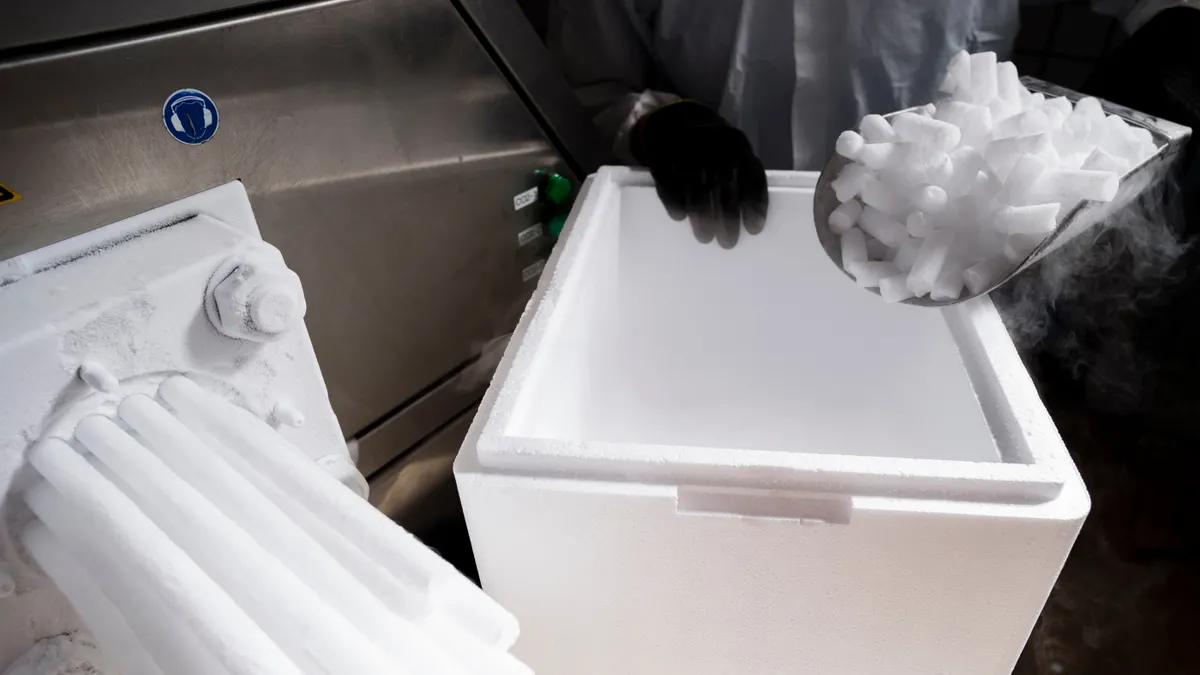
A block of dry ice left on a kitchen counter will vanish by morning without leaving so much as a puddle behind it. That's not a party trick. It's the only way carbon dioxide is physically able to behave at the pressure inside your kitchen, and it's also, right now, the reason a growing list of food shippers, labs and hospitals are quietly worried about where their next supply is coming from.
Why does dry ice not melt?
Every other common substance you've watched melt — ice cubes, butter, candle wax — follows the same script: solid warms into liquid, liquid warms into gas. Dry ice skips the middle step entirely. At normal atmospheric pressure, dry ice sits at a bone-dry -109.3°F (-78.5°C), and when it absorbs enough heat to change state, it goes straight from solid carbon dioxide to carbon dioxide gas. No puddle, because there's never a liquid to puddle.
The reason comes down to pressure, not temperature. Carbon dioxide can only exist as a liquid above roughly 5.1 atmospheres of pressure — about five times the pressure of the air around you. Below that threshold, at any temperature, solid CO2 has nowhere to go but straight to gas when it warms up. Chemists mark this on a phase diagram at the "triple point," the exact pressure-temperature combination — about -56.4°C at 5.11 atm for carbon dioxide — where solid, liquid and gas can theoretically coexist. Your kitchen counter sits nowhere near that pressure, so the liquid phase simply isn't an option there.
Why is dry ice suddenly harder to get?
Because the raw material behind it has a supply problem that has nothing to do with chemistry. Dry ice is compressed, frozen carbon dioxide, and CO2 itself is mostly a byproduct of other industrial processes — ammonia and ethanol production, chiefly — rather than something made on purpose. US dry ice production runs at roughly 4,600 tons a day, and demand has climbed about 5% a year for nearly a decade, driven by food shipping and, increasingly, industrial dry ice blasting for cleaning. Supply hasn't kept pace: CO2 production capacity has grown only about 0.3% a year over the past decade, according to Supply Chain Dive's reporting on the cold-chain packaging industry.
We're not in outright shortage. We could kind of get into a shortage next year — it just depends on what the producers are able to do,
Maura Garvey, president of Intelligas Consulting, said of the outlook heading into 2026. California, one of the country's leading CO2 suppliers, has been losing capacity rather than adding it: two plants closed by the end of 2025 and a third was due to close by April 2026, a combined loss of nearly 850 tons of daily CO2 production. New capacity is coming, eventually — a Linde plant expansion in Texas would roughly double its CO2 output — but not until 2027, well behind the demand curve.
Is there a substitute for dry ice?
Not really, not yet. Packaging companies have been racing to build alternatives — reusable, battery-cooled containers, gel packs, regional cold-storage networks that shorten how far a shipment has to travel on dry ice alone — but none of them match its combination of cost and cooling power. Salt-based gel packs can run 15 to 20 times more expensive for equivalent cooling, according to Frank Butch, director of cold chain solutions at Veritiv, and Keith Baechle, chief commercial officer at Nordic Cold Chain Solutions, put it plainly: for dry ice's blend of price and performance, there is not one out there
yet that matches it. That's the practical reason sublimation isn't just a chemistry-class curiosity: an entire cold-chain industry, from frozen seafood to vaccine shipments, is built around a phase-diagram quirk of carbon dioxide, and there's no cheap way around it if the supply tightens.
It's a similar physical-chemistry logic, driven by pressure and phase behavior rather than intuition, to why Daybreak Wire explained lakes flip their layers every fall — matter doesn't always change state the way a kitchen-counter mental model expects.
The same property that makes dry ice inconvenient to stockpile — it disappears steadily whether you use it or not, sealed container or none — is also what makes it useful in the first place. A refrigerant that left liquid residue behind would be a much harder sell for shipping frozen fish or lab specimens. Carbon dioxide's stubborn refusal to be a liquid at normal pressure is, in a roundabout way, the whole business model.