Why Tonight's Near-Total Lunar Eclipse Isn't a Monthly Event
Tonight's deep lunar eclipse won't repeat next month, or even next year. Here's the orbital mechanics behind why eclipses arrive in pairs, twice a year, and no more.
At 11:13 p.m. Central time tonight, the moon will slide almost entirely behind Earth's shadow, and for the next hour or so, 96% of its face will glow the color of rust. It is the deepest lunar eclipse the Western Hemisphere will see until New Year's Eve 2028. And it will not happen again next month, or the month after that, or even six months from now — a fact that surprises people every single time, because the geometry seems like it should repeat on schedule.
The moon is full once every 29.5 days. Earth's shadow is always there, stretching millions of miles into space opposite the sun. By that logic, the two should collide constantly. They don't, and the reason comes down to five degrees of tilt.
Why doesn't a lunar eclipse happen every full moon?
The moon's orbit around Earth is inclined about 5 degrees relative to Earth's orbit around the sun, according to EarthSky's astronomy desk. If that tilt didn't exist, every full moon would pass directly through Earth's shadow and every new moon would pass directly in front of the sun — a minimum of 24 eclipses a year, like clockwork.
Instead, most full moons pass just above or below the shadow, missing it entirely. An eclipse only becomes possible when the full moon lines up near one of two points called nodes, where the moon's tilted path crosses Earth's orbital plane. Miss the node by too many days, and the moon slides past the shadow in the dark, unnoticed. Land close to it, and Earth's shadow swallows the moon whole.
That's also why eclipses travel in pairs. A solar eclipse at new moon is typically followed, about two weeks later, by a lunar eclipse at the next full moon, because the moon crosses the same node region twice in one lunar month — once for each phase. This year's total solar eclipse on August 12 and tonight's partial lunar eclipse are exactly that kind of pair, separated by two weeks and one node crossing.
What time is tonight's eclipse where you live?
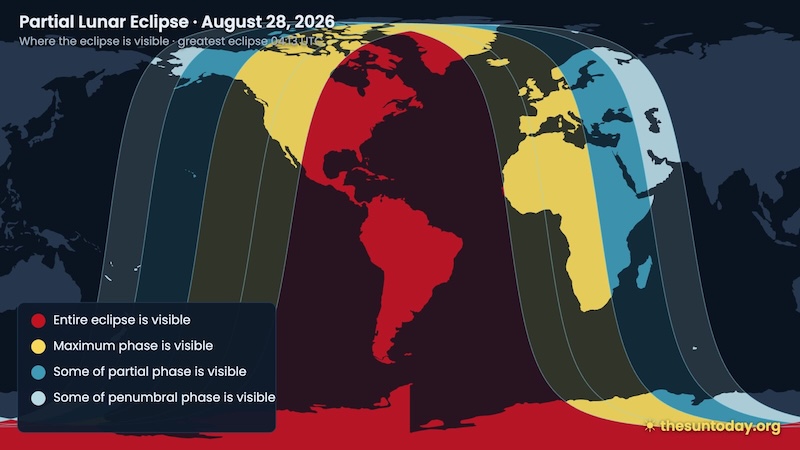
The moon starts entering Earth's faint outer shadow, the penumbra, at 9:23 p.m. ET. Most people won't notice anything at that stage. The real show starts around 10:33 p.m. ET, when the dark inner shadow — the umbra — begins visibly biting into the moon's edge. Maximum eclipse, with 96% of the disk submerged, lands at 12:12 a.m. ET on August 28 (11:12 p.m. CT, 10:12 p.m. MT, 9:12 p.m. PT on August 27).
West Coast viewers get the peak just a few hours after sunset; East Coast viewers get it close to midnight. Europe and Africa will catch the tail end of the eclipse in the pre-dawn hours of August 28, with the moon low near the western horizon as the sun comes up. Roughly 3.3 billion people, across North America, South America, and parts of Europe and Africa, will have some view of it, according to Space.com. Australia, India, China, and Japan will be on the daylight side of Earth and will miss it entirely. No glasses, filters, or equipment are required — a lunar eclipse, unlike a solar one, is just as safe to look at with the naked eye as any other full moon.
Will the moon actually turn red?
Probably, though nobody can promise exactly when the color shows up. As more of the moon slides into the umbra, sunlight bends through Earth's atmosphere and scatters — the same physics that paints sunsets orange — before landing on the lunar surface as a dim, coppery glow. Some observers start to see it around 90% coverage; others say 95%. Since tonight's eclipse peaks at 96%, there should be at least a brief reddish cast near maximum, though the exact shade depends on how much dust and smoke happen to be floating in Earth's atmosphere that night. People near wildfire smoke, EarthSky noted, sometimes get a deeper red or a darker, murkier eclipse altogether depending on local sky conditions.
Because this eclipse tops out at 96% rather than 100%, it will also carry something a total eclipse doesn't: a bright sliver along the moon's northeastern edge that never leaves direct sunlight. That contrast — blazing white crescent next to a dim red disk — is arguably the more striking part of the view, and it's unique to eclipses that fall just short of totality.
How rare is a night like this?
Not especially, in the grand scheme — the 21st century alone will see 228 lunar eclipses — but deep, near-total ones over a heavily populated hemisphere are a different story. This one belongs to Saros 138, a family of eclipses that repeats every 18 years, 11 days, and 8 hours as the moon's node slowly drifts. The last member of that cycle happened in a slightly different part of the world; the next won't line up over the Americas again for a generation.
For a planet whose two closest neighbors, the sun and moon, line up perfectly only a handful of times a year, tonight is one of the good ones. Miss it, and the next comparably deep lunar eclipse visible from North America doesn't arrive until 2028.