Why Uranus Tilts on Its Side, and a New Theory Why
Uranus is the only planet that spins on its side. The classic explanation is a violent collision, but a newer theory blames a moon that slowly tilted the planet, then destroyed itself.
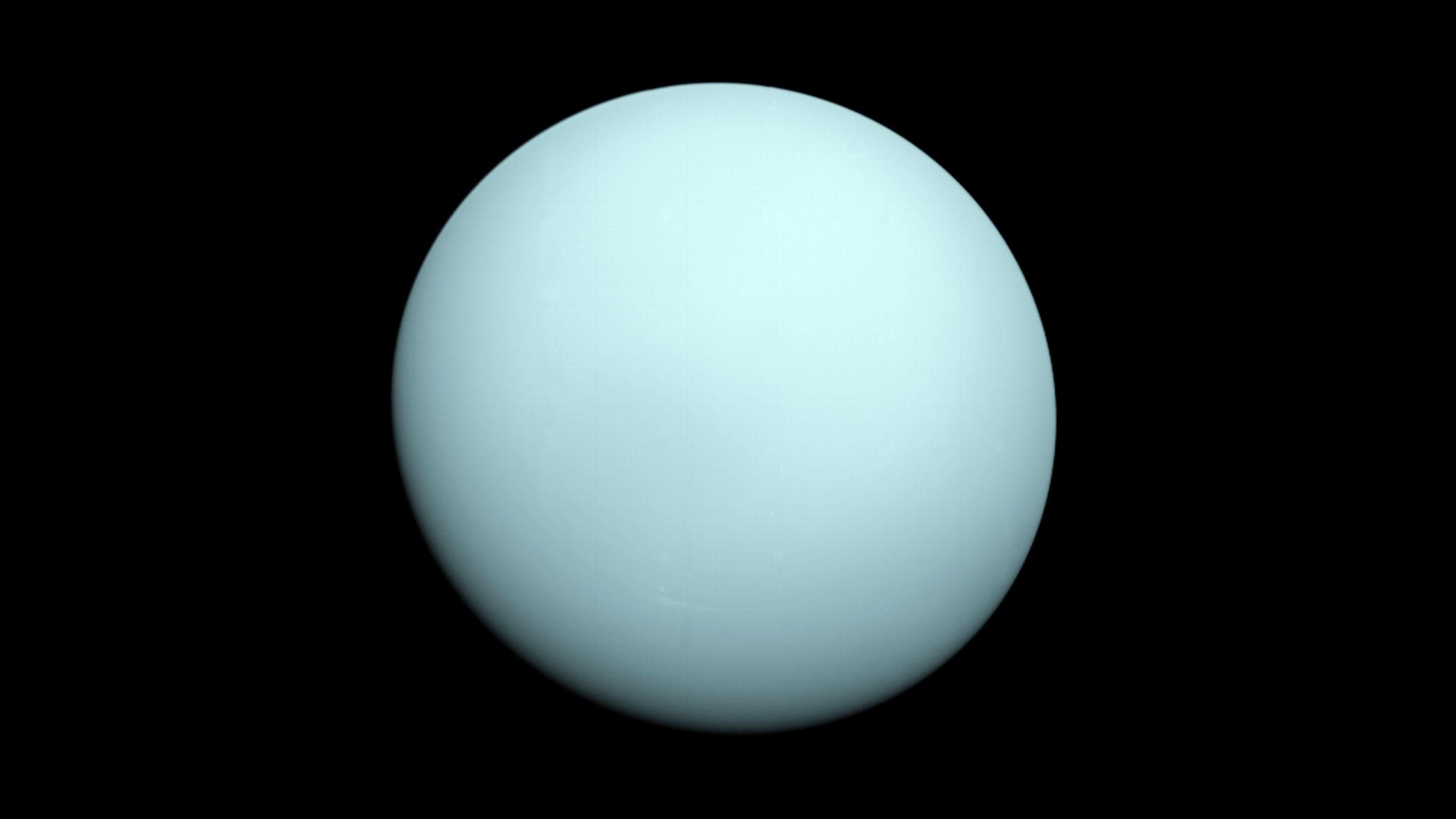
On Jan. 14, 1986, Voyager 2 sent back the only close-up images of Uranus humanity has ever had. They showed a featureless pale-blue marble, disappointingly plain next to Jupiter's storms or Saturn's rings, save for one detail that has puzzled astronomers for decades since. Uranus doesn't spin like the other seven planets. It spins on its side.
How tilted is Uranus, exactly?
Every planet in the solar system has some axial tilt, but all of them stay under 30 degrees except Uranus, which sits at 98 degrees. That number means Uranus isn't just leaning: its north and south poles point roughly toward where every other planet's equator points. The whole system tips with it: Uranus's rings and its 27 known moons all orbit perpendicular to the planet's path around the sun, rather than around its middle the way Earth's moon orbits us.
What knocked it over?
The long-standing explanation is a giant impact: something large, possibly Earth-sized, struck Uranus early in the solar system's chaotic formation and never let it right itself. It's a plausible story on its face: the early solar system really was, as one astrophysicist put it, a shooting gallery of debris, and Earth itself got hit hard enough early on to form the moon.
The trouble is Neptune. Uranus and Neptune are close siblings (similar size, similar mass, similar tangled magnetic fields, similar formation history in the outer solar system), and Neptune's own tilt is a modest 30 degrees, in line with everything else. If random impacts were common enough to flip Uranus by 98 degrees, it's not clear why Neptune escaped mostly unscathed. Both planets also spin at similar rates today, and a collision violent enough to tip a planet 98 degrees should have scrambled its spin rate along with its axis. Neither planet's spin looks scrambled.
What's the alternative theory?
A team of researchers from the Sorbonne, publishing in the journal Astronomy and Astrophysics and posting their work to the preprint server arXiv, proposed a quieter mechanism in 2022: not a single violent collision, but a large moon that slowly pulled Uranus over and then destroyed itself in the process.
The physics works like this. Every planet's axis wobbles slightly over time, a motion astronomers call precession. Ordinarily a moon has no effect on that wobble. But if a moon's orbital period happens to line up with the planet's precession in a whole-number ratio (what physicists call a resonance), the moon's gravity can start reinforcing the wobble instead of ignoring it, tugging the axis a little further with each pass. Over hundreds of millions of years, that small, steady tug compounds.
Researchers calculated that a moon roughly 0.03 percent the mass of Uranus, caught in exactly this kind of resonance, could have dragged the planet's tilt to around 80 degrees. At that point, the planet-moon system would have become gravitationally unstable, pulling the tilt even further sideways before the moon itself spiraled in and crashed into Uranus, vanishing from the record entirely and locking the planet at its current 98-degree angle.
Why would a moon theory explain Uranus but not Neptune?
This is the part that makes the lost-moon idea more satisfying than another lucky impact: it doesn't require Uranus to have suffered a rarer or more violent history than Neptune, just a different one. Large moons falling into destabilizing resonances, then crashing into their planets, may simply not be a common outcome: common enough that it happened to Uranus once, rare enough that Neptune's moons never fell into the same trap. No scrambled spin rate, no mismatched magnetic field, no need for Uranus to have been struck any harder than its neighbor.
The theory is still just that — a theory, tested against computer models rather than direct evidence, since whatever moon caused it is long gone. Confirming or ruling it out will likely wait for China's planned Tianwen-4 mission, which is expected to fly past Jupiter before reaching Uranus sometime after 2030 for the first close look at the tilted planet since Voyager 2's single pass nearly four decades ago. NASA's own long-running effort to keep aging spacecraft alive faces a similar arithmetic problem closer to home: why satellites fall from orbit in the first place, and what it takes to save one.