Nitrogen Puffs and Two Landings: Japan's Plan to Fetch Phobos Soil by 2031
MMX leaves Tanegashima at 04:41:03 JST Tuesday, 19:41:03 UTC Monday. The mission is a five-year chain of firsts, and the dates show where it can break.
Two clocks are counting down to the same rocket, and they disagree by a calendar day. JAXA's reads 4:41:03 a.m. on Tuesday, Oct. 20. NASA's reads 3:41 p.m. on Monday, Oct. 19. Both are right: it is a single instant, 19:41:03 UTC, seen from Japan and from the U.S. East Coast.
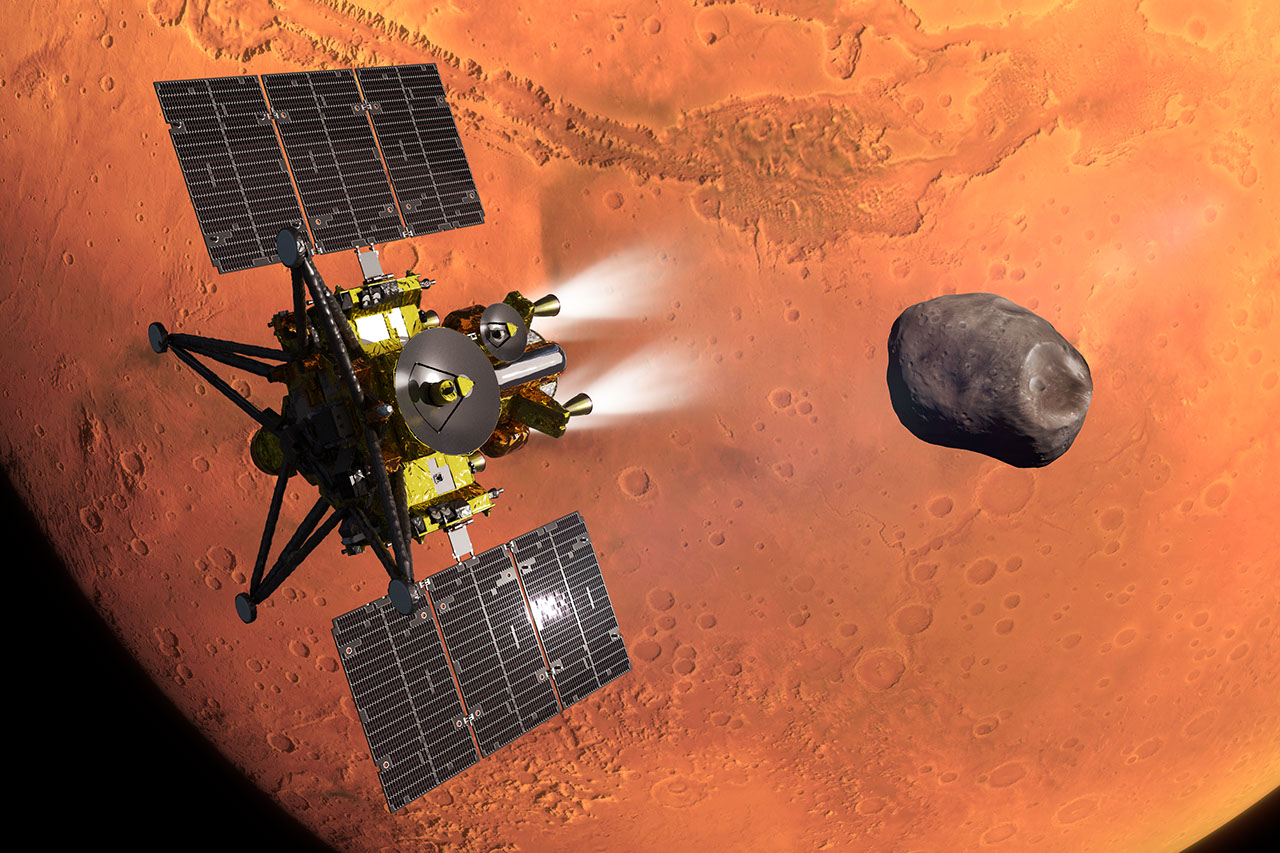
That instant sends Japan's Martian Moons eXploration spacecraft, or MMX, off the Tanegashima Space Center on an H3 rocket. If the mission works, the probe will reach Mars in August 2027, land twice on the moon Phobos to gather at least 10 grams of soil, and drop a capsule into Australia in 2031. It would be the first sample ever returned from the Martian system. The launch has not happened; everything below is plan, not result.
The same moment is 12:41:03 p.m. PDT on Monday, and 8:41:03 p.m. BST or 9:41:03 p.m. CEST that evening. JAXA will stream it on YouTube and Niconico, with coverage opening about 03:45 JST on Oct. 20 (2:45 p.m. EDT on Oct. 19) and running about 75 minutes past liftoff, subject to change.
A 71-minute ascent, 302 days after an H3 failure
The rocket is an H3-24L, about 63 meters tall, with two LE-9 engines and four solid boosters, flying as H3 Flight No. 10 from the Yoshinobu Launch Complex. According to JAXA's launch announcement, a backup period runs from Oct. 21 through Nov. 9, 2026. That is 20 days of tries; JAXA stretched it by two days on Sunday, Oct. 18, though Nature World News still prints the old Nov. 7 end.
A Mars launch needs a window because Earth and Mars line up for the most efficient trip only about once every 26 months, NASA says. Miss it and the next chance is, by arithmetic, late 2028. JAXA adds that the flight plan after the first second-stage cutoff varies with launch date, so the sequence below holds only for Oct. 20.
That sequence is brisk. The fairing, the nose shell protecting the payload, comes off at 3 minutes 17 seconds. The second stage burns, coasts for 53 minutes 17 seconds, then burns again for 6 minutes 24 seconds. MMX separates at 1 hour 11 minutes 12 seconds, which is 05:52:15 JST or 4:52:15 p.m. EDT, inside the broadcast. It will then be 592 kilometers up, moving at 11.2 kilometers per second.
Now the uncomfortable part. JAXA's own H3 press kit lists nine launches: seven successes, two failures. Test Flight 1 failed on Mar. 7, 2023, when the second stage did not ignite. Flight 8 failed on Dec. 22, 2025, leaving a Michibiki navigation satellite out of orbit. Flights 6 (June 12, 2026) and 9 (Aug. 11, 2026) have flown clean since.
JAXA traced Flight 8 to a manufacturing defect: delamination in the payload support structure, the part that holds the satellite. It most likely grew under the shock of fairing separation. Flight 9 used a fastener-joined structure, and the press kit says fastener joining "will be the baseline for important missions in the near term." The press kit does not say which structure Flight 10 carries.
Flight 10 adds firsts of its own: H3's first planetary launch and the first flight of the H3-24L, whose long fairing needed dedicated separation tests. Ground stations cannot see the vehicle from the start of the second burn through separation, so a NASA TDRS relay satellite will carry telemetry in its first operational use. The weighing is simple. Launch is the best-understood link in the chain, and two clean flights since December help. But a first-of-type rocket flying a burn out of sight of ground stations on a second stage that failed to light in 2023 is still a risk.
Mars in August 2027, soil in 2030, a capsule in 2031
JAXA, NASA and ESA each publish a slice of the schedule. Counted from liftoff, the slices make this path.
| When | Milestone | Time since launch |
|---|---|---|
| Mon., Oct. 19, 19:41:03 UTC (Tue., Oct. 20, 04:41:03 JST) | Liftoff of H3 Flight 10 from Tanegashima | 0 |
| Oct. 19, 20:52:15 UTC | MMX separates onto its Mars transfer trajectory | 1 hour 11 minutes |
| Oct. 21 to Nov. 9, 2026 | Backup launch period if Oct. 20 slips | 20 days of tries |
| August 2027 | Arrival at Mars and entry into Mars orbit | About 10 months |
| September 2027 | Moves into orbit around Phobos | About 11 months |
| Early 2029 | Idefix rover released; about 100 days of work | A little over 2 years |
| 2030 (NASA's earliest: December 2028) | Two landings and sample collection | About 3 to 4 years (earliest about 25 months) |
| November 2030 | Return module leaves Mars, passing Deimos and Mars | About 4 years 1 month |
| 2031 | Capsule lands in Woomera, Australia | About 5 years |
The first hard test is Mars-orbit insertion, the burn that lets Mars's gravity capture the craft. JAXA's press kit calls it "the greatest challenge of the first half of the mission," and with no second chance it is a single point of failure in the plainest sense. MMX is three modules (propulsion, exploration, return) with a launch mass of 4,480 kilograms. Propellant in the propulsion and return modules alone is 3,030 kilograms, or 67.6% of that.
Phobos's gravity is too weak for a normal orbit, so MMX will fly a "quasi-satellite" orbit around Mars that tracks the moon. From Mars the spacecraft appears to follow Phobos; to an observer on Phobos it would "look around" the surface. ESA expects that orbit from September 2027. The Planetary Society says a year of remote study precedes the choice of landing sites, while AP says MMX will fly near and around Phobos for three years. From September 2027 to November 2030 is about 3 years 2 months.
The 25-kilogram Idefix rover, from France's CNES and Germany's DLR, goes first. It lands in early 2029 and works about 100 days, and JAXA says its explorations "will reduce risk during spacecraft landing and sampling operations." Landings are timed for when Earth is closest, to minimize eclipses and occultations. At the farthest point of the trip, 2.5 au, a signal takes roughly 40 minutes for the round trip. Project manager Yasuhiro Kawakatsu said, AFP reported: Going deep into what we call the 'gravity well' is difficult.
The last link is the departure. Only the return module and capsule head home, and JAXA says its main engine fires "to escape the Martian sphere in one go. A tense event in the final phase of the mission." ESA's infographic puts that in November 2030. The trip takes just under a year, ending in the Woomera Prohibited Area in Australia. JAXA counts in fiscal years, which run April to March, while NASA, ESA and AP say calendar 2031; a November departure plus just under a year fits both. JAXA's total is "approximately five years."
Nitrogen, a corer and a 2-to-3-hour stay
MMX carries two samplers, and they work together. JAXA's C-Sampler is a corer on a robotic arm that drives a cylinder about 2 centimeters into the ground. (NASA's release says "a few inches"; JAXA's figure is the one to use.) NASA's P-Sampler is mounted on one of the spacecraft's landing legs, and it collects with gas, not a mechanical arm.
It fires bursts of high-pressure nitrogen gas. JAXA says the gas lofts material into the sample container "in a fraction of a second." The Planetary Society's Asa Stahl describes the technology, called PlanetVac, as blasting pure nitrogen gas. This stirs the dirt and rocks below into a tiny tornado, while another puff sweeps that material up into a collection chamber.
Her shorthand: Picture a dustbuster attached to the landing leg of a spacecraft, and you won't be far off.
Honeybee Robotics, a Blue Origin company, developed it. Vice president Kris Zacny said sampling will take only seconds, SpacePolicyOnline reported:
"You blink, and it's all done."
Kris Zacny, vice president, Honeybee Robotics
The record is respectable and small. The device collected 13 grams of lunar regolith aboard Firefly's Blue Ghost Mission 1 in 2025, SpacePolicyOnline reports, and a 2018 rocket test gathered 332 grams of simulated Martian soil, per the Planetary Society. Phobos adds a harder problem: gravity there is 1/1700 of Earth's, so the 25-kilogram Idefix would weigh about 15 grams.
That is why the visit is short and the legs are elaborate. JAXA plans two soft landings and says the spacecraft will spend about 2 to 3 hours on the surface. AP reports the first uses both devices on surface and underground material and the second takes more underground samples, with four shock-absorbing legs "to minimize bouncing at touchdown." This is the riskiest link, and a puff that takes seconds is the right design for it.
One date needs reconciling. NASA says sampling comes "no earlier than December 2028," about 25 months after launch. ESA, Astronomy.com and The Conversation say 2030. Read NASA's as the earliest possible, and 2030 as the expected year.
Ten grams, of which perhaps ten milligrams is Mars
Phobos, potato-shaped and up to 27 kilometers across, circles about 6,000 kilometers above Mars about three times a day. Is it debris from a giant impact on Mars, or a captured asteroid? NASA's Tom Statler, MMX program executive and program scientist, says the moons look like D-class asteroids found elsewhere in the solar system. But their orbits are circular and aligned with Mars's equator, not tilted as captured bodies would likely be.
"So you see, there's two totally different lines of evidence that point in two different directions. That's what makes it an interesting puzzle."
Tom Statler, NASA MMX program executive and program scientist, at NASA's Oct. 15 briefing
Soil would break the tie because each answer predicts a different recipe. Per JAXA's press kit, a captured body gives "a sample from a water-transport capsule prior to planet delivery," while impact debris gives "a mixed sample from a water-transport capsule and from early Mars." JAXA says Phobos grains could hold records of water and organic matter, a thread that echoes the complex organic carbon in a Jezero mudstone that Perseverance found, carbon that can form with or without biology.
Against its predecessors, 10 grams is modest. Hayabusa2 took 6 years and 3 days, from launch on Dec. 3, 2014 to recovery in Australia on Dec. 6, 2020; it aimed for 0.1 gram and returned 5.4. OSIRIS-REx took 7 years and 16 days, from Sept. 8, 2016 to Utah on Sept. 24, 2023, with 121.6 grams. MMX's goal is 1.85 times Hayabusa2's haul and 8.2% of OSIRIS-REx's.
It can be small because the science asks for something specific. AP reports that Mars material is expected to make up about 0.1% of what is collected, according to JAXA officials. If both numbers hold, 0.1% of 10 grams is 10 milligrams. The press kit says Phobos should hold more than two orders of magnitude more Mars-derived material than Deimos, one reason JAXA chose it; Mars's own gravity makes landing and return from the planet hard.
Principal investigator Kiyoshi Kuramoto said, per AP: We can almost certainly come to a conclusion by analyzing (Phobos) soil samples.
The confidence is real, and so is the arithmetic: the answer rides on the right milligrams, not on the 10 grams. NASA contributes MEGANE (Japanese for eyeglasses, a neutron and gamma-ray spectrometer), the P-Sampler and Deep Space Network support, and will receive about 15% of the returned sample ("at least 15 percent," Hays said), curated at Johnson Space Center in Houston. That is 1.5 grams if the haul is the 10-gram minimum. Lindsay Hays, acting director of NASA's Planetary Science Division, put NASA's 14-year cost at $87 million, SpacePolicyOnline reports.
China runs a parallel race with different targets. Tianwen-2, launched in May 2025, reached the asteroid Kamoʻoalewa in early summer 2026, SpaceNews reported on July 6 (the Planetary Society put the rendezvous at June 7); its sampling status since is unverified. Tianwen-3 is set to launch in late 2028 and return at least 500 grams as early as 2031, Scientific American reports, and AFP says China hopes to return its samples as early as 2031, potentially before MMX. But Tianwen-3 aims at Mars's own ground, while MMX, Kawakatsu told AFP, is the first round trip to the Martian system.
Kawakatsu said, per AP, that the Martian moons are the most important unclimbed mountains in the solar system.
The first real exam, orbit insertion, is due in August 2027. The summit, though, is a puff of nitrogen on a moon where a rover weighs 15 grams, and a verdict that may hang on 10 milligrams of dust.