Japan's 9.9 Alert Used Two Epicenters and a Formula for Domestic Quakes
A magnitude 6.9 earthquake off Kamchatka became a 9.9 alert across eastern Japan for eight minutes. The weather agency's own map shows how it was built.
The Japan Meteorological Agency explains its false 9.9 alert with a single map and three stars. The map sits in JMA's second report, issued at 5:30 p.m. Japan time (JST) Friday. It shows the seas east of Kamchatka and the Kuril chain, with the stars scattered across them. All times below are JST.
A red star marks the epicenter JMA later published for the real quake, 50.0 N, 158.1 E. A blue star, labelled ① in the report, marks the place the early-warning system used as the epicenter to calculate the magnitude. An orange star, ②, marks the place it used as the epicenter, carrying the magnitude from ①, to predict how hard Japan would shake. JMA said, in translation, that the two should be the same place, and in this earthquake they were not. Its 2 p.m. release adds numbers for the alert itself: a source at 48.2 N, 153.4 E, 140 km deep, magnitude 9.9, in the report issued at 12:40:02.6.
In short, on Friday, Oct. 16, 2026, JMA sent an Earthquake Early Warning (the public "warning" class) at 12:40 p.m. forecasting a magnitude 9.9 quake and shaking up to intensity 7 from Hokkaido to the Tokai region, then withdrew it at 12:48 p.m., eight minutes later, after a real magnitude 6.9 earthquake near Russia's Kamchatka Peninsula. By 5:30 p.m. JMA said a formula for a domestic magnitude had been applied to a very distant quake. It says it is still investigating.
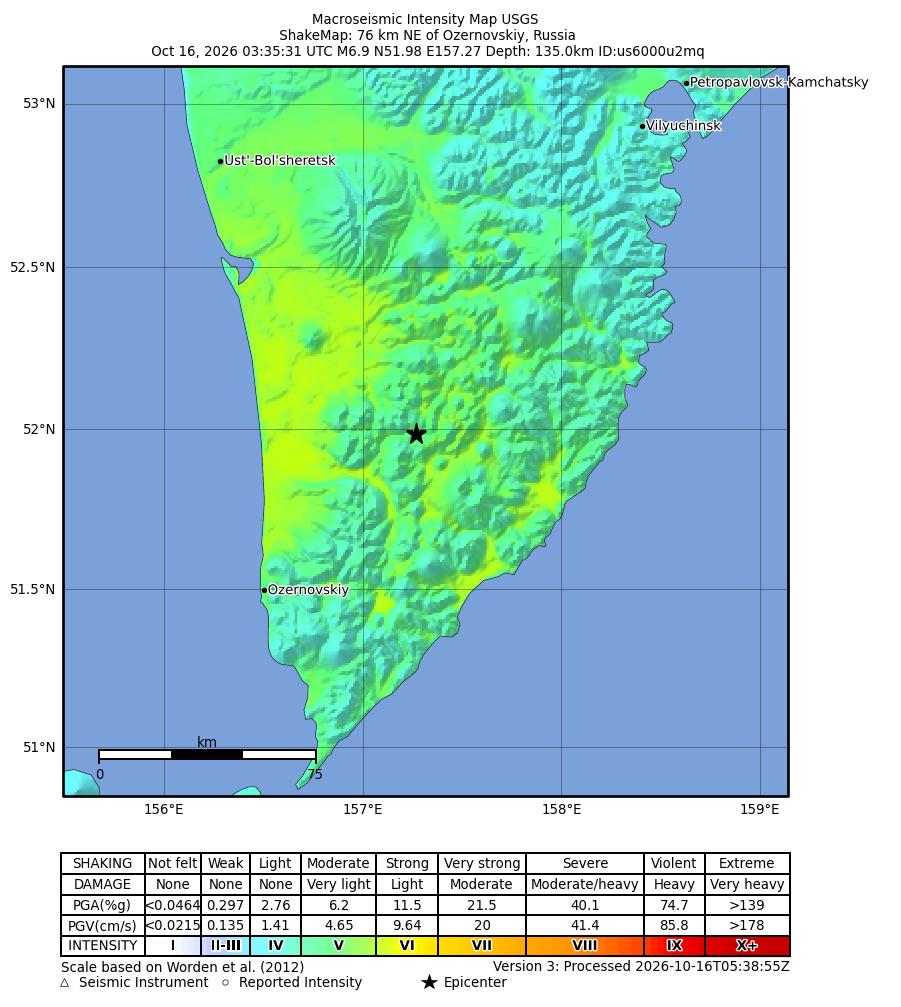
The quake was real, and small: magnitude 6.9 by both JMA (a preliminary value) and the U.S. Geological Survey (USGS). The agencies disagree on the rest. JMA put it at 50.0 N, 158.1 E, about 160 km deep, at about 12:38. USGS has it farther northwest, on the peninsula, at 135 km and 12:35. EMSC initially reported 7.0. Only Hakodate, in Hokkaido, felt it, at intensity 1 on Japan's shindo scale, which runs from 0 to 7. JMA saw no tsunami concern, and the government reported no damage. JMA ruled out a cyberattack, saying in translation that it found no external access during that time period.
Three stars on one map
Phones, TV and radio carried the warning for eight minutes. Asahi listed the regions in translation: Hokkaido, Tohoku, Kanto, Hokuriku, Koshin, Tokai and the Izu Islands. NERV Disaster Prevention app users saw a 9.9 warning with a countdown to shaking that never came.
In Tokyo, the Japan Times reported, pedestrians paused over their phones, then carried on. The Tokaido Shinkansen stopped for 15 minutes after its automatic safety system triggered, JR Central said. Chief Cabinet Secretary Minoru Kihara said the government "took seriously" the anxiety of people who evacuated or took other steps.
At a 2 p.m. press conference, Ayataka Ebita, head of JMA's earthquake and tsunami observation division, opened with an apology: "we deeply apologize for the great inconvenience," in translation. It was the first withdrawal of an early-warning "warning" in JMA's history, the Japan Times said, though not the first false alarm.
NHK's on-air explainer guessed "some kind of noise," J-CAST reported. Mynavi's account of the briefing instead puts the problem in processing of observation data, not station hardware, and Ebita said lightning was not believed involved.
Three seconds of P wave, one formula
Early warning must name a quake's size before the quake has finished. JMA's English page says lead time is "a matter of seconds" and admits "limits to the accuracy of estimating magnitude, especially for large earthquakes."
Here is the pipeline, as JMA's technical reference describes it (in Japanese; the translations are ours). Each seismometer processes its waveform in the first second after it triggers, then sends results to a central system every second. The central system finds the epicenter with IPF, a particle filter that starts from where past earthquakes have occurred and keeps the source that best fits all the station data.
The magnitude is the harder part. JMA's ordinary magnitude uses the largest amplitude of the whole waveform, so it cannot be instant. Early warning uses a P-wave magnitude instead, taken from the largest amplitude measured three seconds after the P wave (the fast first wave) is detected at a station, and updated every second. The published formula is 0.72M = log10 A + 1.2 log10 R + 5.0 x 10^-4 R - 5.0 x 10^-3 D + 0.46, where A is amplitude, R is a distance term and D is a depth term.
Now our arithmetic, not JMA's. A tenfold change in amplitude moves the magnitude by 1.39 units; a tenfold change in the distance term moves it by 1.67, so on that logarithmic term, doubling the assumed distance adds about 0.50 (a small linear term adds more at long range, but not enough to change the picture). Climbing from 6.9 to 9.9 on that term alone would take a distance ratio of 63.
Moving a source a few hundred kilometers cannot by itself explain a jump of 3.0. That fits JMA's statement that a domestic formula was used far outside its range, and it means the full explanation is still missing. JMA has published no stations or amplitudes. Its 2 p.m. release does list each report's epicenter, depth and magnitude, but not how they were reached.
The reference does explain the direction of the error: its Figure 12 caption says that if the estimated source lies far from the real one, the magnitude computed from the triggered stations' amplitudes comes out too large.
A big number then becomes a wide alert. For the intensity forecast, JMA treats the source as a sphere whose radius is half the fault length predicted from magnitude, and it measures distance to the sphere's surface. At 6.9 that sphere has a radius of about 16 km. At 9.9 it is about 517 km, a rupture roughly 1,034 km long. Take the 48.2 N, 153.4 E source in JMA's table: Nemuro, Hokkaido is about 812 km from it point to point, but only about 295 km from the surface of the 9.9 sphere. A magnitude alone can push a forecast of shindo 7 and a warning across seven regions that way. This assumes 9.9 passes through JMA's conversion as a JMA magnitude, and JMA's reference says it also uses plain point-source distance for some products, so this illustrates the scale and is not a reconstruction of the Oct. 16 run.
One inference more. PLUM, the system's second method, forecasts shaking from shaking already observed and needs no source. Japan felt intensity 1, so in our reading PLUM could not have produced this alert alone. The 2019 review in Annual Review of Earth and Planetary Sciences says the system takes the maximum of PLUM and the point-source forecast.
The 2020 error ran the same way
On July 30, 2020, a magnitude 5.8 quake struck near Torishima at 9:36. At 9:38 JMA issued a warning to 15 prefectures including Tokyo, and no intensity 1 or above was observed. In JMA's 2020 release, the agency said it had placed the source south of the Boso Peninsula instead of at the true location, and had used data from the Hahajima station in the Ogasawara Islands, more than 800 km away. The magnitude came out as 7.3, 1.5 units too high by our subtraction.
The fix was a distance rule: use only stations within 700 km of the source for magnitude, planned for September 2020.
Same family of failure: a wrong source and a magnitude computed against it. The difference is distance. Friday's quake sat more than 1,200 km from the nearest Japanese city on the map. The 2020 rule counts stations within 700 km of the estimated source, and JMA has not said whether it was in force or how it interacted with the blue-star calculation.
Earlier erroneous warnings, as JMA and the outlets cited describe them:
| Date | What JMA issued | Real event | JMA's stated cause |
|---|---|---|---|
| Aug. 25, 2009 | Warning to Chiba, Ibaraki, Tokyo's 23 wards and nearby | No quake cited | Abnormal amplitude data from the Chiba Miyoshi station inflated the magnitude (JMA) |
| Aug. 8, 2013 | Warning, wide area centered on Kinki | M2.3, northern Wakayama | Noise from an ocean-bottom seismometer read as shaking (JMA) |
| Aug. 1, 2016 | "Forecast" of M9 (Keitai Watch; AP said 9.1), shindo 7; cancelled in about 15.5 seconds | None | Large noise at Futtsu station (Keitai Watch); lightning suggested at the time (AP) |
| Jan. 5, 2018 | Warning to Kanto and Fukushima phones | M4.4 off Ibaraki and M3.9 in Toyama, same moment | Two quakes processed as one (Keitai Watch, citing JMA) |
| July 30, 2020 | Warning to 15 prefectures, M7.3 estimated | M5.8 near Torishima | Wrong source; data from a station more than 800 km away (JMA) |
| Oct. 16, 2026 | Warning, M9.9, Hokkaido to Tokai; withdrawn after 8 minutes | M6.9 near Kamchatka | Domestic magnitude formula applied to a far quake; magnitude and intensity computed from different epicenters (JMA); under investigation |
Of the first five rows, three trace to a faulty or noisy station, one to two quakes merged into one, and one (2020) to a mislocated source. Oct. 16 and July 2020 are the two rows where JMA's stated cause is how the source was located and the magnitude computed rather than a faulty instrument. That is our reading, and the investigation continues.
The opposite failure is also on record. At the 2011 Tohoku earthquake, which Allen and Melgar call M9.1, JMA's estimate "saturated at M8.1." On why point-source methods saturate near M7, they write:
"[I]t is difficult or impossible to distinguish an M8 earthquake from an M7 when only information about the first few seconds of the source time function is known."
Allen and Melgar, Annual Review of Earth and Planetary Sciences, 2019
In the aftershocks, they add, 63% of the 70 warnings were false because near-simultaneous events were taken for one. Telling overlapping quakes apart is hard, and our explainer on swarms and mainshocks shows why. The system under-sized a 9.1 in 2011 and over-sized a 6.9 in 2026.
The 9.9 is "the highest magnitude figure its systems can send out externally," per the Japan Times citing JMA, so the true internal estimate is unknown. The largest quake ever recorded is Chile in 1960, at 9.5 by USGS. A 9.9 would release roughly 32,000 times the energy of a 6.9 (BNO's figure; our check gives 31,623). Ebita said, in translation, that 9.9 is quite a hard value, seismologically. For a genuine big quake's aftermath, see our report on the Panama earthquake and its aftershocks.
What JMA has not yet explained
Ebita described how the system works at the Tokyo news conference, as the Japan Times reported.
"We do not watch the calculations in real time as each result is generated. The system produces them automatically, so we cannot necessarily observe these changes as they happen."
Ayataka Ebita, head of the Japan Meteorological Agency's earthquake and tsunami observation division
A JMA official told Mynavi, in translation, that the withdrawal went out once it was clear waves had occurred but there was no shaking, and that at 160 km depth, in an area with few stations, they judged 9.9 excessive. Ebita said reliability drops when a quake is far from stations.
There is a documented mismatch in the cancellation rule, and we will not try to resolve it. JMA said at the briefing, per the Japan Times (quoting Ebita) and Mynavi (an official), that a cancellation goes out when the maximum observed intensity is shindo 2 or lower, or when the shaking has a cause other than an earthquake. JMA's own explainer page says, in translation, only false alerts from non-earthquake phenomena such as lightning are cancelled, and that a downgrade from 5-lower to 3 is not.
Then the sound. The cancellation notice rang with the same loud alarm as the alert. A JMA official said, in translation, that this specification dates from more than 20 years ago and is not under review "at present." Posts on social media complained.
JMA's advice, in translation: on hearing a warning, calmly secure your own safety first, depending on your surroundings. Because the cancel chime sounds like the alert, the sound alone is no verdict; the text on the screen is what to read (our advice, not JMA's). The place to check is JMA's earthquake information, which listed the real quake at magnitude 6.9 and intensity 1 at 12:52 p.m.
JMA's own paperwork sets up a pair of questions. It describes a check built to reject a far-off source, re-estimating magnitude from up to three stations near it. It also describes a rule against forecasting intensity for sources deeper than 150 km. JMA's release gives the depth the alert used as 140 km, against the 160 km in its bulletin for the real quake, and 140 km sits under that 150 km cutoff. Whether either safeguard ran, and what it did, is the one sentence the 5:30 p.m. report does not contain.