59 Screwworm Cases Now, and the First Wild One Is a Hunter's Elk
The USDA's dashboard counts 59 U.S. screwworm cases, one of them a hunter-harvested elk in Pecos County, Texas. Here is how the fly works and what to do.
Two numbers have circulated, 56 and 59. USDA's public dashboard totals 59 animal cases as of Wednesday, Oct. 21: 54 in Texas and five in New Mexico. The 56 came from a Nature World News report citing Texas Public Radio's tracker, with data through Oct. 15; USDA's own table now shows 59.
One of the 59 is the reason for the attention: a female elk, harvested by a hunter in Pecos County, Texas, and the only wild animal on the list. The other 58 are domestic.
What the elk is, and what it isn't
The Texas Parks and Wildlife Department said it "received confirmation of a detection of New World screwworm (NWS) in a hunter-harvested female elk in Pecos County." A sample was confirmed at the federal Knipling-Bushland livestock insects laboratory in Kerrville. USDA's Animal and Plant Health Inspection Service (APHIS) calls it the first U.S. wildlife detection of this outbreak and says the elk was on a game ranch. The dashboard lists it as "inactive," as are 52 of the 59; seven are active.
Context matters here. Pecos County already had five domestic cases, the latest cattle on Oct. 10. The elk is not a new place. It is a new kind of animal in a place already under a state "infested zone," an area where animals cannot leave without permission.
The same day, the New Mexico Department of Agriculture confirmed a case in a beef cow in Otero County. Reuters reported a minimum 12.4-mile (20 km) infested zone around it.
Much is unknown. How and when the elk became infested, and where on its body, has not been reported. Whether other wildlife are infested is open, as is how the animals in Jeff Davis, Grant and Otero counties were exposed and whether flies are established locally in New Mexico.
One elk is one detection: it does not show the fly has escaped into the wild, or that it hasn't.
Seven detections in 12 days after a two-month slowdown
The first U.S. case of this outbreak was a calf in Zavala County, Texas, on Wednesday, June 3; the elk came 140 days later. The dashboard now spans 21 counties: 18 in Texas, plus Lea, Grant and Otero in New Mexico. By species, the total is 26 cattle, 16 sheep, seven goats, five dogs, four horses and the elk.
August and September together produced seven confirmations. The table then added seven more between Saturday, Oct. 10 and Wednesday, Oct. 21, in Pecos, Grant, Brewster and Jeff Davis counties, plus the elk and the Otero cow.
Three counties are new in about five weeks: Grant (first case Sept. 17), Jeff Davis (Oct. 20) and Otero (Oct. 21). A wild fly caught in a Brewster County trap on Sept. 25 is tracked separately and is not in the 59.
A caution: the chart counts confirmations, and confirmations depend on who is looking. A surge can mean more flies, more attention, or both.
How the fly works, in numbers
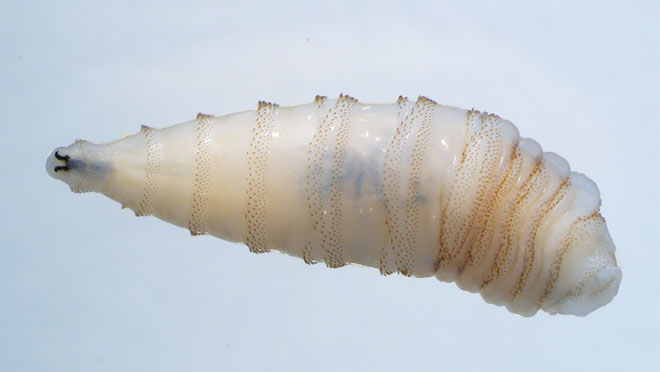
The "screwworm" is not a worm. It is the larval stage of a fly, Cochliomyia hominivorax. Ordinary maggots feed on dead tissue; "only NWS feed on living tissues," the Texas Animal Health Commission (TAHC) says. The larvae have backward-pointing spines that give them a screw-like look and sharp mouth hooks that tear tissue, so a wound grows larger and deeper.
The fly needs very little. Per USDA and CDC, wounds as small as a tick bite attract egg-laying females. A female lays 200 to 300 eggs at a time, up to 3,000 across a 10- to 30-day life, and the eggs hatch within hours.
Then the clock runs. Larvae feed for about seven days, drop to the ground and pupate in the soil. Adults emerge after 7 to 54 days, depending on temperature and humidity. Add the stages and one missed wound can seed the next generation in roughly two weeks at the fastest, up to about two months. That is arithmetic from USDA's figures.
The main weapon is the sterile insect technique. Factories rear flies, sterilise the males and release them. Females typically mate only once, so one that mates with a sterile male lays nonviable eggs, and over a few life cycles the wild population falls. The method eradicated screwworm from the United States in 1966 and ended Florida's 2016 outbreak in the Keys in 2017, though in months about 15% of the Key deer died, per Texas A&M AgriLife.
Why animals nobody can inspect change the math
On a ranch, the defence has layers: owners inspect and treat animals, report cases, and hold animals in a zone until an inspector signs a certificate. Every one of those tools assumes an owner and a fence.
Wildlife has neither. TPWD's 2026-27 forecast puts the white-tailed deer herd at 5.64 million. Nobody inspects them, treats their wounds or restricts where they walk. Donald Huser, who runs Coastal Bend Feed in Beeville, Texas, said in June:
"Yes, you can check all of your cattle and everything else, but you're not going to catch all your deer."
Donald Huser, Coastal Bend Feed
In June, Jason Suckow, who directs USDA's National Wildlife Research Center, said more than 20,000 inspections in border states, roadkill included, had found no screwworm in U.S. wild animals, while Mexico had confirmed cases in white-tailed deer.
Set that beside a first positive that arrived in hunting season, from a harvested animal. It fits a rare event, and it fits a hidden one that shows only when a hunter happens to look. The data cannot yet separate them.
Sterile flies are different: they act on the wild fly population wherever it breeds, deer country included. So the number that matters is how many USDA can make. Per APHIS, Panama's plant makes about 100 million a week. Metapa, Mexico, a $21 million conversion finished in late June, is ramping up to 100 million. A Texas plant at Moore Air Base, projected at 300 million, is under construction and, as of a June report, not expected to be operational until May 2027. USDA says it has released more than 1 billion sterile flies in Texas since February and aims for 500 million a week by next summer.
The three plants add up to 500 million a week, but that sum is Daybreak Wire's arithmetic, not USDA's, and APHIS lists capacity, not flies released. Our reading, as analysis: the target needs every plant at full output, and the largest is furthest from running.
What hunters, pet owners and ranchers can do now
Hunters
Archery season is open, and the general deer season opens Saturday, Nov. 7, 17 days after the Oct. 21 count. TPWD's Alan Cain asked for vigilance:
"We encourage all hunters and landowners to be vigilant for signs of New World screwworm while they are out in the field this season."
Alan Cain, Wildlife Division Director, Texas Parks and Wildlife Department
In practice, Texas Parks and Wildlife's release asks hunters to inspect a harvest before field dressing it or moving the carcass. After the shot, look at:
- Eyes, ears, nose, mouth, genitalia and any mucous membranes.
- The whole body, running your hands along it.
- The feet and between the toes, for wounds with a foul smell or maggots.
In a live animal, TPWD lists irritated or depressed behavior, loss of appetite, head shaking, a smell of decaying flesh and maggots in wounds. Report a wild animal to the local TPWD wildlife biologist or call 512-389-4505.
Pet owners
Dogs and cats can be infested through any wound, such as a tick bite, a scrape or a fight, or through a body opening, according to Texas Public Radio and Texas A&M AgriLife. Five dogs are on the USDA table. Guy Loneragan, dean of the Texas Tech University School of Veterinary Medicine, says it is treatable if caught early.
Check pets daily for wounds, and call your veterinarian and TAHC right away if you suspect it. The FDA has issued an emergency use authorization for generic nitenpyram tablets for dogs and cats at least two pounds and four weeks old, per the Texas Tribune; many treatments still need a prescription.
Livestock owners
Inspect wounds regularly, especially on newborns and after branding, surgery or injuries, and treat wounds and keep them clean and covered. TAHC lists infested zones in parts of 12 Texas counties: Brewster, Crockett, Edwards, Jeff Davis, Pecos, Presidio, Schleicher, Starr, Sutton, Terrell, Val Verde and Zapata. There, "all warm-blooded animals in an Infested Zone may not move out of the zone without prior authorization," and a TAHC or certified inspector issues the certificate. Inspectors: 512-714-1936. To report a suspected case, call Veterinarian on Call, 1-800-550-8242. In New Mexico, report to the Livestock Board or your veterinarian.
TAHC says screwworm is reportable and suspected cases should be reported within 24 hours, and some ranchers balk. In June, Texas Agriculture Commissioner Sid Miller said some had told him "I'm not reporting it. I don't want to be locked down. I'm just going to treat it and shut up." USDA later clarified that a detection will not automatically lock down a whole ranch.
People: very low risk, with one travel case
CDC's situation page, updated Oct. 7, 2026, says: "The risk of NWS in people remains very low." CDC reports no human infestations acquired in the United States, as of that update. One human case was confirmed in August 2025 in a person who had travelled to El Salvador and returned to Maryland; Maryland's health department saw "no indication of transmission to any other people or animals."
For scale, CDC says Central America and Mexico have reported over 209,400 animal cases and over 2,700 human cases.
CDC's advice: "If you see or feel maggots in or on a wound or other area of your body, contact your healthcare provider immediately." And: "Do not try to remove any maggots or egg masses yourself." If maggots or eggs fall out, put them in a leak-proof container with rubbing alcohol and take them to the provider; do not throw live maggots in the trash or outside.
On meat, USDA does not consider screwworm a food-safety threat. TAHC says USDA's Food Safety and Inspection Service would identify an infestation at inspection and the product "would not be allowed to go into commerce." That covers the commercial supply. For field-dressed game, the only guidance in hand is TPWD's: inspect the carcass first.
The general white-tailed deer season opens Saturday, Nov. 7, on a herd of 5.64 million, and by the reasoning above, sterile flies are the only tool in this story that reaches every one of them. The plant meant to make most of that supply is still under construction.