How Swift Outlived Its Failed Rescue by 62 Days Before Drag Won
Swift's rescue was abandoned on Aug. 19, yet Swift stayed in orbit 62 more days, observing again from Aug. 26, while drag pulled it down. Here is what failed on LINK, why the fall sped up, and what astronomers lose.

The rescue of the Neil Gehrels Swift Observatory was called off on Wednesday, Aug. 19. Swift then stayed in orbit for 62 more days, observing again from Aug. 26 and sinking the whole time, until Tuesday, Oct. 20, when it reached 171 miles (275 kilometers) and could no longer hold its aim against the thin air. Three days later, on Friday, Oct. 23, NASA announced that its science mission had ended.
Most headlines treat them as one event. NASA's end-of-mission statement says Swift "has ended its science mission now that the spacecraft is orbiting less than 171 miles (275 kilometers) above Earth's surface," and expects it "to re-enter the atmosphere in the next few weeks." But a NASA blog post says the servicing mission "ended in August without an attempt to boost the observatory," and Swift "then restarted science observations, which the team had paused to minimize drag."
That pause is the key. When Katalyst Space launched the rescue robot on July 3, Swift was already giving up science to stay aloft. Why satellites lose altitude is simple: even up there, a trace of air drags on anything moving through it. Restarting observations, NASA says, "increased drag on the spacecraft, and Swift again began to sink rapidly." On Oct. 20 it entered safe mode, a protective state, and Penn State controllers sent a command that "effectively ended Swift operations."
Daybreak Wire's reading, not NASA's: the failed rescue removed the lifeline, and drag plus a deliberate choice to observe set the date. NASA's August update ties the restart to the scaled-back commercial mission, so the rest of this reading is analysis, not stated explanation. With the rescue gone, the drag-saving pointing plan was protecting altitude for a boost that was never coming.
Katalyst's robot lost its reaction wheels first
This is Katalyst's account. NASA's Aug. 19 update called it "ongoing commercial spacecraft attitude control issue," meaning trouble keeping a spacecraft pointed. Katalyst's mission log on July 28 was blunter: LINK had been "in a multi-axis spin," and "two of three reaction wheels onboard LINK are disabled."
A reaction wheel is a spinning disc that turns a spacecraft by trading momentum with it. Without them, a spacecraft has to steer some other way.
Kieran Wilson, Katalyst's principal investigator for LINK, laid out the chain on Sept. 23, as quoted by SpacePolicyOnline. A reaction-wheel switch on the power system failed about a week in. Then a thruster valve stopped responding, spinning the spacecraft up, and a second power-circuit switch failed downstream. Those events, Wilson said, are "largely responsible for the fact that we weren't able ultimately to perform rendezvous operations, capture Swift or any sort of reboost, but we came very, very close."
The spin was severe: about 9 degrees a second, which by Daybreak Wire's arithmetic is one full turn every 40 seconds. By Aug. 5 it was down to about one turn every four minutes.
Wilson told Ars Technica the wheels came from Rocket Lab, but their control electronics were Katalyst's own. In a braking circuit, "the transistor on that essentially shorted, and that caused it to overheat and render that circuit inoperable."
Plenty worked: "All of our robot arms deployed as expected," Wilson said. Katalyst said it re-entered the atmosphere on Sept. 25, after 85 days on orbit.
Then there is the schedule. NASA announced the $30 million contract on Sept. 24, 2025, and LINK launched 282 days later, by Daybreak Wire's count. Wilson was candid with Ars: "we just did not have enough time or people to test that with the level of care that was necessary." Katalyst CEO Ghonhee Lee told CNN on Aug. 24 that more time "would have made a tremendous difference." NASA Administrator Jared Isaacman called it "not the outcome we were working toward."
Fifty kilometers in 25 days
Can anything still stop the fall? Not on present evidence. Swift has no propulsion, and SpacePolicyOnline reports it "was not designed to be reboosted and doesn't have grappling fixtures," so a servicer had no purpose-built grip points to use. LINK has re-entered, and NASA has announced no second servicing spacecraft.
The International Space Station gets pushed back up by docked cargo ships. Swift never had that option. NASA's Shawn Domagal-Goldman said on Sept. 28: "Without intervention, Swift was going to re-enter the atmosphere by year's end."
What NASA could do was slow the slide. In December 2025 controllers began swapping "around 25%" of science targets for points on the sky that minimized drag. By February 2026 they used that approach entirely, which halted observations with the ultraviolet/optical and X-ray telescopes, and in April the Burst Alert Telescope was halted too. Former operations lead Jamie Kennea, as reported by Ars, said it "essentially" extended "the lifespan of Swift by several months."
The cost was real: from February to Aug. 26 was about six and a half months, without pointed science. That bought time above 185 miles (300 kilometers), the line below which, NASA says, "operating the telescope becomes difficult, and the spacecraft's rate of descent quickly increases." After the Aug. 26 restart, NASA put Swift on Sept. 25 at around 200 miles (325 kilometers), with the crossing expected "early to mid-October."
Run NASA's figures and the speed-up is stark. Fifty kilometers in 25 days is about 2.0 kilometers a day. Over its life, from a launch orbit of about 600 kilometers, Swift averaged about 40 meters a day. The recent pace is about 49 times the lifetime average.
Put another way, the last 50 kilometers is about 15% of the whole descent, in about 0.3% of Swift's time in orbit. These are averages from rounded figures, not a decay curve. Penn State's John Nousek explained the cause in June: "As it gets lower, where the atmosphere is thicker, there is even more drag that slows it down even more."
A reentry date NASA has not given
NASA has given no date and no place. Its only timing is "in the next few weeks." The Register infers that reentry "is likely just shy of the vehicle's 22nd anniversary." That is the Register's inference, not NASA's; the anniversary is Friday, Nov. 20, 31 days after the final observation.
Why so vague? Because the answer depends on the Sun. NASA builds predictions from U.S. Space Force orbital data, solar research and each satellite team's details. Michael Shoemaker of NASA Goddard said the predictions "evolve over time, based on space weather forecasts and other factors like Swift's current height and orientation."
The error bars can be wide. A November 2023 model had some reentries inside two years and a similar number running into the 2030s; then the Sun peaked in 2024, and by early 2025 almost all models had Swift down by summer 2026. Nature World News notes that forecasts narrow only in the final days. NASA's Alise Fisher said in August the agency "will share more information as reentry approaches."
On danger, Fisher told Space.com that Swift "will have an uncontrolled reentry." NASA expects most of the 3,200-pound (1,452-kilogram) spacecraft, per CNN, to burn up, but "some components are expected to survive," and she said the risk to anyone on Earth "is unlikely."
Darren McKnight of LeoLabs expects it to disintegrate enough not to pose a ground casualty hazard, though optical lenses and titanium tanks might reach the ground. He has "seen no public reporting on the survivability analysis." Ewan Wright of the University of British Columbia noted the 21-degree orbital inclination, so reentry could come anywhere from 21 North to 21 South. His view: "The most likely outcome is that any surviving debris will land in the sea, but there is a chance it could impact a built-up area and cause a casualty."
NASA has given no casualty figure.
No single mission does Swift's whole job
Swift was built around a chain measured in seconds. A gamma-ray burst is a brief flash of extremely energetic light. Swift's Burst Alert Telescope pinned a burst to within a tenth of a degree and sent the position to the ground within 20 seconds. The spacecraft then turned its X-ray and ultraviolet/optical telescopes toward the spot on its own, in 20 to 100 seconds by NASA's range. Principal investigator S. Bradley Cenko said "This typically took Swift about a minute to do," catching the afterglow, the fading light left behind, before it vanished.
Speed made the difference. In May 2005, GRB 050509B lasted 0.03 seconds, yet Swift turned fast enough to detect 11 X-ray photons, the first short burst with a detected afterglow, evidence such bursts likely come from mergers of two neutron stars. Penn State's Michael Siegel said Swift could "respond quickly to other triggers," like gravitational waves or supernovae.
NASA counts more than 2,000 bursts and about 7,000 papers, across 21 years and 11 months by Daybreak Wire's count. The data stay: the archive spans about 12 terabytes and remains publicly available.
Post by @NASAUniverse
NASA's Universe account was already describing Swift as nearing "the end of its mission" on Oct. 8, 15 days before the announcement.
Three missions do part of the work.
| Mission | Launched | What it watches | Position and response | Status |
|---|---|---|---|---|
| Swift | Nov. 20, 2004 | Gamma rays, X-rays, ultraviolet and visible light | Position within 0.1 degree (3 arcminutes or less), sent to the ground within 20 seconds; telescopes turn in 20 to 100 seconds (NASA) | Last observation Oct. 20, 2026 |
| Fermi | June 11, 2008 | Gamma rays; burst monitor sees the whole sky not blocked by Earth | Burst position uncertain by "a few degrees" | "Good health", extended mission (NASA) |
| SVOM | June 22, 2024 | Gamma rays, X-rays, visible light | 107 bursts localized by ECLAIRs as of June 12, 2026; 79 seen in soft X-rays, 66 in optical, 40 with redshifts | Science operations since April 2025 |
| Einstein Probe | Jan. 9, 2024 | X-rays only, 3,600 square degrees at once | No gamma-ray trigger; saw X-rays 372 seconds before a burst Swift also saw (March 2024) | Three-year mission, extension possible |
Fermi sees the whole sky, but a published comparison says it localizes bursts to "a few degrees." Swift's 3 arcminutes is 0.05 degree, so taking "a few" as three, Fermi's is about 60 times wider (an illustration only).
SVOM, a French-Chinese mission, is the closest structural match. According to SVOM's own two-year summary, when its ECLAIRs camera localizes a bright burst the satellite slews automatically and follows the afterglow "for nearly eight hours." But it lists no ultraviolet telescope, and the UK Swift Science Data Centre notes that "UV measurements cannot be made from the ground."
Einstein Probe sees X-rays only, but a lot of sky: ESA says it can observe "almost the entire night sky" in three orbits.
The honest verdict: nobody has Swift's whole chain, from trigger to precise position to ultraviolet and X-ray eyes within about a minute. Domagal-Goldman, speaking at a National Academies meeting reported by Ars, said the loss "creates a big hole" in NASA's science portfolio.
"We are doing the proverbial running around and seeing what we've got on the shelves to see what is available for us to put back up in space to replace the Swift capabilities we're about to lose."
Shawn Domagal-Goldman, director, Astrophysics Division, NASA Headquarters, via Ars Technica
NASA says it is "exploring" options. Exploring is not building, and no replacement exists.
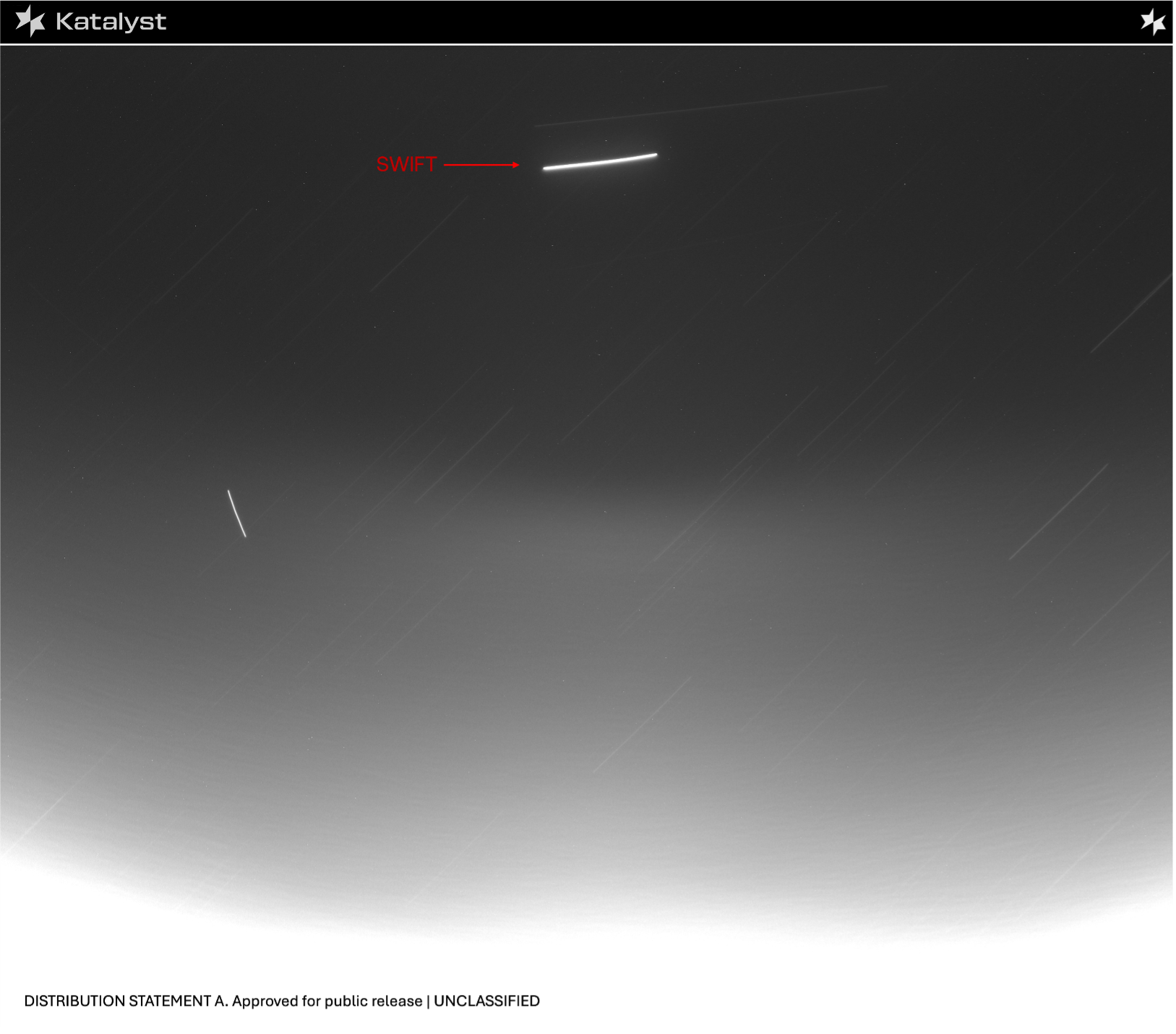
Go back to the LINK frame. Swift is a bright dash against black, seen from 12 to 15 kilometers away, the nearest the rescue craft came. A robot took that picture and then fell out of the sky nearly a month before the telescope stopped working.