Has the Kessler Syndrome Already Started? Experts Are Split
NASA, ESA, MIT and University of Arizona scientists agree the space-debris cascade is plausible. They do not agree on whether it has already begun, or how bad it gets from here.
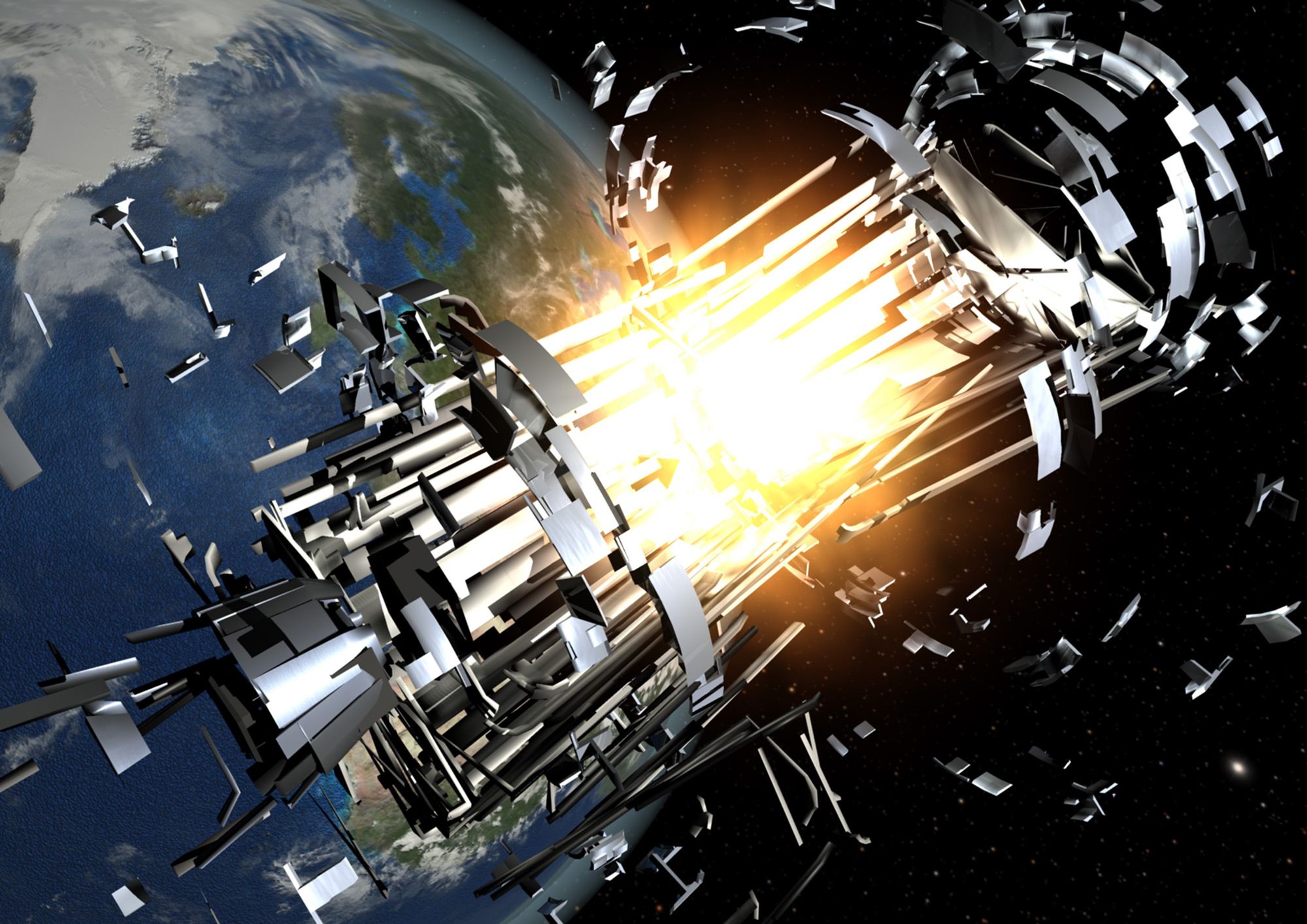
On Feb. 10, 2009, a dead Russian military satellite called Kosmos 2251 crossed paths with a working Iridium communications satellite nearly 500 miles above Siberia. Neither operator saw it coming. The two spacecraft were closing at several miles a second when they hit, and the wreck left almost 2,000 trackable fragments spinning through low Earth orbit.
Nobody called it the start of anything at the time. More than a decade later, some of the scientists who study orbital debris for a living aren’t so sure.
The term for what they’re arguing about is Kessler Syndrome — a scenario, first modeled by NASA scientist Donald Kessler in a 1978 paper, in which collisions in low Earth orbit create debris fast enough to trigger more collisions, which create more debris, in a cascade that doesn’t need a single new rocket launch to keep going. Kessler and his co-author, Burton Cour-Palais, put it plainly: satellite collisions would produce orbiting fragments, each of which would increase the probability of further collisions, leading to the growth of a belt of debris around the Earth,
they wrote, warning that debris flux could eventually exceed the natural meteoroid environment.
Whether that cascade has already begun is, as of 2026, still an open question — and the disagreement runs through some of the most credentialed people in the field.
What NASA and MIT Actually Disagree About
Mark Matney, a physicist in NASA’s Orbital Debris Program Office at Johnson Space Center, points to the Iridium-Kosmos crash as an early warning shot. I tell people that’s a harbinger of things to come,
he told Aerospace America. But his own models don’t show an exponential runaway — they show linear growth over the next 200 years, even if launches continue. NASA and the European Space Agency, running similar debris-forecasting software, land in different places: ESA’s modeling found that debris would more than double... without us sending anything else up there,
according to Tiago Soares, lead engineer at ESA’s Clean Space office, while NASA’s modeling doesn’t predict that kind of runaway curve at all.
Richard Linares, an MIT astrodynamicist who runs the university’s orbital-capacity simulation tool, splits the difference by altitude. Near the International Space Station, atmospheric drag pulls debris back down within a few years. Climb past 600 miles, into the range used by defunct rocket stages and aging satellites, and “you’re talking about centuries for things to drag down,” Matney says — long enough that a bad year of collisions there could compound for generations before anyone could prove it.
The Record So Far
Three events anchor the debate. In January 2007, China intentionally destroyed one of its own defunct weather satellites to test an anti-satellite missile, generating more than 3,000 tracked fragments and an estimated 32,000 more too small to catalog — most of which are still in orbit today. In February 2009, the Iridium-Kosmos collision added roughly 2,000 more. And across 2019 and 2021, India and Russia each destroyed a satellite in separate anti-satellite weapons tests, together producing a little over 1,500 pieces of trackable debris.
Donald Kessler himself, in a 2012 interview with Space Safety Magazine, argued the cascade doesn’t announce itself with a single dramatic event. The cascade process can be more accurately thought of as continuous and as already started, where each collision or explosion in orbit slowly results in an increase in the frequency of future collisions,
he said, according to Space.com.
Why the Timeline Keeps Slipping
Vishnu Reddy, who directs the University of Arizona’s Space4 center for space safety, sits in the middle. I think we’re not there yet, but we’re approaching the situation very quickly,
he says. The debate is about when it will happen, whether it is five years from now, 10 years from now or 20 years from now.
Abhishek Tripathi, director of mission operations at UC Berkeley’s Space Sciences Lab, is the most skeptical of the group — but not because he doubts the physics. He doubts ordinary satellite traffic will trigger it on its own. A lot of things have to go wrong for us to end up in a Kessler Syndrome situation by slowly boiling the frog,
he says. What worries him more is intent: We have the launch capacity to intentionally cause a Kessler Syndrome if we wanted to,
he says, pointing to the risk of a nation deliberately targeting satellites during a conflict.
One thing is currently doing more than any treaty to keep the low-altitude numbers from bending upward faster: SpaceX’s Starlink constellation, now the largest population of satellites in orbit, flies low enough — under 400 miles — that failed units deorbit and burn up within five or six years rather than lingering for centuries.
What Would Actually Fix It
Reddy frames the fix as two separate jobs: stop adding junk, and start removing what’s already up there. The first is mostly enforcement — U.S. and European rules already require satellites to deorbit within five years of finishing their mission, though compliance is uneven. The second is harder. ESA’s ClearSpace-1 mission, aiming to grapple and deorbit a derelict rocket adapter, has slipped its target more than once; Soares says the hardware “was not at all designed to be removed,” which is true of nearly everything currently in orbit.
Separately from the decades-long Kessler debate, Daybreak Wire has tracked a faster-moving and more immediate signal: the CRASH Clock measures weekly conjunction warnings between active satellites, a narrower gauge of how crowded low Earth orbit has become right now.
Matney, who spent his career at the agency that coined the term, doesn’t pretend the disagreement will resolve soon. Whether the clock on Kessler Syndrome started ticking in 2007, in 2009, or hasn’t started at all depends on math nobody has fully agreed on — and won’t, probably, until enough more time passes to see which model was right.