The Schumann Resonance, Explained: Real Physics Behind a Wellness Myth
The Schumann resonance is a real electromagnetic hum circling the planet, discovered in 1952 and confirmed in 1960. Here's the physics, and why the wellness claims built on it don't hold up.
Type "7.83 Hz" into a search bar and the algorithm assumes you're shopping for inner peace. Sound bowls tuned to it. Wellness apps that play it on a loop while you sleep. Grounding mats that promise to sync your nervous system to "Earth's heartbeat." Almost none of the pages selling that experience bother to explain what 7.83 Hz actually is, which is a shame, because the real physics is stranger and better documented than the marketing around it.
The number refers to the Schumann resonance — a real, continuously measured electromagnetic hum that circles the planet, produced by lightning. It has nothing to do with meditation apps and was never designed to. It was discovered by a physicist doing math on a chalkboard, confirmed a decade later by two engineers straining to detect a signal fifty million times weaker than a compass needle responds to, and eventually picked up by a NASA satellite in a place scientists didn't expect to find it at all.
What the Schumann resonance actually is
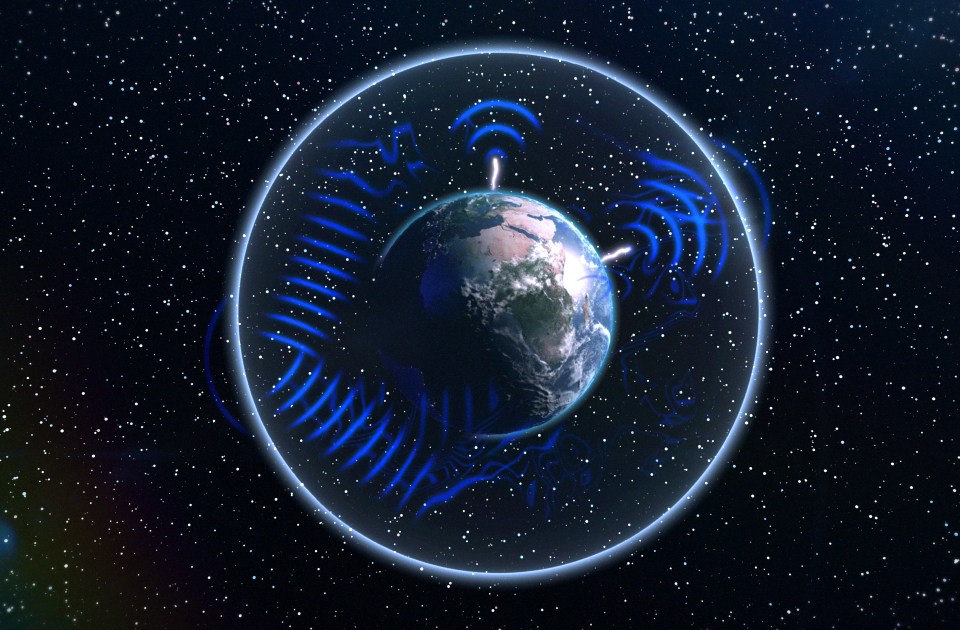
Earth's surface conducts electricity. So does the ionosphere, the charged layer of atmosphere that starts roughly 60 miles — about 100 kilometers — overhead. Between those two conducting shells sits a gap that behaves like a resonant cavity, the same basic principle that lets a specific note make a wine glass ring. The energy that keeps that cavity "ringing" comes from lightning: roughly 2,000 thunderstorms are active somewhere on Earth at any given moment, firing off something like 50 lightning strikes a second. Each strike releases a burst of electromagnetic energy that gets trapped in the cavity, and the cavity's exact dimensions — Earth's circumference, essentially — determine which frequencies survive and reinforce each other rather than canceling out.
The strongest of those surviving frequencies sits at 7.83 Hz. There are others stacked above it, roughly every 6 to 7 Hz, fading out as they climb.
A prediction, then a decade of silence, then a signal
German physicist Winfried Otto Schumann worked out the math in 1952, predicting that a cavity of Earth's size would resonate at a low frequency if excited by something like global lightning activity. Early attempts to actually measure it, through 1954, came back empty. The signal was there in theory. Nobody could pull it out of the noise.
It took until 1960 for two researchers at MIT Lincoln Laboratory, Martin Balser and Charles Wagner, to build receivers sensitive enough to isolate it. What they found matched Schumann's prediction closely enough to confirm it: a set of resonant peaks near 8, 14, 20, 26 and 33 Hz. The difficulty wasn't conceptual — it was that the signal itself is almost absurdly faint, on the order of one picotesla in magnetic field strength, against Earth's steady background magnetic field of roughly 50 microtesla. That's a signal some 50 million times weaker than the field that makes a compass needle move — the same background field that separates magnetic north from true north on every compass ever made.
"There are no known mechanisms for the interplay of low-frequency electromagnetic waves with any biological systems."
Big Think, "Schumann resonances: Amazing physics, sham medicine"
The part NASA found by accident
In 2011 and 2012, researchers using NASA's C/NOFS satellite reported something the standard model didn't predict: Schumann resonance signatures showing up at altitudes of 400 to 850 kilometers, published in the journal Geophysical Research Letters and later summarized in a NASA technical report. That's hundreds of kilometers above the ionospheric boundary that was supposed to contain the resonance entirely. The cavity, in other words, leaks — and finding the leak forced a revision of the propagation models scientists had been using for low-frequency wave behavior in the Earth-ionosphere system. It's a small, technical correction. It's also a reminder that this is an actively studied piece of geophysics, not a settled curiosity, let alone a wellness gadget's marketing copy.
Where "Earth's heartbeat" turns into a sales pitch
Nobody disputes that the Schumann resonance is real, measurable and driven by lightning. What has no support in the physics is the leap from "this frequency exists" to "this frequency does something to your body." As Big Think's physics desk put it bluntly, there's no known mechanism by which a picotesla-scale electromagnetic hum — a field roughly a thousand times weaker than the pull from a refrigerator magnet held at arm's length — would register with human neurons, let alone regulate mood or sleep. The claims persist anyway, propped up by the coincidence that 7.83 Hz sits in the same rough range as some brainwave frequencies, which sounds meaningful and isn't; plenty of unrelated things share a frequency band without one causing the other.
That gap between the measured phenomenon and the marketed one is exactly why an entire cottage industry — sound-therapy devices, "grounding" mats, frequency-tuned meditation tracks — has grown up around a number most of its customers have never seen explained. The physics is legitimate enough to have its own NASA technical reports and a seventy-year research history, in the same league as the solar and geomagnetic cycles that genuinely do reach Earth's surface and reshape its skies. The health claims riding on the Schumann resonance's back are a separate, much less rigorous story, and the two are worth telling apart.