Why Trout and Contreras Can Both Veto a Trade
Three days before MLB's Aug. 3 deadline, Mike Trout and Willson Contreras each shut down trade talk in the same week, one leaning on 10-and-5 rights, the other on a negotiated no-trade clause.
Mike Trout heard the Phillies question again at the All-Star Game in Philadelphia on July 14, and he answered it the way he always does. I didn't think I was going to hear this question. I enjoy coming to Philly. I'm an Angel. I got a no-trade clause. So, it's ultimately my decision. I love Philly.
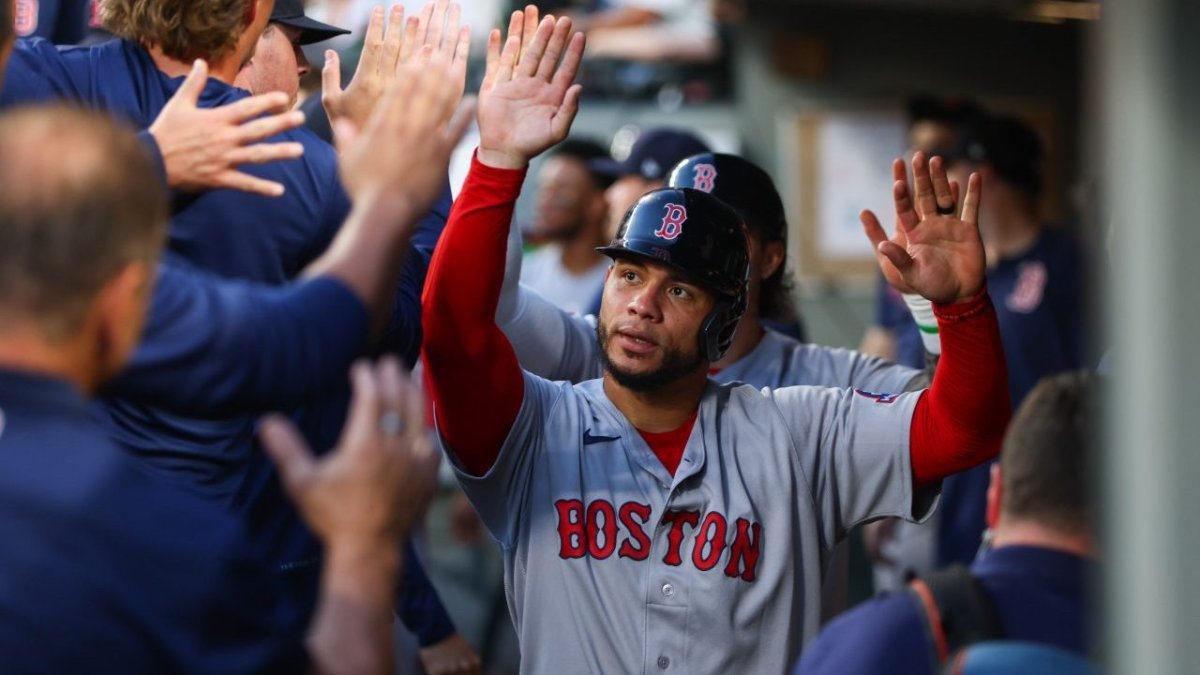
In the same media scrum that week, three hundred miles north, Red Sox first baseman Willson Contreras was saying something similar about Boston. He'd already gone to the front office himself.
"I said, 'I would trade something to stay here.' I like it here, I like Boston. It's a great place to play. And it's not easy to get traded again, so I think I've found my family here."
Willson Contreras, to reporters in Philadelphia, via WEEI's Rob Bradford
Both players hold the same power: one word kills any deal a general manager puts together. But they arrived at that power by different roads, and the gap between those roads explains why some front offices will spend the next few days trying, and failing, to move a player at all.
Monday, Aug. 3, at 6 p.m. ET is the hard stop for this year's trade deadline, the point after which no team can complete a deal until the offseason. Every trade signed before then still has to clear one more hurdle beyond money and prospects: whether the player himself signs off.
What is a 10-and-5 player?
Ten-and-five rights aren't written into anybody's contract. Under baseball's collectively bargained transaction rules, a player who has accrued 10 years of major league service time, with at least the last five consecutive seasons on the same team, automatically earns the right to veto any trade. No negotiation, no clause to draft, just accumulated time in a uniform.
Trout, who debuted with the Angels in 2011 and has never worn another team's jersey, cleared that bar years ago. He also carries something extra on top of it: a full no-trade clause written into the 12-year, $426.5 million extension he signed with Los Angeles in 2019. Where 10-and-5 status is a floor every veteran eventually reaches on his own, a negotiated no-trade clause is a bargaining chip a team hands over up front to close a deal.
What kind of no-trade clause does Contreras have?
Contreras isn't a 10-and-5 player. He doesn't have the service time yet. What he has is a full no-trade clause the Red Sox wrote into the contract that brought him over from St. Louis this past offseason, one of two such protections on Boston's books; pitcher Sonny Gray carries a similar clause on his own deal. Gray, dealt to Boston only this winter and playing on an expiring contract with a $30 million mutual option attached, is widely seen as the more moveable of the two. Contreras, still owed $17 million for 2027 and an option worth $20 million for 2028, is not, and not because the number scares anyone off. He's simply told the people who run the team that he isn't going anywhere.
A full no-trade clause is the strongest version of the protection. Some players settle for less: a limited no-trade clause lets a club redraft, usually once a year, a short list of teams the player can block, while every other destination stays open. It's the version front offices push for when a star wants protection but a team doesn't want to hand over total control of its own roster.
Can a team ever override a no-trade clause?
No. Once 10-and-5 status or a written no-trade clause attaches, the front office's only lever left is persuasion: a bigger role, a return home, more guaranteed money, or a bonus for waiving the protection, the way Contreras's own deal allows. Some players take that kind of offer. Trout and Contreras, this month, simply didn't need convincing.
Post by @JeffSkversky
Why do teams still hand out that kind of leverage?
Because it's the going rate for a player who has other suitors. A club chasing a $400 million commitment, the way the Angels did with Trout in 2019, or trying to pry a proven bat away from other bidders, the way Boston did with Contreras last winter, rarely gets to negotiate that language out of the deal. Refuse to include it and the player picks a team that will. It's the cost of landing a star, not a favor tacked on afterward.
Other sports ring-fence roster control through entirely different plumbing; the NBA, for instance, keeps young talent in a contractual gray zone with the two-way contract rather than handing out trade vetoes to anyone. Baseball's answer, for its most decorated veterans, runs through service time and the fine print teams agree to just to get a signature on the dotted line.
The tradeoff shows up hardest in weeks like this one. As of mid-June, ESPN still had Contreras ranked ninth on its list of the sport's top 100 trade candidates, even with the no-trade language attached, a sign of how much talent can sit behind a door only the player can unlock. Front offices that guess wrong on a season are left holding a contract nobody can move without a phone call, a conversation, and, more often than not, a very firm no.
Boston was still weighing whether to buy or sell as it headed into the All-Star break, and that calculus will keep shifting all weekend as Monday's 6 p.m. deadline closes in. Whatever chief baseball officer Craig Breslow's front office decides, one name is already off the board, because Willson Contreras told them so himself.