Toyota's Scion Kei Truck Is Limited to 25 MPH by a Federal Rule
Toyota's 25 mph cap on the Scion KEI-01 is the ceiling of a 1998 federal vehicle class, and each state decides which streets the truck may use.
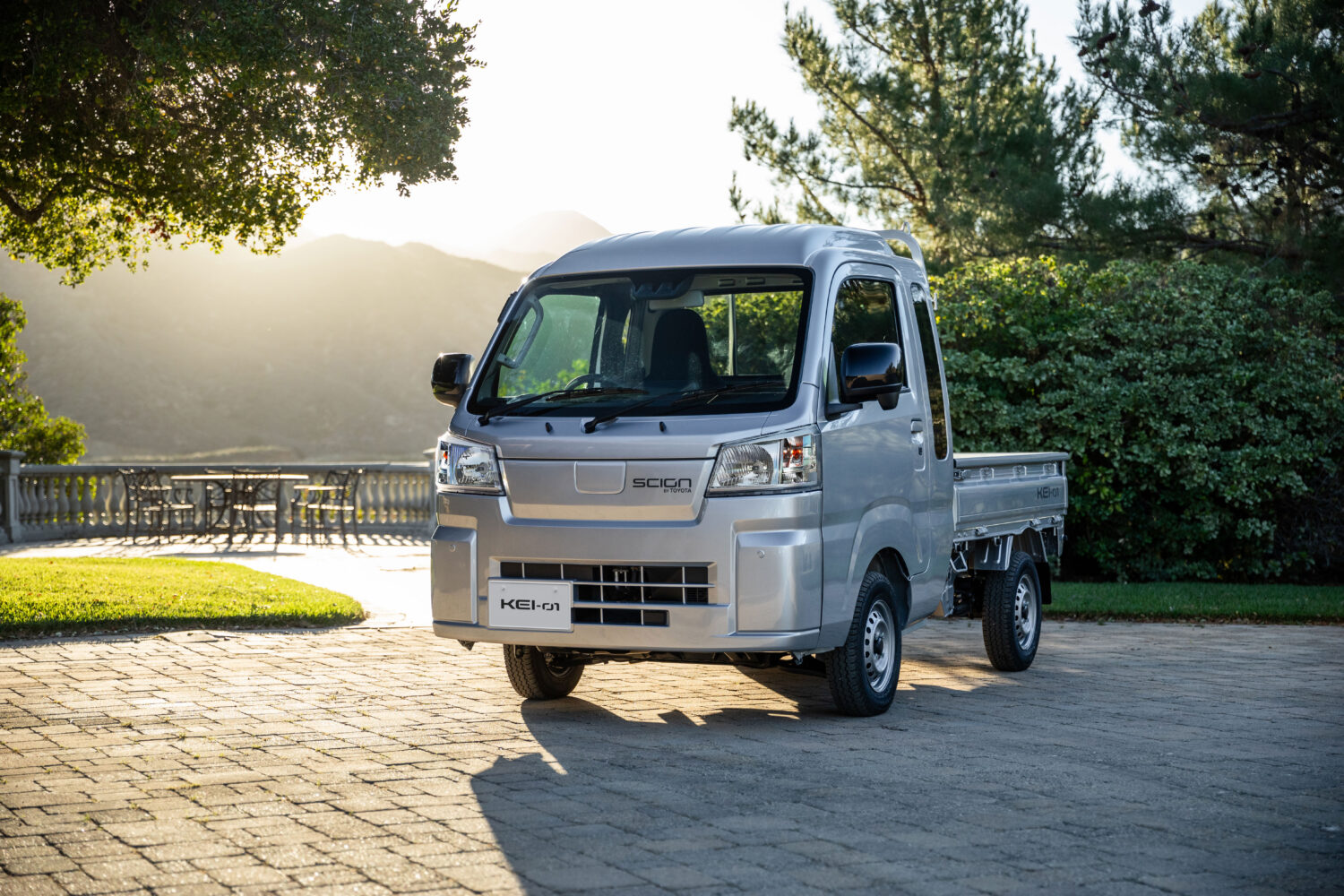
Toyota is bringing a Japanese-style mini pickup to America under the revived Scion badge, building it in Indiana and holding its top speed to 25 mph.
Toyota Motor North America announced the truck, called the KEI-01, on Tuesday, Nov. 10, as the first vehicle from a brand it now calls Scion by Toyota. It arrives in the second half of 2027, goes to fleet buyers first, and has no price yet.
That speed is not what the engine can manage. It is the ceiling of a federal vehicle class written 28 years ago for golf-course communities, and anyone hoping to drive one to work will find that Washington set the speed while their own state decides the roads.
"The KEI-01 is a right-hand-drive vehicle designed to comply with FMVSS No. 500 requirements for LSVs. Its maximum speed will be 25 miles per hour."
Toyota Motor North America, press release, Nov. 10, 2026
Unpack the initials and the truck makes sense. FMVSS is a Federal Motor Vehicle Safety Standard, the kind of rule that decides what a new vehicle must carry (the vehicle kill-switch mandate would become another), and LSV means low-speed vehicle.
The hardware is a kei truck, from Japan's class of mini vehicles. Toyota's announcement lists a 660cc three-cylinder engine, a continuously variable transmission (an automatic with no fixed gears) and selectable four-wheel drive, in a body just over 11 feet long and under 5 feet wide.
The steering wheel is on the right, as in Japan, and The Autopian identifies the truck as a rebadged Toyota Pixis, itself a rebadged Daihatsu Hijet, while MotorTrend says it looks identical to the Pixis.
The bed sides fold down on three sides and the bed carries up to 600 pounds, Toyota said. Car and Driver puts a Ford Maverick at up to 1,500 pounds, so this is a truck for tools and feed bags, not a pallet of bricks.
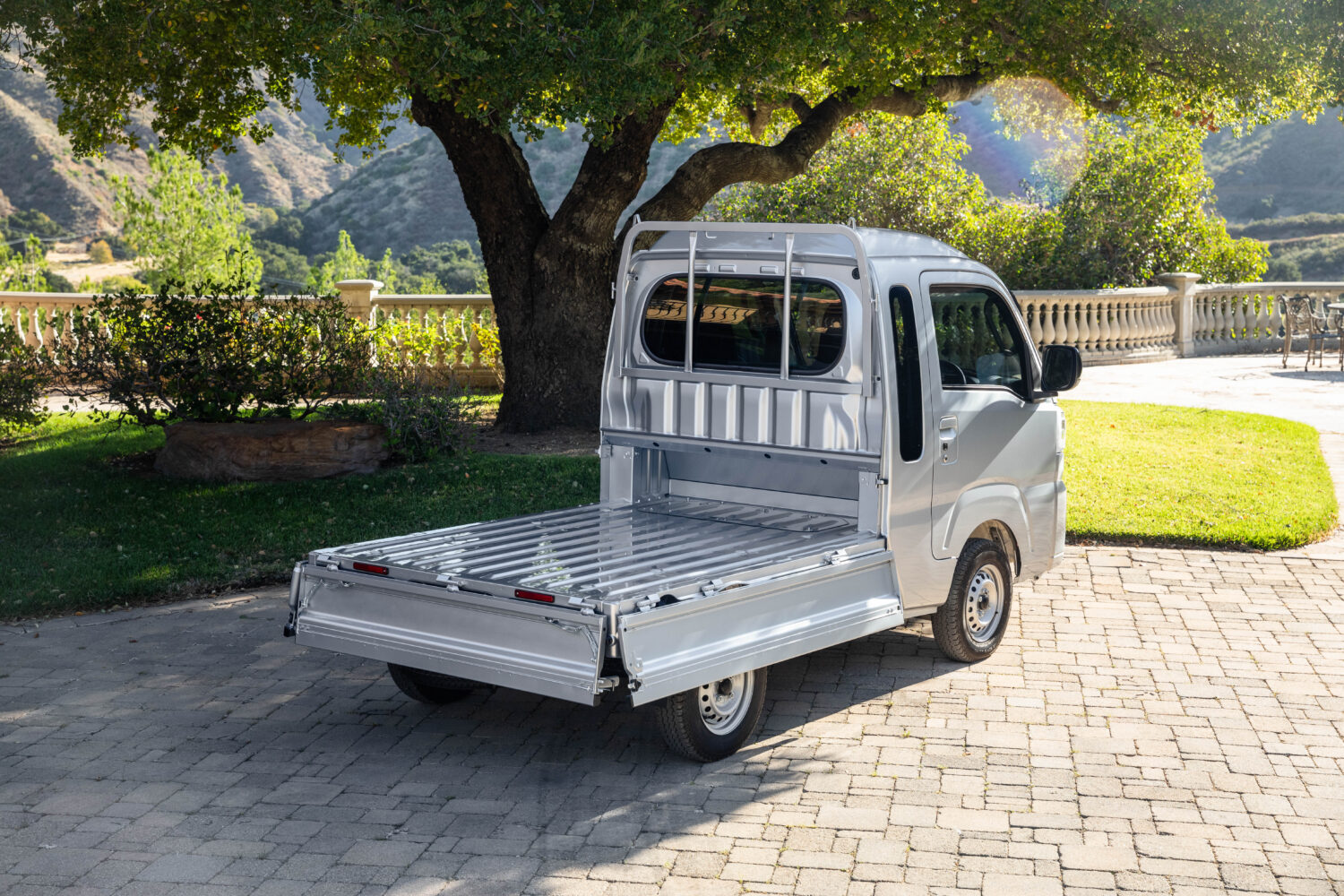
Toyota has not said what the truck costs, how much power it makes, what it weighs or how many dealers will sell it, and its release names no states.
A five-mile-an-hour window
Federal regulations define a low-speed vehicle with three tests. It has four wheels, its top speed over a measured mile is more than 20 mph and not more than 25 mph, and its gross vehicle weight rating is under 3,000 pounds.
The safety standard written for that class is Federal Motor Vehicle Safety Standard No. 500.
So the truck lives in a window five miles an hour wide; build it any faster and it leaves the class, and with it the short standard.
That window is how Toyota can sell the design at all, and why an owner should not expect to tune the cap away. The class is defined by the speed a vehicle can attain from a standing start over one mile, so a truck able to go faster would fall outside it.
Toyota has not said how it limits the speed.
The weight ceiling bites too, because gross vehicle weight rating is the loaded weight the manufacturer specifies: truck, driver, passenger and that full payload all have to fit under it.
Twelve items, no crash test
Inside the class, the federal safety standard is short. It lists 12 pieces of equipment: headlamps, turn signals, taillamps, stop lamps, reflectors, mirrors, a parking brake, a conforming windshield, a vehicle identification number, seat belts at every seat, rear visibility and an alert sound.
There is no crash test in it, no airbag requirement and no roof or side-impact requirement.
The Insurance Institute for Highway Safety has said regulators set the standard in 1998 for "short trips for shopping, social, and recreational purposes primarily within retirement or other planned communities with golf courses."
Toyota did not make kei trucks legal in America. It fitted one into that rule.
The safety case against doing so is old and blunt. In crash tests the institute ran in 2010, a Changan Tiger Star minitruck met a Ford Ranger pickup head-on at an offset, and the institute said the dummies "recorded indications of seriously debilitating or fatal injury to drivers in real-world crashes."
Those were not tests of the KEI-01, or of any Toyota or Daihatsu. The warning that came with them was aimed at the whole category.
"By allowing LSVs and minitrucks on more and more kinds of roads, states are carving out exceptions to 40 years of auto safety regulations that save lives."
David Zuby, then chief research officer, Insurance Institute for Highway Safety, May 20, 2010
Toyota's answer is in its customer list: farmers and ranchers, municipalities, universities, corporate campuses, small business owners and urban delivery services. On a campus loop or a ranch track, an enclosed cab with seat belts, heat and air conditioning is being measured against a utility cart, not a crash-tested pickup.
Fifty sets of road rules
The federal standard says nothing about which roads a low-speed vehicle may use. The national regulator, as the institute put it in 2010, "has no say in where LSVs are driven."
Florida's statute shows how a state fills the gap. A low-speed vehicle "may be operated only on streets where the posted speed limit is 35 miles per hour or less," it must be registered and insured, and a county, a city or the state transportation department may close any road under its own jurisdiction to it on safety grounds.
On a Florida street, then, the truck is at best 10 mph slower than the fastest traffic around it, and it may cross a faster road at an intersection but never turn onto one.
Indiana, where the truck will be built, is murkier. The U.S. Energy Department's summary of state law says Indiana defines a low-speed vehicle as "a four-wheeled electric vehicle" and keeps it off roads posted above 35 mph.
The truck burns gasoline, and Toyota has not addressed that definition or said how the truck will be titled or registered in any state.
Business Insider reported on Nov. 10 that Toyota said the truck is "eligible to drive in all 50 states." Set that beside the statutes and the practical question becomes which streets, not which states.
"There are countless Kei enthusiasts, myself included, who simply couldn't own the Scion KEI-01 because there would be no legal way to drive it. All of the roads surrounding my apartment have speed limits of 45 mph or faster."
Mercedes Streeter, writer, The Autopian, Nov. 10, 2026
A fleet manager should check three things at home before counting on one: the posted-limit ceiling for low-speed vehicles, whether the state's definition covers gasoline engines, and whether the city or county has closed particular roads.
The kei trucks already on American roads came in by another door. Federal rules let a vehicle that does not meet U.S. safety standards be imported once it is at least 25 years old, which puts the same kind of truck in a different legal box.
| New Scion KEI-01 | Imported kei truck, 25 years or older | |
|---|---|---|
| Top speed | 25 mph maximum (Toyota) | Generally above 70 mph, per The Autopian |
| Federal safety standard | FMVSS No. 500: a 12-item equipment list, no crash test | Exempt from U.S. safety standards at 25 years old |
| Where it may be driven | Set by each state; Florida allows streets posted 35 mph or less | Set by each state; Georgia banned them outright as of May 2025, Motor1 reported |
| Who can buy | Fleets first, from the second half of 2027 | Private buyers, where the state allows registration |
| Price | Not announced | Can be delivered for under $5,000, per The Autopian |
| Steering wheel | Right side | Right side |
States treat the imports unevenly. Colorado and Texas have enacted laws that legalize titling, registration and on-road use, according to SEMA, though Motor1 reported in May 2025 that Colorado's does not take effect until July 1, 2027.
The import is fast and cheap, with no federal safety standard behind it; the Scion is new and slow, with a short one.
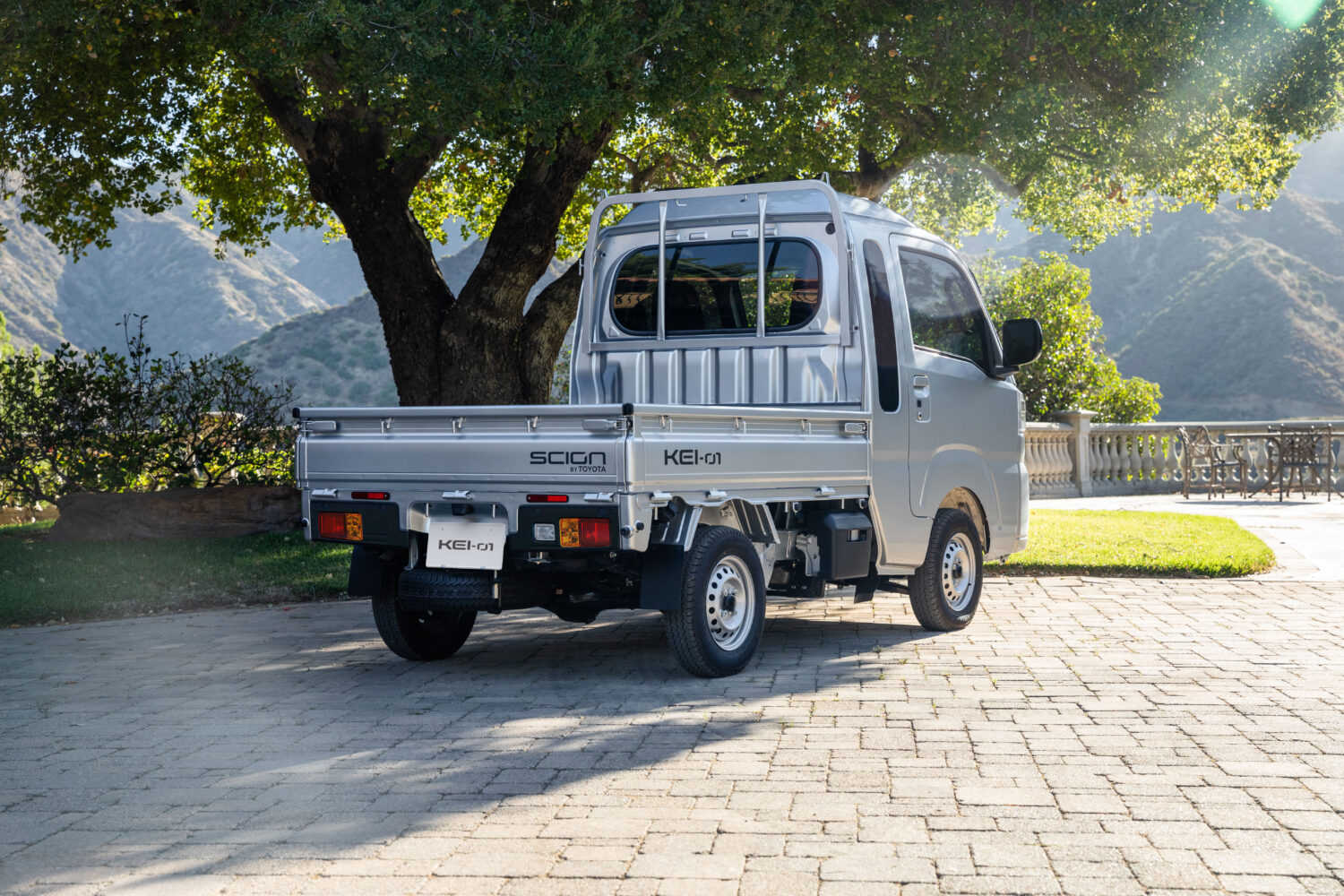
The KEI-01 will be assembled at Toyota Motor Manufacturing Indiana, backed by $34 million and approximately 50 new jobs, Toyota said.
Divide the money by the jobs and you get $680,000 a job, small money for a car plant and a fit with Toyota's own description of the truck as "intentionally low-volume, niche."
Reuters reported that President Donald Trump encouraged the move, and Business Insider reported that he wrote on Truth Social in December 2025: "I have just approved TINY CARS to be built in America."
The rule Toyota used owes nothing to that push: Standard No. 500 was first published on June 17, 1998, and nothing in Toyota's release, which does not mention the president, points to a new one.
For now, an ordinary buyer cannot order one. Toyota said the truck will "initially be offered through a fleet-focused pilot program," sold by Scion by Toyota dealers selected from its existing network.
Retail sales hang on a sentence built from conditionals: Based on market conditions, customer demand, and operational considerations, Toyota may consider expanding availability to limited retail sales at a later date.
Until then, the kei truck most Americans can buy is the one that is at least 25 years old.