The Equinox Never Actually Splits Day and Night Evenly
Two ordinary facts about sunlight, not measurement error, explain why the equinox never delivers a true 12-hour split anywhere on Earth.
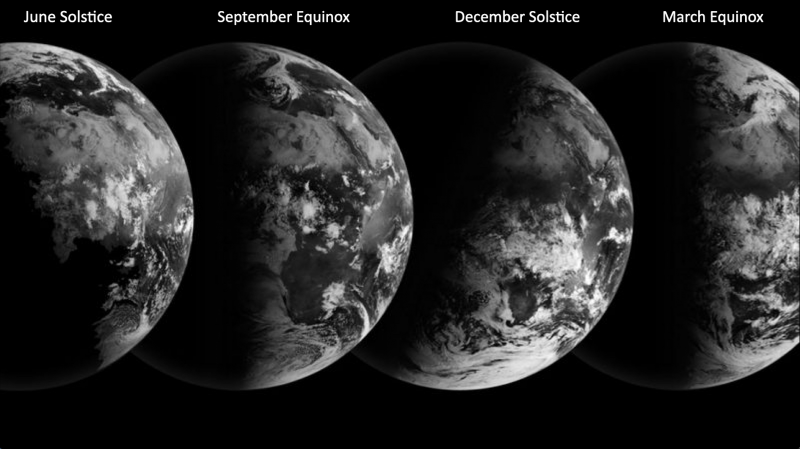
Eight minutes. That is roughly how much more daylight than darkness most of the world will get on Sept. 23, 2026, the day tens of millions of people will mark as the moment day and night are supposed to be equal.
The September equinox arrives at 00:06 UTC on Sept. 23 (7:06 p.m. CDT on Sept. 22 for most of the continental United States, and 12:05 p.m. New Zealand Standard Time on the 23rd), the instant the sun crosses directly above Earth's equator on its way south, according to EarthSky's equinox tracking. It brings autumn to the Northern Hemisphere and spring to the Southern one. The word itself comes from the Latin aequus and nox, "equal night." Nowhere on Earth, on that day, will night actually equal day.
Two things get in the way, and neither is exotic. The first is that the sun is not a point of light in the sky. It is a disk. Almanacs define sunrise as the moment the leading edge of that disk clears the horizon, and sunset as the moment the trailing edge disappears. That convention alone adds roughly two and a half to three minutes of daylight at mid-temperate latitudes, according to EarthSky, because the sun's center is technically still below the horizon when the "day" officially starts and ends.
The second is Earth's atmosphere, which bends light the way a lens does. The U.S. Naval Observatory's Astronomical Applications Department, the federal office responsible for official sunrise and sunset tables, calculates that atmospheric refraction lifts the sun's apparent position by about 34 minutes of arc near the horizon, and adds another 16 arcminutes from the disk's own width. The Naval Observatory's guidance puts it plainly: at the moment tables say the sun is rising or setting, its geometric center is actually 50 arcminutes below a level, unobstructed horizon. That refraction advances sunrise and delays sunset by several more minutes on top of the disk effect.
How much extra daylight is there on the equinox?
Add the two effects together and most of the mid-latitude world gets seven to ten extra minutes of daylight on equinox day, not zero. The Naval Observatory's numbers are specific: at latitudes up to about 25 degrees, day beats night by roughly seven minutes on the equinox. Push north or south to 50 degrees (Ottawa, London, the tip of South America) and the gap widens to ten minutes or more. The higher the latitude, the more shallow the angle at which the sun crosses the horizon, and the longer refraction gets to work.
There is a real word for the day when daylight and darkness genuinely split in half: equilux. It is not the equinox. At latitude 40 degrees North, roughly the line running through Philadelphia, Columbus and northern California, the Naval Observatory calculates the autumn equilux lands around Sept. 26, a few days after the equinox itself. Near latitude 5 degrees, closer to the equator, it falls around Oct. 15. The pattern reverses in spring: equal day and night comes before the March equinox, not after.
Why doesn't the equator get an equilux at all?
Here is the detail that surprises people who assume the tropics are the one place equal day and night should be exact. They are the one place it never happens. Within a couple of degrees of the equator, daylight runs longer than night on every single day of the year; refraction and the sun's disk width apply there too, with no season ever pulling the balance the other way. EarthSky notes there is no equilux whatsoever at the equator. The concept requires a place where the length of day is actually shrinking or growing across the seasons, and near the equator it barely moves at all.
The gap matters more than it sounds. Solar-power forecasters, satellite operators and anyone scheduling outdoor work around sunrise and sunset rely on tables built from the same refraction correction the Naval Observatory publishes. Treat the equinox as a literal 12-hour split, and every planning estimate for that week runs a few minutes off in the same direction, at every latitude, in a predictable way. It is also why two almanacs can list slightly different equinox sunrise times for the same city: refraction varies with air temperature, humidity and barometric pressure, so the "official" correction is itself an average, not a constant.
None of this is a rounding error hiding in an app. It is the same orbital geometry that governs when lunar eclipses can and can't happen, a reminder that "equal," in astronomy, is almost always a first approximation dressed up as a fact. The precise equilux date for any given city shifts with latitude and is worth checking against a local sunrise-sunset table rather than assuming the equinox itself is the day to watch.